• TalkBass has been independent since 1998. Add your voice.
    Create a free account to reply to discussions, view embedded media, and browse with fewer display ads.
    Join freeLog in
    Want zero display ads or expanded classifieds tools? Compare plans.

Help with Transparent Blue Finish

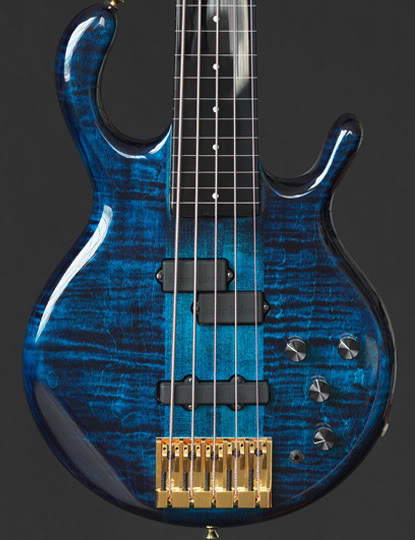
I am currently working on a 5 string bass with a quilted maple top and an ash back. I would like to finish to look like this;
PB1.jpg


What I really like about this Pedualla is how the curl in the wood is almost black in contrast with the blue.

I have experimented with some translucent finishes but I looking for some feedback on this topic.
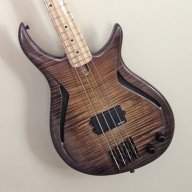
 
Instead of black epoxy grain filler use black dye and sand that back... do that a few time and then spray the blue dye and clear coat that!


Nomad98

+1 Colored grain filler works very well on ring-porous species like ash and oak, and semi-ring-porous species like walnut and mahogany, but not so well on diffuse-porous species like maple and cherry.

I've had very good results using Transtint concentrated liquid dyes from Jeff Jewitt's company, Homestead Finishing. IME, the Transfast powdered dyes aren't nearly as lightfast.

The Transtint dyes are on sale right now (~30% off) at Rockler.com
 
Stew-Mac actually has a tutorial on how to get that exact finish on their website... they finish a quilt-maple top guitar in blue with the sanded back finish as described above, with "natural binding", and finish it with aerosol nitro lacquer.

Invalid Link Removed

Yes, yes, I know... it's on a *guitar*... but I think that the instructions are top notch, and are informative for anyone not using large spray equipment. :hiding:
 
Stew-Mac actually has a tutorial on how to get that exact finish on their website... they finish a quilt-maple top guitar in blue with the sanded back finish as described above, with "natural binding", and finish it with aerosol nitro lacquer.

Invalid Link Removed

Yes, yes, I know... it's on a *guitar*... but I think that the instructions are top notch, and are informative for anyone not using large spray equipment. :hiding:

Similar. only difference would be using black dye for the first pass.

I plan to try this on my bass, only in red instead of blue. And swamp ash instead of maple.

It may fail miserably, as has been suggested to me, due to swamp ash being pretty porous.

If not, it should look good.

-Nick
 
For swamp ash, instead of using dye then sanding back, I'd use a dark pore filler (dark brown will look basically black under a colored finish).

It will look something like this image from Scott French's website, before you shoot the color coat...

[Invalid or Expired Link Removed]

Here's a couple of more extreme examples from Sandberg guitars:

Invalid Link Removed

Invalid Link Removed
 
For swamp ash, instead of using dye then sanding back, I'd use a dark pore filler (dark brown will look basically black under a colored finish).

Those are pretty sweet. I'll keep it in mind. Going to try the dye first, if only to find out how it behaves (I'll use scrap of course). I figure even if it doesn't work, I'll learn some things. ;)

That does look like it's probably the way to go though.

-Nick
 
I think that the dark dye will stay in the pores of the parts of the wood you want to be lighter... the pore filler looks the way it does because it's particles are too large to get into the smaller pores. Dye particles are much smaller... small enough that they will probably get into pores you don't want them in, darkening all the wood.
 
I think that the dark dye will stay in the pores of the parts of the wood you want to be lighter... the pore filler looks the way it does because it's particles are too large to get into the smaller pores. Dye particles are much smaller... small enough that they will probably get into pores you don't want them in, darkening all the wood.

Yeah, most likely that is what will happen. I'm going to do some experimenting just out of curiosity though.
 
Anyone know if this is staight blue dye over quilted maple, or is it sanded back? Think there is colored grain filler? I'm silly over this finish, it looks like water.

[Invalid or Expired Link Removed]
 
I think that the dark dye will stay in the pores of the parts of the wood you want to be lighter... the pore filler looks the way it does because it's particles are too large to get into the smaller pores. Dye particles are much smaller... small enough that they will probably get into pores you don't want them in, darkening all the wood.

My first test piece actually came out pretty interesting. Colour's not quite what I was looking for, but the effect seems right. It's not particularily well sanded, and the edges that are black are that way because I didn't sand through them at all. I'll be trying some more curvy test pieces, and I'll probably try the grain filler as well, but I thought this was worth posting since it certainly shows some potential.

[Invalid or Expired Link Removed]
 
Anyone know if this is staight blue dye over quilted maple, or is it sanded back? Think there is colored grain filler? I'm silly over this finish, it looks like water.

[Invalid or Expired Link Removed]


This one is most likely a dark blue dye first (but not too dark), sanded back, then a lighter blue over that.

If you use water-based dyes they will raise the grain more than an alcohol-based dye and improve that 3D effect. Of course, an immaculate clear-coat and buff-out is also a big factor in that finish.
 
I don't know what I should do?

If I just dye it blue will it look like crap?


I plan on testing it first, but thought if someone has gone down this path first?

A picture of Gibsons one on poplar. Must be transparent nitro?

bodyh9.jpg
 
I don't know what I should do?

If I just dye it blue will it look like crap?


I plan on testing it first, but thought if someone has gone down this path first?

A picture of Gibsons one on poplar. Must be transparent nitro?

bodyh9.jpg

I'm guessing judging by that pic that it will look a little green. Maybe not bad though.

I'd give it a go on some scrap regardless of whether anyone else has had success with it.

If you are dead set on a really true blue. I expect you would need to bleach it, and use a non-ambering finish.
 
For the back I do not care as much as long is it does not look like puke green.


I read in a wood forum that they say if you put poplar in the sun for an hour or so the green will turn brown.


http://www.forums.woodnet.net/ubbth...er=3158297&page=&view=&sb=5&o=&fpart=all&vc=1

I made a Shaker style stepstool from poplar. I let it sit in the sun for most of the day after I made it which did turn the green streaks brown, then I stained it with Minwax cherry gel stain. I take it with me on jobs and I often get compliments but it doesn't really look like cherry.