Why isnt hickory listed in the various descriptions of tonewoods or materials used by luthiers in the construction of musical instruments?

Enjoy the benefits of a premium membership!
Upgrade Account
-
TalkBass has been independent since 1998. Add your voice.
Create a free account to reply to discussions, view embedded media, and browse with fewer display ads.
Join free Log in
Want zero display ads or expanded classifieds tools? Compare plans.
You are using an out of date browser. It may not display this or other websites correctly.
You should upgrade or use an alternative browser.
You should upgrade or use an alternative browser.
Hickory as a tone wood - why not?
- Thread starter Frijoles Negros
- Start date
More options
Who Replied?It is not a "timber of commerce", like maple, cherry, or walnut. Hammer handles are made of it and if you are in this business, you no doubt have some sources of supply. If you have some of it and it is good quality, there is no reason why it couldn't be used in lutherie. I would think a neck made of it would be terrific. Fodera has used ash for necks, and hickory and ash are very similar in physical properties.
Hmm.
Some one should make a bass out of hickory.
If it is so similar to ash.
It's a really dense wood, right?
Some one should make a bass out of hickory.
If it is so similar to ash.
It's a really dense wood, right?
For my thesis, I had to buy 9 8-feet long 2-in diameter shagbark hickory dowels and it cost (my grant) 300 bucks for that wood. I called approx 200 lumber yeards and wholesale distributors and found that anything over two inches isnt produced due to problems with checking (splitting in the drying process).
That is some of the nicest wood i have seen. Just beautiful. You can, however, get Maple and such at larger sizes.
What we do know is that Hickory is used commonly as tool handles- as you mentioned- for the reason of hickory's ability to withstand shock loads so well. For that same reason it is used for baseball bats. I was able to locate alot of sources of hickory, as it is a common wood being turned out in many lumberyards in the east coast and north mid west, but none made seasoned cuts above 2 inches in width due to checking. I could get it "green" (unseasoned) pretty easily at larger sizes, though.
What nags at me is that hickory has a very high modulus of elasticity compared to most North American woods. In plain english the MOE is how wood bends. A higher number means more resistance to bending. It also has a high modulus of rupture. This means an ability to not break whilst bending. For instance a wood used for bows (i.e. bows and arrows) would want a low MOE and a high MOR. it seems you want a neck to be both stiff and sturdy, or to be high in both of these values.
White ash (the strongest ash in these properties)
MOE - 1.74^6 psi
MOR - 15,000 psi
Rock maple
MOE - 1.83x10^6 psi
MOR - 15,800 psi
Shagbark Hickory
MOE - 2.16x10^6 psi
MOR - 20,200 psi
Hickory looks just beautiful too, takes shock loads extremely well, is very hard (tough to dent), and can be had commercially in widths of 2 inches.
Im confused why hickory isnt used as a bass neck when it is used for baseball bats. Hasnt anyone thought of replacing a p-bass neck with its analog?
Theres much stronger commercially available woods out there too.
Compare with Greenheart - a wood used in the construction of instruments
MOE - 3.25x^6 psi
MOR - 24,900 psi
We also import south american woods, such as Ipe, for decking and African woods, such as Azobe for railway ties.
Ipe
MOE - 3.14x10^6 psi
MOR - 25,400 psi
Azobe
MOE - 2.47x10^6 psi
MOR - 24,500
Link to info
There has to be another reason rather than mechanical properties. Is it tradition? It seems to me that one of the biggest problems with bass necks are the ability to control the forces generated by the bass strings. We have double truss rods and such to control these loads, and yet still there are problems where necks are destroyed. Rupture creep (read fatigue) is another problem exhibited by wood. Most of these problems can be alleviated by using a wood with higher values of MOE and MOR as listed above. Im not certain why these woods are not used.
That is some of the nicest wood i have seen. Just beautiful. You can, however, get Maple and such at larger sizes.
What we do know is that Hickory is used commonly as tool handles- as you mentioned- for the reason of hickory's ability to withstand shock loads so well. For that same reason it is used for baseball bats. I was able to locate alot of sources of hickory, as it is a common wood being turned out in many lumberyards in the east coast and north mid west, but none made seasoned cuts above 2 inches in width due to checking. I could get it "green" (unseasoned) pretty easily at larger sizes, though.
What nags at me is that hickory has a very high modulus of elasticity compared to most North American woods. In plain english the MOE is how wood bends. A higher number means more resistance to bending. It also has a high modulus of rupture. This means an ability to not break whilst bending. For instance a wood used for bows (i.e. bows and arrows) would want a low MOE and a high MOR. it seems you want a neck to be both stiff and sturdy, or to be high in both of these values.
White ash (the strongest ash in these properties)
MOE - 1.74^6 psi
MOR - 15,000 psi
Rock maple
MOE - 1.83x10^6 psi
MOR - 15,800 psi
Shagbark Hickory
MOE - 2.16x10^6 psi
MOR - 20,200 psi
Hickory looks just beautiful too, takes shock loads extremely well, is very hard (tough to dent), and can be had commercially in widths of 2 inches.
Im confused why hickory isnt used as a bass neck when it is used for baseball bats. Hasnt anyone thought of replacing a p-bass neck with its analog?
Theres much stronger commercially available woods out there too.
Compare with Greenheart - a wood used in the construction of instruments
MOE - 3.25x^6 psi
MOR - 24,900 psi
We also import south american woods, such as Ipe, for decking and African woods, such as Azobe for railway ties.
Ipe
MOE - 3.14x10^6 psi
MOR - 25,400 psi
Azobe
MOE - 2.47x10^6 psi
MOR - 24,500
Link to info
There has to be another reason rather than mechanical properties. Is it tradition? It seems to me that one of the biggest problems with bass necks are the ability to control the forces generated by the bass strings. We have double truss rods and such to control these loads, and yet still there are problems where necks are destroyed. Rupture creep (read fatigue) is another problem exhibited by wood. Most of these problems can be alleviated by using a wood with higher values of MOE and MOR as listed above. Im not certain why these woods are not used.

so if you had a hickory bass onstage, you could smash it aganst everytihng, so you would look cool, adn have your bass intact at the end of the night 


I remember coming across luthiers who use greenheart and ipe in their basses - but only for tops though. Not sure about necks...
My only guess is that those woods might make the neck rather heavy - neck dive? So to balance that, the body has to be heavy as well, and in the end the whole bass is gonna be really heavy... but that's just my guess.
I'm sure there's always the resistance/obstacle of the "new". Unless someone's gonna stick a neck out (excuse the pun) and embark on a project to test out these woods (and wave the red flag afterwords), most will stick to traditional stuff...
You planning to make a neck outa the hickory wood??
BTW - Great resource paper. I'll definitely be spending some time looking through it
My only guess is that those woods might make the neck rather heavy - neck dive? So to balance that, the body has to be heavy as well, and in the end the whole bass is gonna be really heavy... but that's just my guess.
I'm sure there's always the resistance/obstacle of the "new". Unless someone's gonna stick a neck out (excuse the pun) and embark on a project to test out these woods (and wave the red flag afterwords), most will stick to traditional stuff...
You planning to make a neck outa the hickory wood??
BTW - Great resource paper. I'll definitely be spending some time looking through it

Brian Barrett
Commercial User
- Nov 25, 2001
- 2,799
- 40
- Disclosures
- Dealer LowEndBassShop.com, Builder LowEndBasses.com
Ipe is really nice. D'Alegria uses quite a bit in there instruments being native to Spain. Ipe is used as finger board and Neck woods. It has a beautiful feel and smoothness to it while being very rigid.
Heres a couple of NAMM Dart basses being built for Summer Show.
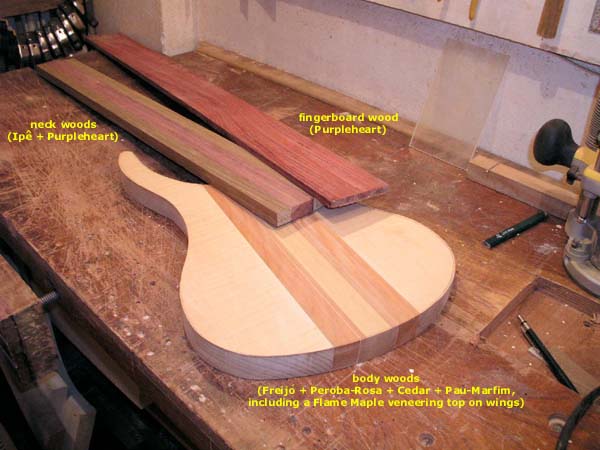
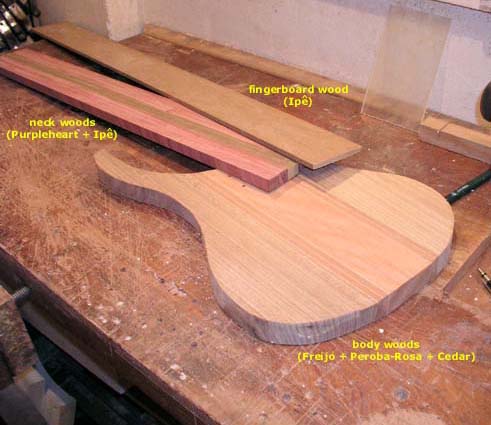
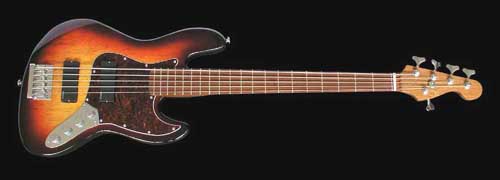
And Heres a Defender with Ipe Neck and Fingerboard
Heres a couple of NAMM Dart basses being built for Summer Show.
And Heres a Defender with Ipe Neck and Fingerboard
Barrett-
Thats what im talking about. Those woods have incredible mechanical properties. Those are neck woods. Although hickory is strong, it is pale in comparison to some of the hardwoods that come out of tropical regions.
Im starting to think that its tradition and such that ash is used as a neck material.
Could be, although, I cant wrap my head around why.
Thats what im talking about. Those woods have incredible mechanical properties. Those are neck woods. Although hickory is strong, it is pale in comparison to some of the hardwoods that come out of tropical regions.
Im starting to think that its tradition and such that ash is used as a neck material.
Could be, although, I cant wrap my head around why.

How heavy is Hickory, in comparison to say, Swamp Ash... I'd guess its substantially heavier.... which is probably why its not used.
the hickories range from .69-.75 specific gravity (1= water)McHack said:How heavy is Hickory, in comparison to say, Swamp Ash... I'd guess its substantially heavier.... which is probably why its not used.
all the ashes range from .49-.60 specific gravity
In contrast Ipe has a .92 specific gravity
rusty said:You planning to make a neck outa the hickory wood??
BTW - Great resource paper. I'll definitely be spending some time looking through it
Make a bass, right now, no- maybe when i learn about it better and get familiar with a better instrument. Id love to watch someone make one.
If you are looking form more material, check out
Hoyle, Robert, J.
1972 Wood Technology in the Design of Structures Mountain Press. Montana. ISBN 0-87842-039-8
and supplement with
American Wood Council
1997. ANSI/AF&PA National Design Specification for Wood Construction. American Forest & Paper Association. Madison, Wisconsin.
to go with your basic civil engineering bib.

Bump for any other more recent thoughts /experiences with hickory being someone's choice wood for neck or body. I am curious if there is some luthier here who has had good success with using hickory. Certainly it stands to reason that it would work well as a neck wood if baseball bats can be made out of it, and it certainly can't be too heavy.
I'm not a luthier but I live a bout 1/2 mile from a hickory handle mill and they sell the scraps for firewood $10 as much as you can get on a pickup truck. They always have dozens of huge logs of it. I've been told it burns hot and even better than anything.
I've made some bridges and replacement parts of it. Didn't find it any more difficult to work than white or red oak.
I've made some bridges and replacement parts of it. Didn't find it any more difficult to work than white or red oak.


I would guess that the main reason it isn't used is tradition.
Since it is so strong, hard and stiff, it should be possible to make
a thinner neck, with the same strength and stiffness,
thereby offsetting some of the weight.
I don't see any point in making a body out of it, though.
Since it is so strong, hard and stiff, it should be possible to make
a thinner neck, with the same strength and stiffness,
thereby offsetting some of the weight.
I don't see any point in making a body out of it, though.


I tend to agree with this.I would guess that the main reason it isn't used is tradition.
It isn't used because it isn't.
Many do and don't do things because others do and don't do things.
And the basic reason,if there ever was one,is lost.

I don't see any point in making a body out of it, though.
In post #4 they mention that in widths over 2" it has a tendency to split (check) as it cures.
The stiffness factor sounds like it would be interesting in a multi-piece neck, but would not be suitable for a body because of checking.

Very old thread, but I have a random general comment from an engineering point of view.
The stiffness of a beam against bending is a very strong power of the beam diameter. Basically, the stiffness of a beam increases as diameter to the fourth power. Resistance to bending ~ (modulus of elasticity) x d^4.
The mass of a beam is proportional to the cross sectional area which is diameter to the second power. Mass ~ length x density x d^2.
From this, we can see that taking a heavy, stiff material - high modulus, high density - and making a skinny beam out of it is not a good tradeoff. For example, if we take the modulus and dried weight of shagbark hickory and hard maple from the Wood Database, [Invalid or Expired Link Removed], the numbers are:
modulus of elasticity: hickory 2.16e6 lbf/in^2, maple 1.83e6 lbf/in^2
dry density: hickory 50 lbs/ft^3, maple 44 lbs/ft^3.
Hickory is 1.18x stiffer and 1.14x heavier. The stiffness means you could make a neck that is 1.042x thinner in diameter (this is an idealized calculation keeping modulus x diameter^4 constant). But that neck would be 1.05 times heavier than the maple neck of the same stiffness. Clearly this is idealized, since two pieces of wood of the same species can easily vary by quite a few percent, but the general point is that even though the stiffness number may have made hickory look like a win, it isn't on average.
There is another issue, which is that the wood database says hickory is harder to work than maple. I don't have any woodworking experience with hickory, but generally ease of shaping and manufacturing is a huge concern. A lot of tradition about wood use probably comes from that.
The stiffness of a beam against bending is a very strong power of the beam diameter. Basically, the stiffness of a beam increases as diameter to the fourth power. Resistance to bending ~ (modulus of elasticity) x d^4.
The mass of a beam is proportional to the cross sectional area which is diameter to the second power. Mass ~ length x density x d^2.
From this, we can see that taking a heavy, stiff material - high modulus, high density - and making a skinny beam out of it is not a good tradeoff. For example, if we take the modulus and dried weight of shagbark hickory and hard maple from the Wood Database, [Invalid or Expired Link Removed], the numbers are:
modulus of elasticity: hickory 2.16e6 lbf/in^2, maple 1.83e6 lbf/in^2
dry density: hickory 50 lbs/ft^3, maple 44 lbs/ft^3.
Hickory is 1.18x stiffer and 1.14x heavier. The stiffness means you could make a neck that is 1.042x thinner in diameter (this is an idealized calculation keeping modulus x diameter^4 constant). But that neck would be 1.05 times heavier than the maple neck of the same stiffness. Clearly this is idealized, since two pieces of wood of the same species can easily vary by quite a few percent, but the general point is that even though the stiffness number may have made hickory look like a win, it isn't on average.
There is another issue, which is that the wood database says hickory is harder to work than maple. I don't have any woodworking experience with hickory, but generally ease of shaping and manufacturing is a huge concern. A lot of tradition about wood use probably comes from that.


