• TalkBass has been independent since 1998. Add your voice.
    Create a free account to reply to discussions, view embedded media, and browse with fewer display ads.
    Join freeLog in
    Want zero display ads or expanded classifieds tools? Compare plans.

Hickory as a tone wood - why not?

After doing quite a bit of research, apparently Hickory while dense and hard enough, is exceptionally springy and resists cracking but would have a hell of a time keeping in tune for a neck wood. This may explain why it works well for baseball bats and tool handles where bending without breaking would be ideal. As for a body wood source it is much too heavy to be practical.
There is also a common problem with tear out regarding workability as well as heartwood rot.

Invalid Link Removed


Now I do wonder why Osage Orange / Bois d'arc isn't used more.
Invalid Link Removed
 
Last edited:
  • Like
Reactions: Rabidhamster
I would guess that the main reason it isn't used is tradition.
Since it is so strong, hard and stiff, it should be possible to make
a thinner neck, with the same strength and stiffness,
thereby offsetting some of the weight.
I don't see any point in making a body out of it, though.

I asked about hickory in TB some time ago. I didn't get much enthusiasm. I presume much of that was because nobody had ever actually tried it. My story is that someone gave me a large bundle of broken hockey sticks. Basically it's just the handles not the bent part. They are solid Hickory. So I began wondering how cool it might be to take those sticks and glue several side by side to make a bass neck. As noted the strength should give you stability and even a thinner neck as well as minimize dead spots. A bass neck from scratch is kind of an advanced project for me, but hey, the bundle of hickory was free so I've got nothing but time to lose!
 
I'm not a luthier but I live a bout 1/2 mile from a hickory handle mill and they sell the scraps for firewood $10 as much as you can get on a pickup truck. They always have dozens of huge logs of it. I've been told it burns hot and even better than anything.
I've made some bridges and replacement parts of it. Didn't find it any more difficult to work than white or red oak.
BBQ drool
 
I would expect Hickory to "creep" over time.
It is a very stiff and tough wood, but only in the short term. Under the type of stress it would see in an instrument neck, it would likely be irreparable after a few years.
It's kind of like glass, which is technically a liquid and over time will 'bend' to the will of gravity.
Hickory also has a rather dull resonance.
It's unfortunate, but probably better kept to demanding tools and some furniture elements.
 
  • Like
Reactions: etherealme
I would expect Hickory to "creep" over time.
It is a very stiff and tough wood, but only in the short term. Under the type of stress it would see in an instrument neck, it would likely be irreparable after a few years.
It's kind of like glass, which is technically a liquid and over time will 'bend' to the will of gravity.
Hickory also has a rather dull resonance.
It's unfortunate, but probably better kept to demanding tools and some furniture elements.

Still have that bundle of used hockey sticks but haven't got around to building a bass neck out of them yet so I can't say one way or other. But is seems a VERY strong wood and if it were laminated (like several hockey sticks glued together that should make it even stronger. And in a neck I think lack of resonance might be a plus tending to keep from getting dead spots, but as I said I haven't built anything yet so I can't say if it works or not.
 
  • Like
Reactions: Tucson
Still have that bundle of used hockey sticks but haven't got around to building a bass neck out of them yet so I can't say one way or other. But is seems a VERY strong wood and if it were laminated (like several hockey sticks glued together that should make it even stronger. And in a neck I think lack of resonance might be a plus tending to keep from getting dead spots, but as I said I haven't built anything yet so I can't say if it works or not.
True you might gain some stability by using lamination, could be worth a try. What I was trying to get at about "resonance" was that hickory tends to absorb the vibration you would get from the strings. It would probably give a muddier dull sound, instead of the sought after sustain of a good neck.
I'm not totally knockin' the idea, that could be a cool sound, maybe just not as versatile. My favourite 2 guitars have been a beautiful old Japanese made classical with a broken headstock which lost some of it's flavour when I repaired it, and a Stella 1/4 size (kids guitar) which I bought for 15$ at a street sale.
 
  • Like
Reactions: bassbenj
Wonder what the MOR & MOE of mahogany and other commonly used tonewoods are?

I'm suspecting that the higher the MOR/MOE of the timber, the less likely it is to be used as a tonewood, as it may become too dense for the vibrations involved, whether they'll absorb too much vibration, or alternatively, pass on too much vibration (too resonant?).

Hickory's use for tool handles and drumsticks puts it into a "high use/high durability" category, where durability is more important than anything else. Durability is less of a concern on a guitar/bass (though the timber used still needs to show a good level of durability, just not the same level as a hammer or a drumstick).

You could, theoretically, use it for a multiply neck for strength. Say instead of using walnut stringers in a 5 ply neck, you could use hickory, though walnut is far more decorative/aesthetically pleasing.
 
So there's this professor type who always goes into a certain bar and orders an almond daiquiri, 5:30 PM every weekday like clockwork. One day he goes in, the bartender sets him up, he takes a sip, makes a sour face, and asks the bartender - "Hey, what's up? This isn't my almond daiquiri!" The bartender winks and says "Nope, we're all out of almonds, that's a hickory daiquiri, doc!" :woot::roflmao:
 
So there's this professor type who always goes into a certain bar and orders an almond daiquiri, 5:30 PM every weekday like clockwork. One day he goes in, the bartender sets him up, he takes a sip, makes a sour face, and asks the bartender - "Hey, what's up? This isn't my almond daiquiri!" The bartender winks and says "Nope, we're all out of almonds, that's a hickory daiquiri, doc!" :woot::roflmao:
Was there a mouse involved?...
 
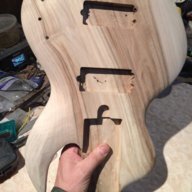
I'm joining because I'm building a bass with Hickory and maple laminate. The neck will be 7 pieces with 3 maple and 4 hickory.. The headstock will be a single piece of maple the body is a mixture of epoxy soaked MDF and a hickory/maple alternated laminate I sourced from my work.. I work for a flooring manufacturing company that has an engineered line that has both Hickory and Maple as well as Oak Acacia and many others..

I'll also be using smaller reinforcement pieces under the bridge for example of hickory.. and some other random hardwoods for bracing.. I've only built ukuleles so far but I'm not scared to try things and I'm aerospace trained for BOEING so I should be able to make this happen.. Timeline has me finishing somewhere in February. I'm going fretless with and Archtop style and I will be building a rear resonator head as well
 

Attachments

  • 20181231_152001.jpg
    20181231_152001.jpg
    284.6 KB · Views: 40
  • 20181231_153730.jpg
    20181231_153730.jpg
    248.7 KB · Views: 45
  • 20181231_151103.jpg
    20181231_151103.jpg
    285.5 KB · Views: 47
  • 20181231_151111.jpg
    20181231_151111.jpg
    279.3 KB · Views: 48
  • 20181231_151453.jpg
    20181231_151453.jpg
    332.6 KB · Views: 45
  • 20181231_151948.jpg
    20181231_151948.jpg
    399 KB · Views: 47
  • IMG_20181230_111429.jpg
    IMG_20181230_111429.jpg
    203.8 KB · Views: 49
I'm joining because I'm building a bass with Hickory and maple laminate. The neck will be 7 pieces with 3 maple and 4 hickory.. The headstock will be a single piece of maple the body is a mixture of epoxy soaked MDF and a hickory/maple alternated laminate I sourced from my work.. I work for a flooring manufacturing company that has an engineered line that has both Hickory and Maple as well as Oak Acacia and many others..

I'll also be using smaller reinforcement pieces under the bridge for example of hickory.. and some other random hardwoods for bracing.. I've only built ukuleles so far but I'm not scared to try things and I'm aerospace trained for BOEING so I should be able to make this happen.. Timeline has me finishing somewhere in February. I'm going fretless with and Archtop style and I will be building a rear resonator head as well

You are making history
 
  • Like
Reactions: Paragon3
No he's making a bass.
I can't see any reason to not try this... I have a whole bunch of Hickory strips seems most are bent but I've found enough to make this happen and enough straight maple to make this work as well.. Now as far as making the neck I'm using epoxy and superglue for as much as I can and not using a truss rod.. I'm not sure about fingerboard... Probably just leave the layers open and visible.. Any usefull feedback will be appreciated.

I play my homebuilt 8 string ukulele and will be posting my Bass Banjo updates here mostly..

 
I tend to agree with this.

It isn't used because it isn't.

Many do and don't do things because others do and don't do things.
And the basic reason,if there ever was one,is lost.

^This^

Many rock musician's are far more conservative-minded than the general, popular image might lead people to suspect. Take, for example what happened with the binding of Les Paul guitars years ago. Because of the carving of the guitar's maple top cap, when the binding maintained a uniform width around the entire body, the seam where the top cap met the underlying mahogany was visible where the top edge of the binding rose up to follow the top edge of the cap contour inside the body cutaway (see PIC on right below). For awhile (I forget what year) Gibson started widening the binding inside the cutaway to hide/cover this seam (see PIC on left below). Although this looked tidier from a strictly woodworking perspective, lot's of people objected vociferously to the "non-vintage look", so Gibson went back to the original method of doing the binding which (unless I am mistaken) it has continued to do to this day.

vAvgjki.png
 

Latest posts