• TalkBass has been independent since 1998. Add your voice.
    Create a free account to reply to discussions, view embedded media, and browse with fewer display ads.
    Join freeLog in
    Want zero display ads or expanded classifieds tools? Compare plans.

High-Mass Bridges- Loved or Hated?

I've noticed recently on the Classifieds and in other recent NBD posts that a lot of people have been swapping out the High-Mass bridges on their basses for "stock" bent-metal bridges, while for other people the first thing they do when they get a new bass is install a High-Mass bridge. Are there any of you out there that just HATE the High-Mass styled bridges like the Badass/Omegas? I know people say the High-Mass bridges give you more sustain, but are there any other advantages/disadvantages to them that I just haven't heard of? FWIW, I have one bass with the Fender version of the Badass on it and I don't particularly find it to have better sustain than any of my other basses.

Right here. I have actually bought basses and swapped out high-mass bridges for bemt-plate. I prefer the tone and note decay of a bent-plate. They just sound more "woody" and open to me. Yes, sustain is diminished. But I can't remember the last time I held out a note 37 seconds on stage anyway. ;)
 
  • Like
Reactions: lalo_garcia-maynez
I have a lot of basses With 2tek bridges ; they DO make a difference ! No doubt they sound better to my ears ; but it’s also a matter of personal taste . The omega bridge and Kickass bridge are great and are a direct replacement for fenders ; buy one and leave it there for a couple of months ; if you don’t like the sound sell it and you lost $15! It’s worth the experiment; the 2tek is a more complicated installation.
The best basses historically have used brass bridges (ken smith; Spector , alembic , Fodera , modulus , Linc luthier, acacia , Tobias , Pedulla and the list goes on…) ; may be that is an indicator but in the end everybody hears things differently.
 
Nobody sustains a note for 37 seconds but sustain is important because it’s an indicator of how “alive” the bass is and resonates. (Again in my opinion!)

Right here. I have actually bought basses and swapped out high-mass bridges for bemt-plate. I prefer the tone and note decay of a bent-plate. They just sound more "woody" and open to me. Yes, sustain is diminished. But I can't remember the last time I held out a note 37 seconds on stage anyway. ;)
 
I find that it depends on the metal.

As much as I like the adjustability and look of, say, a Badass-type bridge, I prefer something else that isn't made of cast "pot metal" as they tend to sound a little dead to me.

A steel bent-plate bridge sounds just fine to me.
That’s my point ! In the end everyone has different ears and should be the judge , just like we do with speakers, strings , amplifiers etc …
 
  • Like
Reactions: 31HZ
I've noticed recently on the Classifieds and in other recent NBD posts that a lot of people have been swapping out the High-Mass bridges on their basses for "stock" bent-metal bridges, while for other people the first thing they do when they get a new bass is install a High-Mass bridge. Are there any of you out there that just HATE the High-Mass styled bridges like the Badass/Omegas? I know people say the High-Mass bridges give you more sustain, but are there any other advantages/disadvantages to them that I just haven't heard of? FWIW, I have one bass with the Fender version of the Badass on it and I don't particularly find it to have better sustain than any of my other basses.
I dislike high-mass bridges, though I wouldn't say "hate".
A high mass bridge may help to increase sustain, but it's at a price. Sustain is increased by keeping as much energy as possible in the string, and a high-mass bridge will do that since it will vibrate less. But that also means that less energy is transferred to the body of the instrument. The body acts like a filter, modifying the string vibration by partially absorbing some frequencies - thus colouring the sound. For some, that's an acceptable price to pay for sustain. Not me.
 
I’ve played many, many basses over the years and I never owned nor played a bass that, for a second, I thought, gee, this bass would benefit greatly from a different bridge, regardless of what style it was originally equipped with.

From the Fenders with the thin-style to modern basses originally equipped with so-called high-mass bridges on recent basses, both Fenders and now the Lulls, they all felt like they are designed and built with those bridges in mind and not a trend-follower.
 
1) People feel inclined to change something in order to "make it better". Regardless of whether that's true or not
2) I've changed many over the years. The change in sound is subtle and only appreciated by the most demanding ear.
2a) The two times I did it, I had to shim the neck once I went to the high mass bridge. Not a big deal... just my 2 cents
2b) The minor weight change can be used to help balance out a neck heavy bass
3) UNLESS.... If you change the mass significantly, the tone / sustain / is changed to the point where anybody can hear the difference. Example: after replacing a Ric stock bridge vs a Hipshot (brass) bridge. The change was in the half pound range and the tone had a significant change. Now whether you like that change is another topic. For me, I thought it improved the Ric.
 
View attachment 1056114 View attachment 1056115 This Alembic Epic is the only bass I have with a "High-mass" bridge - assuming it has the big brass block under the bridge that Alembics are supposed to have - and frankly? I'm not a big fan of sustain anyway, but, gotta tell ya, this bass doesn't have a whole lot of it. That Kramer 450B lumie? Aside from where it holds the strings ball ends, it's bridge is essentially just a bent-plate, Fender style bridge. And the sustain on this bass? Truly, epically obnoxious. Piano-with-sustain-pedal-depressed kind of sustain. I'm not going to tell you what kind of bridge to put on your bass. It's your bass; please yourself. But, personally? Trying to get more sustain by changing the bridge is the last reason I'd change it for - even if did work. And, from the very mixed results I'm reading all the time here on TB, I have serious doubts that it does...:whistle:

Since I posted this, I've acquired several more basses, but only one of them has what could be considered a "high mass" bridge. It's a very blingy looking Tom Hamilton Sig. G&L ASAT Bass. It has the heavy stock bridge with the block that sticks down into the bass' body. TBH, I wouldn't call the bass a high sustain one; about average for my 26 bass herd. Which is still too much sustain, AFAIC. The Kramer 450B is still the Sustain King in my herd; followed pretty closely by my Rick 4003 and 4001. I have never changed a bass' bridge in a search for anything - other than the bass needing a new one, 'cause the stock one was broken. Otherwise? If it ain't broke? I don't mess with it. Trying to maintain and play 26 basses is all the "fun with tools" I care to deal with, anyway...:whistle:
 
Most of the Hi-Mass bridges also have features like adjustable string spacing, string through option, easier intonation adjustment,etc that make them arguably "better" than some old school bridges, and that might be reason enough to upgrade. Any tonal difference is going to be minimal. The original Ric bridge, for instance was a famous PITA to intonate, despite being one of the early "Hi-Mass" bridges, so mass in itself isnt inherently better.
 
  • Like
Reactions: bigtone23
Most of the Hi-Mass bridges also have features like adjustable string spacing, string through option, easier intonation adjustment,etc that make them arguably "better" than some old school bridges, and that might be reason enough to upgrade. Any tonal difference is going to be minimal. The original Ric bridge, for instance was a famous PITA to intonate, despite being one of the early "Hi-Mass" bridges, so mass in itself isnt inherently better.

Zombie thread.

Ask yourself this if you’re a purist. Would Fender make them the standard on their P and J basses now if they weren’t sorta good? They cost more. Does Fender make design changes that increase their manufacturing costs? Is that something Fender would do for no reason?

Great points. I have installed many a high mass bridge for the increased adjustability alone. Bridges like the BadAss were great in that they required no drilling on my Fenders.

Those original Ric bridges are horrible. The newer version is much better.

It might be argued that Fender installs high mass to give the appearance of higher quality (mostly from a marketing standpoint), though some of their high mass bridges are not super high mass, but maybe medium to medium-high mass. These particular bridges do have multiple slots per saddle, allowing better manipulation of string spacing.
 
  • Like
Reactions: Killing Floor
Great points. I have installed many a high mass bridge for the increased adjustability alone. Bridges like the BadAss were great in that they required no drilling on my Fenders.

Those original Ric bridges are horrible. The newer version is much better.

It might be argued that Fender installs high mass to give the appearance of higher quality (mostly from a marketing standpoint), though some of their high mass bridges are not super high mass, but maybe medium to medium-high mass. These particular bridges do have multiple slots per saddle, allowing better manipulation of string spacing.
Bottom line is there’s no best. As your strings vibrate, so does the neck/body which also acts as a damper. Bridge is a small part of a system.
 
Balance may be another advantage of Hi-Mass, the extra weight can help to cancel some neck dive, though its usually more effective to lighten the tuners than add weight at the bridge. Some of the fancier ones are nice bass "jewelry" too, nothing wrong with swapping a bridge for bling sake alone. The versions of the old Fender bent plate with threaded saddles that allow some string spacing adjustment work fine, but Leo never intended them to be visible, which is why they all originally shipped with ashtray covers. The Babicz bridges are superbly designed and fully functional, but I could do without the big logo engraved into the top.
 
  • Like
Reactions: Zooberwerx
My only gripe about the more complex / convoluted bridges is the increased baseplate thickness required to accommodate "sled" tracks and such. The geometry of many instruments is centered on the pretense we're using conventional bent-plate assemblies with fairly common expectations re: up 'n down, back 'n forth travel. New bridge is installed and we start seeing threads "help...my strings are too high!"...it's usually the G. In some instances, we can over-notch the saddle provided we don't compromise the break angle. I usually end up adding a shim.

Riis
 
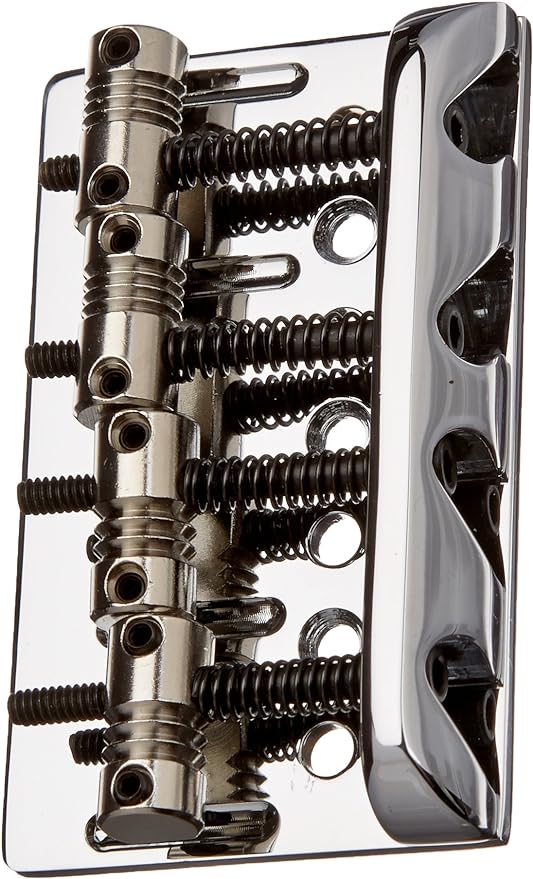
More for aesthetics, I've been wanting to put this bridge on my Standard P, a bridge that comes standard on some Fenders. It is probably high-er mass than high-mass compared with the usual bent plate:

81mGgihHOmL._AC_SY879_.jpg


Ironically it looks like it's out of stock:
https://www.amazon.com/Fender-American-Standard-Bridge-Assembly/dp/B003AYTN2Y/

and from the comments looks like it won't work with a MIM.

From their catalog there seems to be a number of good alternative bridges from Fender.
 
Last edited:
As an Amazon Associate, TalkBass may receive commissions from qualifying purchases made via links on this site.
  • Like
Reactions: Gilmourisgod
More for aesthetics, I've been wanting to put this bridge on my Standard P, a bridge that comes standard on some Fenders. It is probably high-er mass than high-mass compared with the usual bent plate:

81mGgihHOmL._AC_SY879_.jpg


Ironically it looks like it's out of stock:
https://www.amazon.com/Fender-American-Standard-Bridge-Assembly/dp/B003AYTN2Y/

and from the comments looks like it won't work with a MIM.

You may have to fill and re-drill some mounting holes in the MIM bass in question, but it would certainly work.

Be aware that a neck shim may be needed because of the higher plate height. May.....
 
As an Amazon Associate, TalkBass may receive commissions from qualifying purchases made via links on this site.
  • Like
Reactions: Btbp
I don’t like them. I can’t get action low enough without a shim, which seems to negate the purpose. Bridge ‘supposedly’ adds sustain, shim reduces it. It’s a wash as far as I’m concerned. I don’t like the look either.

great to reduce neck dive though!