Interesting video. I like the tone of the high mass better.

Enjoy the benefits of a premium membership!
Upgrade Account
-
TalkBass has been independent since 1998. Add your voice.
Create a free account to reply to discussions, view embedded media, and browse with fewer display ads.
Join free Log in
Want zero display ads or expanded classifieds tools? Compare plans.
You are using an out of date browser. It may not display this or other websites correctly.
You should upgrade or use an alternative browser.
You should upgrade or use an alternative browser.
High mass vs low mass bridge
- Thread starter ics1974
- Start date
More options
Who Replied?
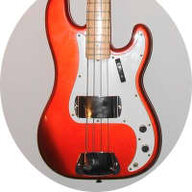
I have put "no-name", from AMZ, $15-$20 high mass bridges on most of my basses primarily for the saddle adjustments "right to left", so to get my string spacings, and alignments over pu poles and the edge of the fretboard where I want them. And also to dress up my budget basses.

Ugh. Again?
You cannot use philosophy to solve a physics problem.
Density is a known contributor to vibrations/wave mechanics.
“I like” is a known contributor to bass procurement.
Make your own bed.
You cannot use philosophy to solve a physics problem.
Density is a known contributor to vibrations/wave mechanics.
“I like” is a known contributor to bass procurement.
Make your own bed.

This has been flogged to death, there are plenty of reasons to buy a modern high-mass bridge, like better adjustability for string height, spacing, etc, but dramatic improvement in tone isn’t one of them. The original Fender bent plate still works fine, but I always thought it was kind of ugly. Leo thought so too, hence the ashtray cover. If you have a perfectly balanced bass, don’t mess with it. A high mass bridge might help a little against neck dive, but you’d get more effect using ultralite tuners.

For me high mass = more sterile, tighter, "modern" tone. Low mass = more resonant, open, "vintage" tone.
For most purposes I prefer a simple plate of bent.
For most purposes I prefer a simple plate of bent.

Companies are really missing out on the money mountain that would come with the development & manufacturing of Medium Mass bridges. And yes, they can have this idea for free. Just remember- you saw it here first, folks!

I'll take the high mass lite model.Companies are really missing out on the money mountain that would come with the development & manufacturing of Medium Mass bridges. And yes, they can have this idea for free. Just remember- you saw it here first, folks!

The year was 1992, and in a vain attempt to emulate AJ's 'Career Girl', I took the bent plate bridge off my '78 jazz bass and replaced it with a badass II at a cost of $80.00 AUD.
To make a long story short, I wasted $80.00. Sonically there was no difference and the addition of the badass made an already heavy bass, just *that* much heavier. LOL. Oh well...
To make a long story short, I wasted $80.00. Sonically there was no difference and the addition of the badass made an already heavy bass, just *that* much heavier. LOL. Oh well...
In my experience the only thing in a bridge that would make a difference is saddle types. I've learned to dislike sharp saddles where strings rest on a sort of knife edge. Always hard for me to get setup right, sometimes dead sounding strings. Hipshot A type or clones is the best, followed by fender round types. Haven't tried the new Foderas, they seem to use thinner round tubes as witness points

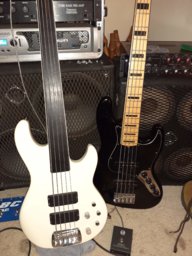
Give me a Bent Plate, Threaded Saddle bridge every time. Or, just as important to me, original equipped bridges. I wouldn't change a Spector or Smith bridge. I have changed Fender type bridges. Always went back to the original.

The atomic mass of iron is 55.8; one mole of iron atoms would weigh 55.847 grams. Aluminum, would be in about 1/2 that weight. So clearly an iron bridge would have more mass, and thus help vibrating more, spark some mojo, etc.
I’ve been thinking what a bridge made of livermorium would sound like, with a scary atomic mass of 292. Beyond decaying and eating you alive before you end your first tune, given its radioactive condition, I am pretty sure that the B string will finally sound - at least for a short while - thunderous.
I’ve been thinking what a bridge made of livermorium would sound like, with a scary atomic mass of 292. Beyond decaying and eating you alive before you end your first tune, given its radioactive condition, I am pretty sure that the B string will finally sound - at least for a short while - thunderous.

buldog5151bass
Kibble, milkbones, and P Basses. And redheads.
In about 1983, I bought a used FSO. Like many basses then, a BadAssII bridge had been installed. After playing it about 35 years, I installed a bent plate bridge. Other than a slight weight reduction, absolutely no difference.
D
This is a rather poor comparison video as he digs in much harder with the high-mass bridge. The volume is also louder with the high-mass. The only time he really digs in hard with the the traditional bridge the tone just breaks up into fret buzz, which suggests to me that the action was set slightly higher (which made it possible to play more aggressively) with the high-mass. There are too many variables to make any meaningful comparison IMO.
Personally I've always preferred the dynamics and "feel" of traditional, vintage-style Fender bridges. Or at least that's what I think... But again: Too many variables. I really don't mind playing ANY type of bridge as long as it doesn't have any sharp edges, has an acceptable intonation range, provides a decent break angle over the saddles and allows the bass to be set up properly with correct strings spacing and action. As long as these boxes are ticked I don't really care whether it's a Gibson 3-point or a $$$$ Babicz. Bonus points for fast&easy setup though.
Personally I've always preferred the dynamics and "feel" of traditional, vintage-style Fender bridges. Or at least that's what I think... But again: Too many variables. I really don't mind playing ANY type of bridge as long as it doesn't have any sharp edges, has an acceptable intonation range, provides a decent break angle over the saddles and allows the bass to be set up properly with correct strings spacing and action. As long as these boxes are ticked I don't really care whether it's a Gibson 3-point or a $$$$ Babicz. Bonus points for fast&easy setup though.

Again?? I didn't listen to the video, but I personally prefer the look of bent plates. The bulky bridges look ugly to me. And I like to run my strings through bridge, so I don't care about that high mass improving the sustain "argument" whether it exixst or not.

133 grams. A standard Fender bent-plate bridge is 103 grams, the Fender HiMass is 236. So more than twice as heavy.I wonder just how much more mass does the Fender high mass bridge have compared to the standard bent plate one. I bet it's just a few grams, if at all.
Last edited:
133 grams. A standard Fender bent-plate bridge is 103 grams, the Fender HiMass is 236. So more than twice as heavy.
Thanks for the info. Admittedly that's considerably more mass. By Fender HiMass you mean the one on the AmStd since 2008 and current AmProf models?

+1For me high mass = more sterile, tighter, "modern" tone. Low mass = more resonant, open, "vintage" tone.
For most purposes I prefer a simple plate of bent.
This is exactly the deal with bridges.

A few ounces is more like it. I once weighed a bunch of bridges, including the high mass Fender and a Fender bent plate, and I seem to recall at least a 4 oz difference. That said, it’s been a few years, but I do remember it was a good bit more than a few grams.I wonder just how much more mass does the Fender high mass bridge have compared to the standard bent plate one. I bet it's just a few grams, if at all.