Good Day - Keepn' It Low lovers
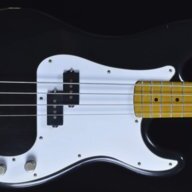
I recently purchased and installed a Hipshot Highmass bridge onto a Fender Jazz Bass Deluxe Series (Mexico). The removal of the original bridge; installed the Hipshot bridge (style " B ") and the installation was smooth as expected.
Because I own multiple bass guitars, I am of the believe that if I learn to setup my guitars, I could dial in each MY personal touch, feel and taste.
I followed the recommended step-procedure:
1) TRUSS ROD adjustment - Because I like low action I set my fret/fingerboard flat to level all existing frets; I used a .008"/20mm gauge; capoed fret one (1) and measured at the 12th fret.
2) RADIUS (R) of STRING ACTION: Fretboard R=12"
3) ACTION of STRING adjustment: Target: "E" string - 0.085" & "G" string - 0.075". Procedure: With bass tuned to pitch and fret 1 capoed I measured both strings at the 12 fret (Top-of-fret to Bottom-of-string). For the "E" string, the height measurement should have landed between lines .08 & .09, and the "G" string measurement should have landed between lines .07 &.08; However, both landed slightly above the .14 measurement.
I was able to lower all bridge saddles to where they were approximately 0.002" above the bridge base and that was still too high. I made sure that there was a string break-over at both the nut and saddle. With all of that, I was still unable to get the string action to the recommended starting point and adjust up or down from there.
3) NUT HEIGHT adjustment: Not adjusted!
4) INTONATION adjustment: On the Hipshot that I received, from the factory, all four of the intonation saddles were set nearest the bridge pickup and very slightly staggered backward.
Using my Peterson Tuner, I tuned my bass (open strings) to pitch. All strings measured between plus (+) 18-22 percent SHARP. I adjusted the "E" saddle back as far as possible, remeasured, and got a 12 percent sharp reading. I lengthened the other strings and received a similar percentage reading.
5) PICKUP HEIGHT adjustment: This will be performed after obtaining the proper string action and intonation.
With the above explained my concerns and questions are:
A) Does anyone have a reasonable recommendation(s) or suggestion (s) to lower the saddles? - (see "Action of Strings adjustment" above)
B) Does anyone have a reasonable recommendation(s) or suggestion (s) to adjust the intonation? - (see "Intonation adjustment" above)
Thanks in advance for taking time from Your busy schedules and please reply here and to a private email address: [email protected] if You would...Please!!!
Thanks again and have a good day.
Play4U
I recently purchased and installed a Hipshot Highmass bridge onto a Fender Jazz Bass Deluxe Series (Mexico). The removal of the original bridge; installed the Hipshot bridge (style " B ") and the installation was smooth as expected.
Because I own multiple bass guitars, I am of the believe that if I learn to setup my guitars, I could dial in each MY personal touch, feel and taste.
I followed the recommended step-procedure:
1) TRUSS ROD adjustment - Because I like low action I set my fret/fingerboard flat to level all existing frets; I used a .008"/20mm gauge; capoed fret one (1) and measured at the 12th fret.
2) RADIUS (R) of STRING ACTION: Fretboard R=12"
3) ACTION of STRING adjustment: Target: "E" string - 0.085" & "G" string - 0.075". Procedure: With bass tuned to pitch and fret 1 capoed I measured both strings at the 12 fret (Top-of-fret to Bottom-of-string). For the "E" string, the height measurement should have landed between lines .08 & .09, and the "G" string measurement should have landed between lines .07 &.08; However, both landed slightly above the .14 measurement.
I was able to lower all bridge saddles to where they were approximately 0.002" above the bridge base and that was still too high. I made sure that there was a string break-over at both the nut and saddle. With all of that, I was still unable to get the string action to the recommended starting point and adjust up or down from there.
3) NUT HEIGHT adjustment: Not adjusted!
4) INTONATION adjustment: On the Hipshot that I received, from the factory, all four of the intonation saddles were set nearest the bridge pickup and very slightly staggered backward.
Using my Peterson Tuner, I tuned my bass (open strings) to pitch. All strings measured between plus (+) 18-22 percent SHARP. I adjusted the "E" saddle back as far as possible, remeasured, and got a 12 percent sharp reading. I lengthened the other strings and received a similar percentage reading.
5) PICKUP HEIGHT adjustment: This will be performed after obtaining the proper string action and intonation.
With the above explained my concerns and questions are:
A) Does anyone have a reasonable recommendation(s) or suggestion (s) to lower the saddles? - (see "Action of Strings adjustment" above)
B) Does anyone have a reasonable recommendation(s) or suggestion (s) to adjust the intonation? - (see "Intonation adjustment" above)
Thanks in advance for taking time from Your busy schedules and please reply here and to a private email address: [email protected] if You would...Please!!!
Thanks again and have a good day.
Play4U