• TalkBass has been independent since 1998. Add your voice.
    Create a free account to reply to discussions, view embedded media, and browse with fewer display ads.
    Join freeLog in
    Want zero display ads or expanded classifieds tools? Compare plans.

Double Bass Hipshot FreeRange Xtender

CF is more like wood than you might think. Its of a similar density to maple and is definitely similarly sticky, so there would be no friction benefits in a CF top. Nice oily Dalbergias might work ie. cocobolo.

*WARNING: GUITAR CONTENT!* I will sometimes use a slice of CF as the bottom 25-35% of a bone guitar saddle. Its much lighter than bone and can give a woolly sounding, floppy-topped dreadnought some responsiveness and bite.

 
CF is more like wood than you might think. Its of a similar density to maple and is definitely similarly sticky, so there would be no friction benefits in a CF top. Nice oily Dalbergias might work ie. cocobolo.

*WARNING: GUITAR CONTENT!* I will sometimes use a slice of CF as the bottom 25-35% of a bone guitar saddle. Its much lighter than bone and can give a woolly sounding, floppy-topped dreadnought some responsiveness and bite.

Is CF the same thing as Graphite? I was under the impression that what is used for guitar and slab-bass nuts is plastic impregnated with graphite powder, not "Carbon Fiber". Can anyone expand on this?
 
I think it has something to do with the construction- carbon fiber is lots of teeny tiny fibers, and the way the fibers are aligned within the structure can drastically alter the strength of said structure- kinda like wood, as Jake mentioned earlier in the thread.

As I understand it, all graphite is carbon- but so are a lump of coal and diamond.

So I guess it has to do with the way it's "cooked", so to speak.

Joe
 
What I was getting at is that I think NicholasF was referring to the "graphite" material which is used for some electric guitar and bass nuts, which supposedly provides an optimally smooth and durable stringpath - especially important when using roundwound strings. This material is different from carbon fibre, however, which I doubt would function very well for this application. Making string groove inserts in the bridge with this material sounds like an excellent idea, actually, if you plan on constantly retuning your strings with a lever device. However, as I said, finding double bass strings which can sound good over a wide tension range seems like the bigger obstacle if you plan to do more than just E to D and back.
 
What I was getting at is that I think NicholasF was referring to the "graphite" material which is used for some electric guitar and bass nuts, which supposedly provides an optimally smooth and durable stringpath - especially important when using roundwound strings. This material is different from carbon fibre, however, which I doubt would function very well for this application. Making string groove inserts in the bridge with this material sounds like an excellent idea, actually, if you plan on constantly retuning your strings with a lever device. However, as I said, finding double bass strings which can sound good over a wide tension range seems like the bigger obstacle if you plan to do more than just E to D and back.

Sorry Rob, I understand what you're saying- I meant that in a different form, the graphite may have different properties- and I thought that the graphite in those nuts and bridge saddles was the same stuff, "served differently" so to speak. Ich habe keine idee! :D
Kinda shootin from the hip again! :p
Affenschande? lol!

I also agree with you on the 5ths tuning thing...going back and forth between 4ths and 5ths doesn't seem to be very plausible to me either.

Joe
 
Ah, yes, the wonders of carbon. I'm waiting for someone to economically produce carbon buckyballs for the lubricant over the bridge and nut, effectively microscopic ball bearings...they're only @$250,000/gram from a research laboratory right now....
:hiding:
 
Ah, yes, the wonders of carbon. I'm waiting for someone to economically produce carbon buckyballs for the lubricant over the bridge and nut, effectively microscopic ball bearings...they're only @$250,000/gram from a research laboratory right now....
:hiding:

:D
 
I recently saw a bridge saver type thing, its a peice of mystery material that goes over the groove on the bridge, its supposed to make the bridge last longer. Maybe hipshot should have come up with something similar first...
 
Sorry for the necropost here, have a question.
I'm looking at getting one of these for my bass, is there anyone here who has actually used them and can share their experience with? So far there's one person who mentioned it briefly, on an EUB, but the rest of the thread appears to be speculation rather than experience. I figure perhaps there's been more time for people to buy and try them since the thread was created, so I'd very interested in seeing if the scenarios presented here have been problems or not for those who have. Thanks!
 
...is there anyone here who has actually used them and can share their experience with?

I haven't GIGGED with one, but we've tried them on several basses, over some time, here at the shop. I can tell you it works pretty reliably with steel core strings (like Helicores, Spirocores, etc.) and has a lesser tuning range with more flexible synthetic core strings (like Evah Pirazzi, et al). The newer ones actually have a little more "throw" to help accommodate that (based on our feedback to Hipshot) but you still get more range with steel strings.

I can easily and pretty reliably drop the E on our shop Estle Louis laminated bass down to B and back, in tune, several times - and that bass has inexpensive "OEM" (Chinese-made) strings on it.

I'm pretty confident that it would work reliably in a gig situation, even more so with a more modest change (like down to D). It's easy and smooth to operate - pitching down can be done with one hand, but a second steadying hand is helpful for tuning back up.

What else do you need to know?
 
Rich Wagor, (talkbass user dickwagor) just posted about his new Upton he had built and he has one on his bottom string with an extension, so he can reach a low Bb. There's a "testimonial" video where he talks about the bass, and demonstrates chromatically going down from the low E to the low Bb via capos on the extension and the Hipshot.

He wrote a novel that rivals some of my own over in Basses about it, which leads me to believe he would be open to talking about it. Other than that, I think there are a couple of guys around here using them. I agree that a low Eb or "Drop D" would probably be the best use of it, steel strings would be a lot more stable for tuning, and switching from 4ths to 5ths would have a ton of tension issues. I'm going to leave it at that though, because I haven't personally worked with them.
 
I play in drop D a lot; especially when I play with the celtic group like on Tuesday when the guitar player is in DADGAD it makes it a lot easier to follow them. It works well for me and my bass loves it. A stark Spirocore E is oh so buttery and lush when it is down a whole step!

I've owned a couple of guitars with the hipshot de-tuners over the years. Interesting, but I always removed them after a while. I was VERY curious about these for bass a while back, but could not find any information or reviews on the web, so I contacted Hipshot directly. I was hoping for a demo unit that I could use for a review here and in a few magazines- basically get him some nice press coverage if the unit performed well and was of use to the community. I did not want a free one; I was simply looking for a demo model to checkout and then give back. I gave a clear background on who I was, my intentions, and all of the other nerdy magazines and such that I write for.

The fellow that I spoke with was VERY unpleasant and unhelpful, with a world of crust grumpy unfriendliness- the response was like I just pissed off a cabbie in NYC. Needless to say, I dropped it at that. I still think about it regularly and I wish them well if it works.....but that's no business model for introducing a new product to a relatively conservative market!

j.
www.condino.com
www.kaybassrepair.com
 
This actually works quite well. With Hybrids I could get down to about Db. With Xyex, only to Eb, so it may not be ideal with medium and low tension strings. You do need to make sure that the notch on the bridge is well lubricated with graphite, or whatever, and follow the instructilns carefully on fitting the device on the tailpiece.
 
The fellow that I spoke with was VERY unpleasant and unhelpful, with a world of crust grumpy unfriendliness- the response was like I just pissed off a cabbie in NYC. Needless to say, I dropped it at that. I still think about it regularly and I wish them well if it works.....but that's no business model for introducing a new product to a relatively conservative market!

Agreed. I'm surprised by your experience, considering ours. I'm not sure who you spoke to, but my contact there is very friendly, and very specifically wanted our feedback on the unit (it's why the newer ones have a longer throw - to better accommodate strings like Evah Pirazzi, with a synthetic core). Sorry to hear that whoever you spoke to quite clearly needed a second cup of coffee or something. ;-)
 
  • Like
Reactions: DaveAceofBass
Thanks for the input, Mark! Also, just out of curiosity, how does the mechanism work? Is it basically an on/off thing where off is E and when you flick the switch it's a lower note that you set beforehand, or does it have varying degrees of detuning that give you the option to tune down to D if that's all you need, or down to C, B etc if you push it another step farther?
 
I have it on my 200+ year old Bohemian bass. The lever flips immediately to the pre-set pitch. Works great on the Hallelujah Chorus. Does not significantly detune the other strings (just a few cents--nothing unmanageable). Not bad for the $130 I spent. Wish I could get a low C, but it's not happening on this bass.
 
Thanks for the input, Mark! Also, just out of curiosity, how does the mechanism work? Is it basically an on/off thing where off is E and when you flick the switch it's a lower note that you set beforehand, or does it have varying degrees of detuning that give you the option to tune down to D if that's all you need, or down to C, B etc if you push it another step farther?

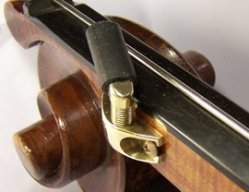
Pretty much as you describe; there's a lever that you flip, and it bump stops against an adjustable screw. You adjust that screw so that when you flip the lever, it adjusts to the pitch that you pre-tune and pre-set:

xtender_detail.jpg


And here's a video of an E to C back to E demo.

Let me know if you have other questions!