• TalkBass has been independent since 1998. Add your voice.
    Create a free account to reply to discussions, view embedded media, and browse with fewer display ads.
    Join freeLog in
    Want zero display ads or expanded classifieds tools? Compare plans.

How Come Old P Basses Sound So Good?

Ric5 said:
There is a theory that as wood ages 20 years or more it sounds better ...

I am not sure I buy into it but it is an interesting theory.

Also an instrument more than 20 years old has had the wood under stress from strings for years and that can change how it sounds. (theoretically)

There are others who believe that as the finish wears and the magnets in the pickups degauss the instrument will sound better.

I usually prefer a new instrument of high quality.
I've heard of that applied to acoustic instruments, and even one study that subjected new guitars to sound at high volume levels to 'break-in' the wood, but I've never heard of it affecting solid-bodied instruments.
 
I have a vintage P and I wouldn't say it's any better, but I would say it's definitely different. Very very mellow. You start with basswood and then that ages. I've also heard others say that the pickups lose their "bite" over time. Some will argue about that and some will argue the wood doesn't contribute to the sound. Regardless of the reason, the one thing I can say for sure is - it sounds different. The ones I hear now are brighter and more clear in comparison. Mine is soft, mellow, with very little highs. You have to have the right amp/speaker combo to get any sort of brightness out of it. Records beautifully. Great all around bass that fits in the mix with ease.
 
Not sure how much this affects solid basses, but I know some luthiers of acoustic stringed instruments will use either vibrating tables, or even closets with speakers to play music at the instrument to 'tune' the wood. Perhaps older Ps have been growling for so long that the wood gets 'tuned.'

My relatively brand new CV P sounds very good, FWIW.
 
(Best read in a hushed voice)

Here we see a herd of Fender P-basses. They're on alert because a 7 string guitar was spotted in the area. Yes they're definitely spooked. P-basses are always cautious when predators encroach on their frequency range.

They've spotted the 7 string. It looks like an Ibanez! They're very fast. The herd is already edging away...no they're fleeing the area now! The Ibanez is giving chase. Already, one P-bass has fallen behind. I can see now that it has been injured already, the D string is missing, and its neck is bowed. Yes it's inevitable now, the Ibanez is rapidly closing in, going for the kill.

:::Scare chord:::

Well that was a grisly scene. But life is brutally hard out here in the plains of low frequencies.

Genius. :bassist:

If only there wasn't a limit to sig length.
 
Because a bass doesn't really break in until roughly 20+ years of use. So word of advice, don't sell your new P bass because in 20 years it's going to sound great! :)
 
after much thinking, it's gotta be the pickups. my question is, did those pickups always sound that great or did they develop that sound over time? logic tells me that they pretty much sounded like that out of the factory and oxidation and rust added a tiny bit of grit to the sound.

the only other great sounding p basses that ive tried was an early 70s fender p and a new daisy rock heart-shaped bass that was purple, short scale, and had the stock duncan p's in them (I'm serious). i bought it for my girlfriend at the time and would always play it because it sounded so punchy. btw, my recent p's were the new American standard p5 and a custom shop Reggie pj 5 and neither of those had that punchy/burpiness, not even close.
 
In my personal opinion P basses sound better with either flats or somewhat-worn roundwound strings. Even if not "better" they certainly sound different. This could be what you're hearing with old P basses vs. new models fresh out of the box.
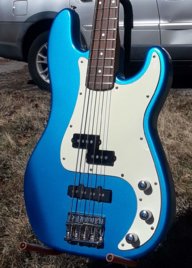
Fascinating theory; I think that's exactly what happens in some cases.

/rick
 
ive been told that for the lack of modern day advancements that basses and guitars werent mass manufactured so people who would construct these instruments to delicate care when building.
this isnt to say that every bass or guitar is beyond that in signicant sound. im sure that back then they had some that sounded bad but they had a smaller scope to compare than opposed to now
 
I did a bit of research on degaussing and here's the gist of what I've found:

Magnets degauss (de-magnetize) naturally over time, but apparently, a lot of guitar pickup repairers and boutique guitar pickup makers degauss their pickups by waving a stronger magnet over the pickup magnets that are in the guitar. This is supposed to reduce the highs a bit and produce a more vintage sound in guitars, but if you overdo it, it will weaken the output. Come to think of it, all of the best P's that I've played didn't have much highs, even if you turned the tone knob all the way up.
 
I've heard of that applied to acoustic instruments, and even one study that subjected new guitars to sound at high volume levels to 'break-in' the wood, but I've never heard of it affecting solid-bodied instruments.

A sure _fire_ way to bring out that vintage tone is to leave your bass in the trunk of a big black sedan in Phoenix for a week during the summer. On the 7th day at 2PM (very important) pull it out of the trunk (use gloves) and quickly toss it in a 7-Eleven "Cold Ice" chest. The zero degree temps in the freezer will pull all the negativity and bad new-bass karma out of the instrument that's been brought to the surface during it's week in the sweat lodge.

Ahhh the tone, the vibe, the warped neck, it's like a total 60's flashback.

YMMV.