This is Peter Steele’s live effects. I have the same thing minus the tuner. If you look at the DS-1, the dist and level dials are cranked! But there also seems to be silicone keeping them in place for some reason. But the DS-1 is notorious for the amount of hum it produces. I have NO idea how Peter was able to use this setting but not have it ruin his sound. I’m playing through a Peavey mini-max and 2 4x10 cabs. The overdrive is off and the channel is as clean as can be. Anyone have any clue how to use or mod this thing so the hum isn’t as loud as the music??? Btw, my DS1 is powered by a 9v.

Enjoy the benefits of a premium membership!
Upgrade Account
-
TalkBass has been independent since 1998. Add your voice.
Create a free account to reply to discussions, view embedded media, and browse with fewer display ads.
Join free Log in
Want zero display ads or expanded classifieds tools? Compare plans.
You are using an out of date browser. It may not display this or other websites correctly.
You should upgrade or use an alternative browser.
You should upgrade or use an alternative browser.
How did Peter Steele overcome DS1 hum?
- Thread starter CCtop
- Start date
More options
Who Replied?


I don't know the answer to your particular question, but remember that this was the late 80's and early 90's. Very few people back then were as into gear as we are today. In fact, hum from a distortion pedal was sort of taken as a given and we just got on with the business of making music without worrying too much about the intricacies of tone. Probably why so much great cutting edge music was produced in those days versus today.
Just looking at his pedalboard you can see the spirit of that philosophy in action. His board would not make it to the pages of Instagram as the neatest wiring job and coolest collection, but again, his main aim was to make music with the limited tools available back then. Silicone on knobs actually seems like a great idea.
Just looking at his pedalboard you can see the spirit of that philosophy in action. His board would not make it to the pages of Instagram as the neatest wiring job and coolest collection, but again, his main aim was to make music with the limited tools available back then. Silicone on knobs actually seems like a great idea.

He probably didn't overcome it. This doesn't look like the gear of a guy who particularly gave a crap lol. Probably just played over any hum. This is a dude that had a chain for a strap and used a ds-1 on bass.

I like it. Play and annihilate...nuff said
/
/
Gotta love the way Peter labeled his pedals.
His sense of humor, at work.
Damn, I miss Type O Negative.
His sense of humor, at work.
Damn, I miss Type O Negative.

This is Peter Steele’s live effects. I have the same thing minus the tuner. If you look at the DS-1, the dist and level dials are cranked! But there also seems to be silicone keeping them in place for some reason. But the DS-1 is notorious for the amount of hum it produces. I have NO idea how Peter was able to use this setting but not have it ruin his sound. I’m playing through a Peavey mini-max and 2 4x10 cabs. The overdrive is off and the channel is as clean as can be. Anyone have any clue how to use or mod this thing so the hum isn’t as loud as the music??? Btw, my DS1 is powered by a 9v.
High gain goes hand in hand with noise.
The way to deal with the noise is to use a noise gate. Probably one of the best noise gates you can get is the ISP Decimator II G-String.
DECIMATOR II G-STRING PEDAL - ISP TechnologiesISP Technologies
What makes this pedal work so well is the key for the gate is developed before the high gain distortion, and the gate is applied after the distortion. This means the gate is keyed be a clean signal with wide dynamic range instead of a distorted signal which has a much narrower dynamic range. The result is the gate can track your playing a lot more accurately.
Be aware that there is a less expensive non G-String model as well that works like most other noise gates in that the key is developed off a sample of the distorted signal.
DECIMATOR II PEDAL - ISP TechnologiesISP Technologies
The G-String version does require more connections and cabling, but the benefit is enhanced performance.

Mine doesn't hum
The hum is probably from the bass. High gain pedals have a lot of compression, so when you stop playing the pedal amplifies any hum or hiss that comes earlier in the circuit. When you start playing the noise is pushed back down and you hear just intended signal.
The G-string cleans up the noise when you are not playing.

High gain goes hand in hand with noise.
The way to deal with the noise is to use a noise gate. Probably one of the best noise gates you can get is the ISP Decimator II G-String.
DECIMATOR II G-STRING PEDAL - ISP TechnologiesISP Technologies
What makes this pedal work so well is the key for the gate is developed before the high gain distortion, and the gate is applied after the distortion. This means the gate is keyed be a clean signal with wide dynamic range instead of a distorted signal which has a much narrower dynamic range. The result is the gate can track your playing a lot more accurately.
Be aware that there is a less expensive non G-String model as well that works like most other noise gates in that the key is developed off a sample of the distorted signal.
DECIMATOR II PEDAL - ISP TechnologiesISP Technologies
The G-String version does require more connections and cabling, but the benefit is enhanced performance.
What they said. That G-String pedal is a godsend. Everyone who uses a lot of gain and/or noisy pedals should have one.

bongomania
Commercial User

Drop the DS-1 out of the chain entirely. I know people swear this is how to get Peter's tone (even though they didn't use it themselves), but I've tried a ton of things with the DS-1 and it simply doesn't work. You'll notice that the pedal board has been altered (extra Velcro and wire anchors) - who knows what he was doing on that particular tour? Maybe using the DS-1 just as a boost, especially if he was using the M10 that didn't have a sustainer? I've seen him stomp on something that made a reverse reverb effect, so his board definitely changed.
He ran pedals into a Peavey Bassist (earlier tours) or MAX Preamp (later tours), so you need to find something that does the job of that. I personally found that either a Boss MT-2 or a DigiTech Metal Master will do a great job replicating his tone. Some say they have had success with a Boss HM-2, Boss HM-3, and the Biyang Metal End, but I've not tried them.
You will need a Boss TU-3 or an active ABY switcher - the TU-3 is more practical. From the output jack of the TU-3, run it into one of the above distortion pedals, then into a CH-1, then into a DD-3 (I'm convinced he only occasionally used this in the Hold mode on this particular pedal board). You can add a Boss NS-2 at the end of this chain if you set the MT-2's gain above midway or are using the Metal Master. The TU-3's bypass jack goes to a tremolo and a reverb (or just use a single Boss BF-2 instead) for the clean tone. Combine both signals into a passive ABY summer, then run this through an EQ (I use an MXR M108S smiling, dropping the 13 and 16k bands to 0), then into a BBE Sonic Stomp (optional. Lo 8, Process 4), and run the whole thing into the effects return of your Mini-Max, bypassing the preamp because this will color the tone. The TU-3 becomes your channel switcher, with the clean tone always on to add definition.
He ran pedals into a Peavey Bassist (earlier tours) or MAX Preamp (later tours), so you need to find something that does the job of that. I personally found that either a Boss MT-2 or a DigiTech Metal Master will do a great job replicating his tone. Some say they have had success with a Boss HM-2, Boss HM-3, and the Biyang Metal End, but I've not tried them.
You will need a Boss TU-3 or an active ABY switcher - the TU-3 is more practical. From the output jack of the TU-3, run it into one of the above distortion pedals, then into a CH-1, then into a DD-3 (I'm convinced he only occasionally used this in the Hold mode on this particular pedal board). You can add a Boss NS-2 at the end of this chain if you set the MT-2's gain above midway or are using the Metal Master. The TU-3's bypass jack goes to a tremolo and a reverb (or just use a single Boss BF-2 instead) for the clean tone. Combine both signals into a passive ABY summer, then run this through an EQ (I use an MXR M108S smiling, dropping the 13 and 16k bands to 0), then into a BBE Sonic Stomp (optional. Lo 8, Process 4), and run the whole thing into the effects return of your Mini-Max, bypassing the preamp because this will color the tone. The TU-3 becomes your channel switcher, with the clean tone always on to add definition.

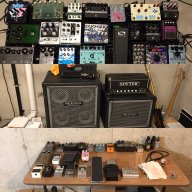
Maybe he is mistaking hiss for hum? With those settings, the DS-1 will hiss like an old AM radio ...even without anything plugged into the input. If it is hum, he needs to plug everything into one power strip.

Bryan R. Tyler
TalkBass: Usurping My Practice Time Since 2002
Staff member
Administrator
Gold Supporting Member
Supporting Member
- May 3, 2002
- 28,948
- 20,934
- Disclosures
- Reviewer: Bass Player Magazine
He probably just stared at the pedal angrily and it knew not to misbehave.


