• TalkBass has been independent since 1998. Add your voice.
    Create a free account to reply to discussions, view embedded media, and browse with fewer display ads.
    Join freeLog in
    Want zero display ads or expanded classifieds tools? Compare plans.

How Do I Play/Count This?

Obese Chess

You Guys Are Getting Paid?
Supporting Member
Sep 4, 2005
4,713
5,595
Portland, OR
Hello!

We are working on our second record and one of our guitarists, bless his heart, has sent me this rhythmic monstrosity.
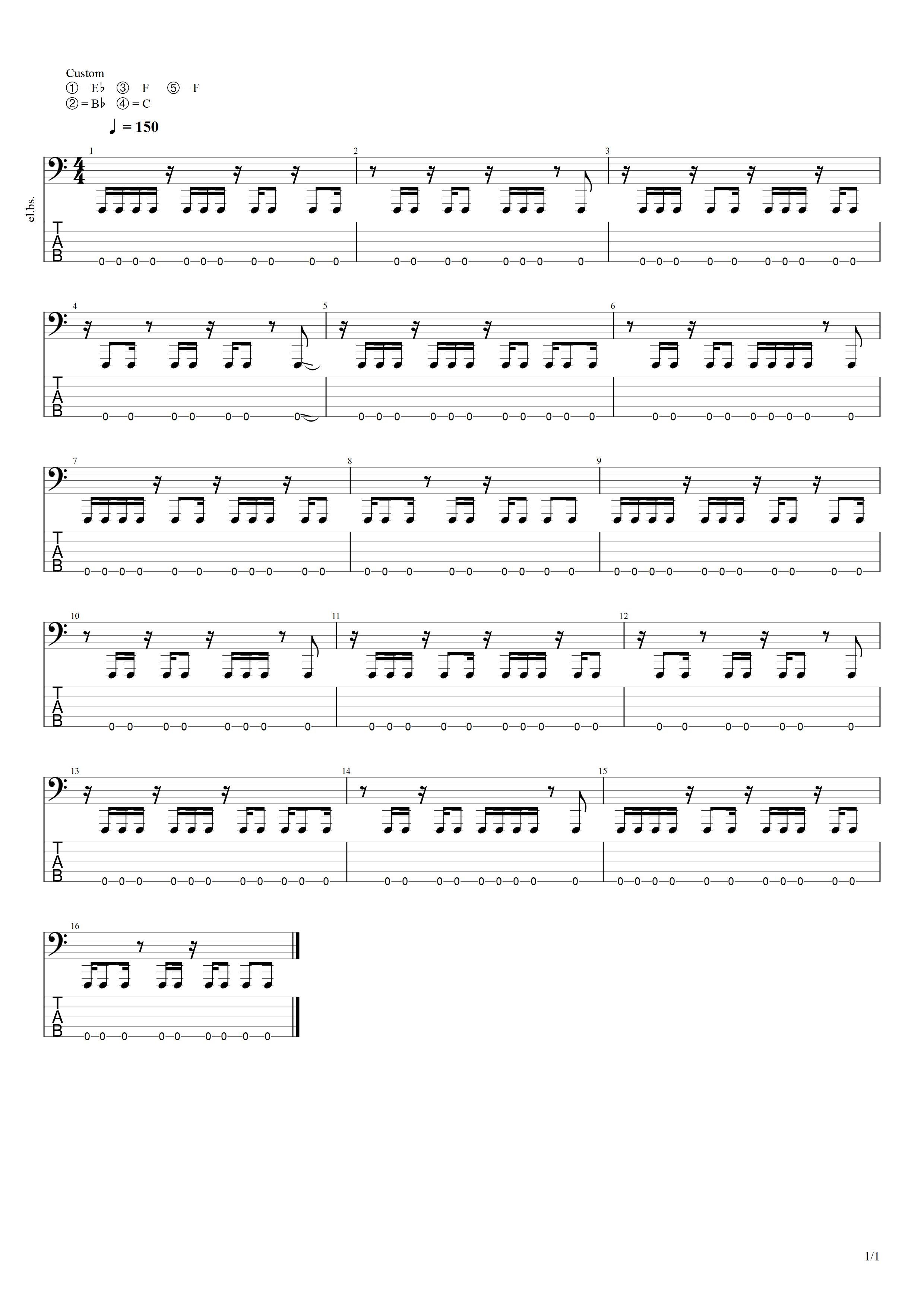
wvvnaNh.png


I cannot for the life of me begin to figure out how to pick this apart. Is this even in 4/4? There's another song we've written that I've found much more helpful to feel as bars of 6 - 5 - 6 - 7 - repeat, but that song is at 110, not 150. I can't begin to pick apart how to count this in an easy way. I could conceivably stumble through it live but want to make sure it's airtight and I'm wondering if there's any repeating pattern or motif that I'm not seeing. It doesn't sound that complicated in the demo track, but, again, I'm wondering if there's anything I'm missing or if I just need to buckle down and learn this full sixteen-bar motif the old fashioned way.

No comments on the insanely low tuning, please, I didn't buy this Dingwall for nothin' ;)

Thanks!
 
My dumb ass missed that it's an 8-bar repetition. I was mostly posting this because I didn't see the repeating pattern at measure 9 and was like "this is a 16-bar bastard of an intro." 8 Bars is MUCH easier! Ha! Well, let's leave this up for posterity any time someone needs a laugh at my expense. :)

To answer the question, I'm fairly comfortable with sixteenths, but in clusters like this at 150bpm it's more of a workout than I'm used to.
 
I'd be more concerned with the slide down the zero fret... :laugh:

I see you figured this out already.

What might help you to get this in your ear otherwise is to replicate this in a notation software of your choice (unless you already have a file like that your guitarist made), maybe MuseScore or even GuitarPro, and play along to it until you've internalized it. Start slow, go faster. I've done this a few times for similar cases, for example 'The Chicken' by Jaco which I had to learn for a big band ensemble and the sheet music had more black than white on it. Listening back to that helped immensely.

At Q=150, subdivisions at the sixteenth level are impractical to count.
 
Wasn't that lifted off of a 1974 Gentle Giant album?
That's quite a catchy tune and sure to get the kids up on the dance floor. ...
Looks like it was pulled from a drummers paradiddles book.

I'd read the first line as
1e&a, /e&a, //&a, //&a ... (/=silent)
It's not perfect but, it won't get you fired.
 
I have a BA in music, took music theory nearly every semester, and there really isn't a problem with how the notes are grouped. They are grouped for each quarter note. No rhythm here breaks the boundaries of the quarter in which it lives. This rhythm is perfectly readable. It's a little uncommon to write so many ledger lines down, but I've seen worse in professional, licensed music scores. Your guitar friend knows exactly what rhythm he wants you to play, and gave you exactly what you need to learn that rhythm: a line written in valid Western music notation. This isn't an improper part, and there are no problems with beam groupings, and to say so is misinformation.

You can practice this one quarter note at a time. First measure I would count: 1e&e (2)e&a (3)e& (4)e-a , similar to what Acoop also suggested. It is in 4/4, so you can count it in 4 with standard 16th note subdivisions. Take it slow until you get the feel, practice it somewhere between 50 and 75 bpm until you can do it perfectly. It definitely feels kind of like an 80's synth part, reminds of like a Pretty Hate Machine NIN synth line. I like rashrader's suggestion of using a sequencer because once you hear it, you will get it.
 
Wasn't that lifted off of a 1974 Gentle Giant album?
That's quite a catchy tune and sure to get the kids up on the dance floor. ...
Looks like it was pulled from a drummers paradiddles book.

I'd read the first line as
1e&a, /e&a, //&a, //&a ... (/=silent)
It's not perfect but, it won't get you fired.
I think it's more like 1e&a, /e&a, /e&/, /e/a ... (/=silent)
 
I have a BA in music, took music theory nearly every semester, and there really isn't a problem with how the notes are grouped. They are grouped for each quarter note. No rhythm here breaks the boundaries of the quarter in which it lives. This rhythm is perfectly readable. It's a little uncommon to write so many ledger lines down, but I've seen worse in professional, licensed music scores. Your guitar friend knows exactly what rhythm he wants you to play, and gave you exactly what you need to learn that rhythm: a line written in valid Western music notation. This isn't an improper part, and there are no problems with beam groupings, and to say so is misinformation.

Let the Pissing Match™ commence! I have a BA in music and an MM in music, so I command thee to bow down before my superior academic credentials!

j/k :)

(...about the bowing/pissing, not the degrees; I really do have those. And what is missing from the OP's example is the inclusion of the rests underneath the beams. That's not 100% mandatory in order to be correct, but it is always considered the preferred way to clearly indicate subdivisions for unequivocal legibility.)
 
what is missing from the OP's example is the inclusion of the rests underneath the beams. That's not 100% mandatory in order to be correct, but it is always considered the preferred way to clearly indicate subdivisions for unequivocal legibility.

I see your point. I think in this case it wouldn't help because all of the rests happen at the beginning of the beat. In the middle of a group, sure, it can help.
 
  • Like
Reactions: SLO Surfer