• TalkBass has been independent since 1998. Add your voice.
    Create a free account to reply to discussions, view embedded media, and browse with fewer display ads.
    Join freeLog in
    Want zero display ads or expanded classifieds tools? Compare plans.

How do I set a proper neck angle?

Okay, even though this is a diminutive thing with six cobwebs for strings, I figured I'd ask TB for advice since you know your stuff.

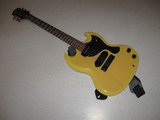
About a month ago I completed the build of this (click to view):
th_IMG_5904.jpg


Even though it's an SG-style body, it's a bolt-on with four neck screws that sandwich the neck, body and a neckplate together and two screws under the neckplate that give some extra stability, since the lower two screws come up right underneath the neck pickup.

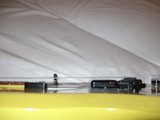
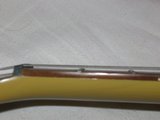
The real problem is this: the string action is so high the instrument is both tough to play and intonation is pretty hard to achieve as well. I've taken profiles of the string height at fret one and above the pickups to show just how it's (not) set up right now:
th_IMG_5957.jpg
th_IMG_5956.jpg


The string height above fret one is 2.2 mm, and it's 7.2 mm above fret 22. The witness point on the bridge is at 12.6 mm above fret level, and the bridge is a wraparound, so vertical adjustment is impossible, and I have tried adjusting the bridge horizontally, but I'm close to maxing out the screws and the adjustable posts are already all the way in the bushing.

So what do I do? Shim the entire neck pocket? Shim the inner side to give the neck more angle? I'm not sure if the truss rod needs to be adjusted, either, though the first-and-fifteenth-fret-press" shows a single business card can fit in and that's it.

:help:
 
by all means shim the neck under the body-most end of the pocket so that you have room for that bridge to be up off the top a bit, so you can adjust your action where you need it.
 
It looks like shimming, or reworking the part of the neck which touches the body, is required. Apart from that, I think a height of 2.2 mm at fret one is caused by the nut being too high. A distance of 0.5 mm is more what I would expect. Fret one is so close to the nut, that this hardly will be changed after having corrected the angle of the neck. With a bass I normally file each notch, so that each string will be some 0.6 mm above the first fret. For a guitar I think I would remove the nut and sand down the back side of it.
Anyway, good luck with this pretty looking guitar.
 
The main reason I'm worried is here:
IMG_5826.jpg


Not sure how much it is visible (the neck is made of a slightly darker piece of wood) but suffice to say about a quarter of the neck pocket is actually underneath the pickup itself and there are two shortened neck screws there (along with two screws hidden by the neck plate which also have to be changed for ones with a bigger head), so I'm hoping that won't disrupt the positioning of the pickup much.
 
I see. I've seen sg-imitations with a bolt on neck. I wondered: "How do they do this?". The element is right on top of the neck, making the construction weaker. If I had to build this one, I would consider gluing and bolting the neck to the body. Before applying any glue, I would adjust the neck position, so that the action is up to specs, with enough adjustment room to both sides. If everything, really everthing is beyond doubt, I'd apply glue to all sides of the neck and the body which are in contact. Then bolt it down and leave it for a few days. The disadvantage, of course, is that the neck cannot be removed from the body anymore, but: so what?
When I inspected my bass, a rather cheap Ibanez, I didn't trust the stability of the bolt on neck. So I took it apart, glued it in place and mounted the screws back in their holes, also applying some glue to the screw thread. It has been rock stable ever after.
 
Drill the pickup side bolt holes right through the neck, if what's left of it is at least 1/4", and get some blind nuts (tee nuts) to insert into the holes from the pickup side. It'll never move. Just don't over-tighten it. Once the Phillips head screwdriver begins torqueing up out of the bolt, stop! That's why Phillips are designed that way; if you are chewing up the slots, you are over torqueing it! Glue if you want, but there's likely no need.
 
Thanks, I didn't think of using T-nuts for that. I might have extra photos showing the neck in detail, I'll see if I can post them before I tear the instrument apart again. I'm loathe to do it because I've more than just the neck to fix (wiring, too, including adding extra wires to the pickup for S/P switching) so I'd rather get it in one go.
 
Well, I got the pictures:

th_gtr002.jpg
th_gtr003.jpg
th_IMG_5863.jpg


This shows how the neck overlaps with the pickup, and as you can see there's not much space in the pickup cavity, so I'm not sure if such small T-nuts are available.
On the other hand here's another anomaly - you can see the two full-length neck bolts, two shortened neck bolts, two intermediate bolts (I guess someone made them to supplement the shortened ones - I'll swap them for proper, big ones, I promise!) and a hole that I have no idea about.

It looks as if it could fit a set screw - but to what end? The neck has no hole of its own there, so it's not a fastening screw, and it doesn't have a plate, either, so it's not a micro-tilt either, plus it's far too much forward for that. Or is it?
 
No idea why there are so many holes.There's not much wood left. I still stick with the idea of gluing the thing into place with the screws keeping it in place during the curing of the glue. Glue has the advantage of spreading the force accross as much surface as there is available. By the way, the third (right-hand side) picture I don't understand.