Led Zeppelin Fans disagree.In my experience, I have owned 2 passive jazz basses. My complaint is that they just don't have a big sound.


TalkBass has been independent since 1998. Add your voice.
Create a free account to reply to discussions, view embedded media, and browse with fewer display ads.
Join free Log in
Want zero display ads or expanded classifieds tools? Compare plans.
Led Zeppelin Fans disagree.In my experience, I have owned 2 passive jazz basses. My complaint is that they just don't have a big sound.

The oc5 is in my future.I've always found overdrive and the like to remove low end, so I don't use it.
I've had a million octave pedals, most recently the OC5, which I think is the best of the bunch. I had a sub n up but found the low octave to be a little thin. One of the more interesting was the TRex, which had both an upper octave and a fifth. I sold it to the guitar player with whom I'm currently working!
Chorus is a good idea, I've always found that to make things more spacious, and i use that.
Actually, the biggest sound I get is using all my pedals at once: Diamond>OC5>Chorus>Hypergravity (with a custom toneprint that works like a trhree-band EQ/compressor). It does sound big, but I'm looking for simpler than that. Maybe it doesn't exist.
Maybe I want an 8-string bass. I don't know. I'm still fleshing it out.
I think I dislike figuring out what sound a new band needs.

I'm one, but also small and sometimes ampless! All HUGE : horses for courses.I can't believe nobody has said get a HUGE amp if you want a HUGE sound. Where are all the SVT toters?
Sam Wilkes style!I often started off the song with my normal tone. That allows space for the guitar.
When the guitarist took a solo I would add an OC2 and play up the octave. That fills out and increases the intensity
Revert (or not) for the rest of the tune.
Use an OD in a similar pattern.
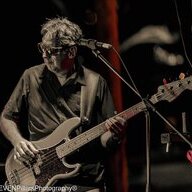
Very much agree, and thanks for reminding me about the SCR-DI. I have one and forgot about it!At my last gig with a classic rock band, I played a Fender USA Geddy Jazz Bass with the bridge pickup just slightly rolled off w/nickel rounds, and tone knob at around 60%, mostly finger style plucked over the neck pickup...
into a TC Spectra Comp pedal with the "Melvin Davis Compress Less" patch and knob at about 10:00....
into an Ampeg SCR-Di with Scrambler off, bass set flat, mids @ 1:00, treble @ 11:00....
Straight to the PA.
No stage amp.
It was huge. The club sound tech asked me if the bass was active, could I cut the lows a little. He said it was "too thick and just in your face".
I turned the Bass on my SCR-di down to about 11:00, and he was happy. The BL walked around the room (guitar wireless) during the first number and said the bass sounded thick but not overpowering in the mix and he liked it.
It also sounded really good in my IEMs.
I've also achieved a big, rich sound using a Fender Player P and D'addario Chromes (flats) into the same pedals, both amped and ampless at different gigs.
You don't always need a big amp or even an expensive di to get a huge sound.
Quality bass pickups and strings, a clean signal, and playing the right way for your particular instrument and the particular songs will get you there.
Oftentimes, less is more.
Jamerson used it in a recording studio with a microphone, a modern single 12" cab using a P with flats is still way better than that at low volume.15s can sound really good at low volume levels if you like the more old school bass sound. Think Jamerson. For high volume levels or a more modern vibe they don't work as well as 10s or 12s IMO.
"Way better" is HIGHLY subjectiveJamerson used it in a recording studio with a microphone, a modern single 12" cab using a P with flats is still way better than that at low volume.
Jamerson used it in a recording studio with a microphone, a modern single 12" cab using a P with flats is still way better than that at low volume.


In a trio situation, and especially when the PA was a couple boxes on sticks for vocals and a couple mics on drums, I've done this…my pedalboard incorporates an small dual out signal splitter, with tuner and compressor before it. One send goes to a TRex Quint(octave up plus a fifth above, dry signal off). That in turn goes through some sort of guitar frequency friendly dirt, and a Keeley Mod Station multi-effects for the usual suspect stuff, followed by an AMT volume pedal(small footprint)acting as a 'blend'.My bass sound is OK, but I'm looking to make it fuller for use in a three-piece hard rock band. I'm wondering how you go about it?
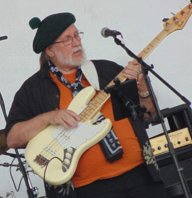
Here, I'm running an '82 Jazz Bass (all Jazz Basses were MIA and passive in '82) into my Eden WT500/800 (800-watts bridged into 8Ω) and feeding that signal into my 8Ω, DNS-410 (handles 1400-watts rms) by DNA. Since we were playing outdoors, I normally would set my master at 9:30, but since I had to place my amp 5-feet behind the stage and a foot below it, I had set the master at 10:30, which was way too loud. Next song turned it down to 10 o'clock. That was still too loud, even with my amp sitting on the asphalt behind and a foot down from the stage. For the next song I turned it down to 9:30 to balance with the rest of the group and I played the rest of the gig with it set at 9:30 on my master.My bass sound is OK, but I'm looking to make it fuller for use in a three-piece hard rock band. I'm wondering how you go about it?