turn up 80 hertzMy bass sound is OK, but I'm looking to make it fuller for use in a three-piece hard rock band. I'm wondering how you go about it?

TalkBass has been independent since 1998. Add your voice.
Create a free account to reply to discussions, view embedded media, and browse with fewer display ads.
Join free Log in
Want zero display ads or expanded classifieds tools? Compare plans.
turn up 80 hertzMy bass sound is OK, but I'm looking to make it fuller for use in a three-piece hard rock band. I'm wondering how you go about it?
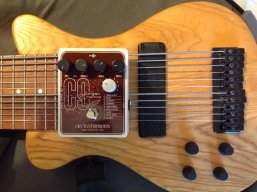
You have some options here:Mesa D800+
Mesa 115, either 1 or two of them, or Mesa 212
Diamond Comp, Hypergravity Comp, Boss OC5, TCE Flanger.
Other various and sundry pedals.
The sounds I get from this rig are stellar, but I'm looking for huge when the guitarist drops out to take a solo. I have a few things going on, But I want to see what you guys do.
Here, I'm running an '82 Jazz Bass (all Jazz Basses were MIA and passive in '82) into my Eden WT500/800 (800-watts bridged into 8Ω) and feeding that signal into my 8Ω, DNS-410 (handles 1400-watts rms) by DNA. Since we were playing outdoors, I normally would set my master at 9:30, but since I had to place my amp 5-feet behind the stage and a foot below it, I had set the master at 10:30, which was way too loud. Next song turned it down to 10 o'clock. That was still too loud, even with my amp sitting on the asphalt behind and a foot down from the stage. For the next song I turned it down to 9:30 to balance with the rest of the group and I played the rest of the gig with it set at 9:30 on my master.
I've pointed out in the image below where my amp was playing from:
View attachment 7028539
Here's what that sounded like from the brewpub owner's iPhone recording as he moved around: I have my master set at 10 o'clock here and it was definitely too loud.
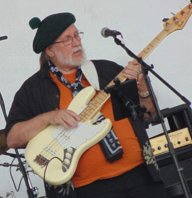
I liked it too, but even with it sitting on the asphalt of the parking lot behind the stage it did pretty well bury everyone on that recording.I don't think it's too loud but hey I do love the bass! That said, probably one of the best rock and roll rigs I ever owned was a Mesa Boogie Big Block paired with a Mesa Engineering 4X10. I play solely for church now and I prefer an old Montrose Eden rig. To me, they just produce the best overall sound for a bass. Plenty of fat, clear seat rattling lows and crystal clear highs that cut through any mix with ease. However, finding a good tech that knows the old rigs can be a bit trying.
I can refer you to one in the Seattle area if that helps. They are pretty spendy, though they do really good work.I don't think it's too loud but hey I do love the bass! That said, probably one of the best rock and roll rigs I ever owned was a Mesa Boogie Big Block paired with a Mesa Engineering 4X10. I play solely for church now and I prefer an old Montrose Eden rig. To me, they just produce the best overall sound for a bass. Plenty of fat, clear seat rattling lows and crystal clear highs that cut through any mix with ease. However, finding a good tech that knows the old rigs can be a bit trying.



Not plugging it, but my OE DCX can liven and broaden your sound and has a variable drive control. Great match to my Mesa D-350.Mesa D800+
Mesa 115, either 1 or two of them, or Mesa 212
Diamond Comp, Hypergravity Comp, Boss OC5, TCE Flanger.
Other various and sundry pedals.
The sounds I get from this rig are stellar, but I'm looking for huge when the guitarist drops out to take a solo. I have a few things going on, But I want to see what you guys do.
Some of it's what and how. Cobalt flats do sound 'bigger' than most strings, though. Some compression and some overdrive help. And good frequency choice on EQ. You don't want to be cutting through with some thin, nasal sound to be almost solo in the mix all of a sudden...Interesting...
I'm completely at odds with everyone else here :
Other than some overdrive / distortion, I don't think a huge bass sound has anything at all to do with the equipment you use.
I think it's entirely about the notes you play - the number of notes played, the way you play them, their attack, their duration, and most importantly their contextual relationship to the rest of the music.
Huge sound comes from use of space, use of sustain, simplicity over complexity, controlled aggression, contrast, groove, mastery of envelope, and a good set of ears.