• TalkBass has been independent since 1998. Add your voice.
    Create a free account to reply to discussions, view embedded media, and browse with fewer display ads.
    Join freeLog in
    Want zero display ads or expanded classifieds tools? Compare plans.

How do you perceive a Jazz/Precision/Tbird/Ray sound?

They all sound like basses to me, with the person playing them being the most important differentiating factor.

Sure, there are innate differences in tone, and you've got more options variety with two pickups instead of one, but a competent player can make any of them work to the point a casual listener wouldn't notice a musical difference.
 
They all sound like basses to me, with the person playing them being the most important differentiating factor.

Sure, there are innate differences in tone, and you've got more options variety with two pickups instead of one, but a competent player can make any of them work to the point a casual listener wouldn't notice a musical difference.
I'm pretty much in this camp too, most of the time. It's easy to magnify the differences between different electric basses in the mind, but then when actually playing them in a band it's still just slightly different flavors of the same thing. Strings have a big impact on tone as well and different strings on different basses can exaggerate the tonal differences between them.

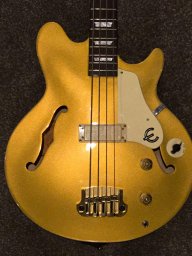
I tend to think of my T-bird as broadly similar to a Jazz Bass, but with a distinct character. My Epiphone Vintage Pro T-bird does a better P impersonation than my Fender J with the neck pickup soloed, while at the same time with emphasis on the bridge pickup, it comes much closer to a Stingray type tone than the J can do. This is mostly down to humbuckers vs single coils I think, pickup placement is very similar between the two basses. The J, with its slightly scooped character, is much smoother sounding. The Bird has more emphasis in the lower mids. Strings are currently D'Addario Chromes on the J, and Fender 9050 flats on the T-bird (I know, kind of backwards with the Fender strings on the non-Fender bass...).
 
Said quickly:

P-bass - Middle of the road tone the fits any type of music. Very percussive.

J-bas - Similar to a P-bass, but cleaner-sounding. Neck pup can get close to a Precision. How close is up you.

Stingray - More similar to a Jazz bass, but a slightly more compressed tone. A tone that pretty much stands on its own. Hard to categorize. Love it or hate it. Not percussive.

Thunderbird - Overall, similar to a Jazz bass but darker.

Mike
 
The hard tone of the bridge pickup on a Jazz is not what I like to hear. Ditto with the Stingray but to a lesser extent. The Jazz neck pickup sounds great and together they’re good too but best with slightly less bridge pickup. The few Thunderbirds I’ve heard sounded nice, but I haven’t heard that many to enable a detailed critique. The Precision sound I’m very familiar with in it’s various setups. I love the heavy flat wound thump but also the low action round wound bite is nice too. I never wound off the tone knob on my Precision but always eq’d my amp with not too much highs. I don’t like the piano-like brightness that has become popular and don’t care much for clicky pick style sounds.
 
I basically divide basses into one pickup or two pickup. The Thunderbird is a murkier Jazz bass with less lows and highs and more low mids instead. Even though it's muddy you can hear the telltale two-pickup quack, and neither pickup is quite optimal on its own. The Ray sounds like stealthy sub-bass lows and airy highs wrapped around a leaner, cleaner P bass tone. There's a built-in midrange to them, no quack, and a kind of simple, compact bluntness to the overall sound that only comes with a single pickup.
 
Most of us have probably tried these big 4 basses....Jazz, Precision, Thunderbird, and Stingray.

I'm not sure I'd put the Thunderbird in with the other three. I own a P (technically a PJ), multiple Js, and multiple Rays, along with a couple other HH-style basses. I can immediately call to mind what each of them sounds like and how they differ from one another.

I've played a TBird exactly once in a GC and the ergonomics were so bad for me that I barely even noticed the sound. (Same with the Ricky I tried.) I can't even call to mind the TBird sound without going to listen to one. I just don't think they're as iconic as the other three.
 
  • Like
Reactions: FRoss6788
I just know P and J.

I prefer the P bass isolated sound. With flats. When playing alone on my couch. The J was sounding thin to me.

I play with a band, mainly "gentle rock". I found the P sound muddy, I have added treble, still lacking articulation. The J with TI flats sound perfect with the band, two Pups full on and adjusting the tone from 50% to full depending of the sound wanted. I can play faster lines without being muddy.
And if I need a P sound the neck Pup is close enough for my taste.

So I am coming back to love my J, I have added my favorite P neck to it, it is a bit too heavy for my taste but perfect to me for touch and sound at the moment.

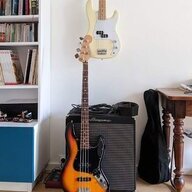
1997 MiM J with 2012 CV60 P neck and P knobs
PXL_20240227_102342135.jpg
 
Like this, preferably with headphones:


I love listening to these comparisons as much as anyone, but they are not and never will be representative of a live situation.

In a processed video they are all decently clear and defined with each for note definition and clarity meaning - if the player plays a run or lick or whatever local term for it is, each note can be heard.

This is never, ever, nor ever has been, the situation live. (The sole exception perhaps being open air concerts) lower notes (E string) get lost when playing live turning into a boom wash, blending in with surrounding frequencies again, as you local language defines it.

I have played all these basses over decades and no-one would equate a Precision with a Thumb bass for note clarity/cutting through with note definition. Or a Ric for that matter, or even a Jazz with a P whereas the Jazz will alway have more note articulation on the E string. A defining characteristic for me.

But, please don't stop presenting them as they are a great help for people unfamilair with them all to gain an idea of their base, net sounds as for this purpose, they are equally represented.

This is also the reason why a P (and any other bass for that matter) records so well, the sound is isolated with its own channel, eq, and volume setting within the mix. It will always sound great in a recording as will any bass, but live playing is the most often exposure for many and although a P is my first choice for home practice, it is my last choice for live work because it washes into surrounding frequencies live, putting a heavier demand on amp settings and speaker configuations to hold those lower notes open to definition.

My point is that they don't represent equally in a live band situation. IMO.

Hope this is seen as the constructive comment intended.
 
Last edited:
There are so many variables at play, and I think the setup and string type plays a big factor. I have played around with rounds and flats on all of my basses, and I've found a similarity across brands. There's clearly a difference between the Jazz and Precision, but there's a certain "Fender-y" sound and feel to both of them. The StingRay, being a Leo Fender design, has similarities, but the pickup type, pickup placement, and active EQ put it in a different ballpark. The Thunderbird in my mind has some tonal similarities to an EB-type bass, both having a "Gibson-ness".

And for what it's worth, everyone gets fooled. Often times you associate a particular player with a certain type of bass, and you don't even notice when they're using something different. The players that many of us look up to have such distinct tones that are reliant more so on technique and amp settings that the subtle differences in pickups and bass types pass us by. In the case of Geddy Lee, for example, there's still people who argue about whether certain tracks on Moving Pictures were done a Rickenbacker or a Fender.

As for telling the four described apart, it's all about the midrange character. The Jazz and Thunderbird both have the same pickup configuration and control layout, so there's that dual-pickup "scoop" happening with everything on full. The single coils of the Jazz allow for a clearer top end, but fresh roundwound strings and the right amp settings can bring that out in the T-Bird as well. In my head, if it's more "grunty", I'm tempted to think it's a Gibson. The Precision and the StingRay, being single pickup designs, have a clearer, more defined midrange. Thanks to the EQ, there's crisper highs on the StingRay that separate it from the P-Bass, and it's easier to scoop the mids there. But that tone works on the StingRay IMO, because of the pickup placement.

My personal favorite of the four is the StingRay. If I someday get my hands on an American StingRay, I might let a lot of the other basses go. But I think there's equal potential in all of them.
 
Perception indicates that most readers here are players in the majority over recording artists and performers. If that perception is accurate, then a live setting is a criteria difficult to evaluate for any bass guitar because of many reasons, covering the artists playing and plucking style, bass set up, strings, amp, settings, speaker box(s), the band and number of instruments, and the room of course, all before the sound is colored by a sound guy.

Maybe we knit pick a touch more than our audience? Self critique can be harsh.
 
  • Like
Reactions: EdO. and kln_bc