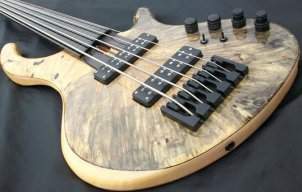
Nine pages in, 180 posts posted, almost 4000 views viewed and no one has solved the mystery yet?  Someone call those guys that have Big Foot stored in their deep freezer they probably have the answer your looking for! Or perhaps we should call a paranormal expert, yeah and a physic too MAAAAAYBE the answer lies within the walls of Hanger 18 at area 51...
There is no proven answer, only opinions and anyone who knows me already knows mine so I'll spare you the details.
Maybe someday someone will post proof but so far no one has. So until then I reserve the right to build basses from whatever wood I want.
I like how Carl Thompson put it,
"Any time you talk about sound I end up in the same place. I really don't know anything about sound. It's something I can't define definitely. That's why I don't talk about it. I only like to talk about things I can define definitely. I can't define tone. A thicker fingerboard's going to get a warmer sound-no it's not. It's going to get a brighter sound-its going to get a thicker sound. That doesn't mean anything to me, not really. So I can't really relate to that. I never had so many questions about sound before. It's too ambiguous. Does that make sense to you?"
Now that's a honest answer and who am I to argue with Carl!? He also uses a quote from Ken Parker that says "I use good wood" or "I use guitar wood" Yep from now on that's all I'm using too guitar wood!
You can check out the entire interview here.
Invalid Link Removed
Why is it when a thread like this comes up everyone and their momma has the million dollar answer? I especially like the "I've been a musician for x amount of years I know what I'm talking about responses".....get real! It's been my experience most musicians don't know jack..... that includes me!
Someone call those guys that have Big Foot stored in their deep freezer they probably have the answer your looking for! Or perhaps we should call a paranormal expert, yeah and a physic too MAAAAAYBE the answer lies within the walls of Hanger 18 at area 51...There is no proven answer, only opinions and anyone who knows me already knows mine so I'll spare you the details.
Maybe someday someone will post proof but so far no one has. So until then I reserve the right to build basses from whatever wood I want.
I like how Carl Thompson put it,
"Any time you talk about sound I end up in the same place. I really don't know anything about sound. It's something I can't define definitely. That's why I don't talk about it. I only like to talk about things I can define definitely. I can't define tone. A thicker fingerboard's going to get a warmer sound-no it's not. It's going to get a brighter sound-its going to get a thicker sound. That doesn't mean anything to me, not really. So I can't really relate to that. I never had so many questions about sound before. It's too ambiguous. Does that make sense to you?"
Now that's a honest answer and who am I to argue with Carl!? He also uses a quote from Ken Parker that says "I use good wood" or "I use guitar wood" Yep from now on that's all I'm using too guitar wood!
You can check out the entire interview here.
Invalid Link Removed
Why is it when a thread like this comes up everyone and their momma has the million dollar answer? I especially like the "I've been a musician for x amount of years I know what I'm talking about responses".....get real! It's been my experience most musicians don't know jack..... that includes me!