• TalkBass has been independent since 1998. Add your voice.
    Create a free account to reply to discussions, view embedded media, and browse with fewer display ads.
    Join freeLog in
    Want zero display ads or expanded classifieds tools? Compare plans.

Double Bass How far can you raise one side of a bridge??

dave79

Rest well Fish
Nov 7, 2006
3,783
406
47
Charlottesville, Virginia
So I got my bass set up at a reputable (for the moment anyway) local area shop and the strings are bottoming out bad on just the A and E strings. So, with the adjustable bridge I can raise that side and leave the other side closed. My question is how far can I push the difference in height? I'm thinking there are various structural aspects to consider and that wood could possibly crack or bend in certain areas due to an imbalance in tension. Luckily, it's a plywood, and a Czech-Ease at that so it's even more structurally durable than most. It's at around a 1/4 inch right now and still buzzing on the E, should I push it further?
 
Dave, theoretically adjusting one side higher than the other changes the fit of the feet to the top. Doing this can also move the strings toward G side of the fingerboard, causing you to then move the entire bridge back to the E side, yada, yada, yada. Although I doubt you are in danger of doing any damage, I'm with Alex on this. It sux, but get it done right.

FWIW, the top of my plywood bass has sunk maybe 1/4" on the G side in its life so I have ignored my own advice in that instance. However, the bridge feet have been tweeked to fit the top.
 
Interesting, that might help...but really though, I'm sure the bridge is correctly placed and the luthier who worked on it is really one of the best around, I just think he didn't quite anticipate how hard I dig in since he only plays classical.

I'm kinda getting the vibe that setting the sides at different heights is a bad idea in general (?)
 
The way I had it explained was that it doesn't really work. If you raise the E side, you also rotate the bridge a bit towards the G side, and that lowers the E and A strings by about as much as you raised them.

If you look at the geometry, you have to go sideways to get any differential adjustment.

Is it possible your bridge has had a bit of a bump and isn't quite where it was set?
 
When you raise and lower adjusters be sure to keep them at equal heights and rotations. --If you raise one side and not the other the bridge becomes off center and the strings are further to one side of the FB than the other. Also if one side is higher than the other leg, this creates a tension inside the leg and foot that might crack the wood of the bridge.
Try and keep things balanced and your bass will like it.
Get your e string to 9mm over the Fb and your G string to 5-6mm over the end of the FB.
Have fun
Michael Hartery
 
These comments about the bridge are exactly what I was thinking about, I had visions of it snapping and causing collateral damage to the rest of the instrument. But at 1/4"??

What I forgot to mention was that when I got the bass back the right side was already adjusted slightly higher on the bridge by the luthier.
 
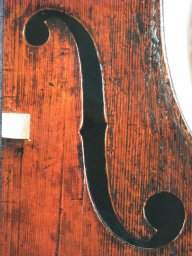
An easier way to check for bridge placement involves measuring the distance of the bridge feet from the f-holes. Of course there are asymmetrically placed f-holes... though that is somewhat unusual, and rather close to impossible on a Czech-Ease bass. Another contingent would be a crookedly glued in neck, which is all too common on older, much-repaired basses, but again, unlikely on that new-ish bass. So if the bridge is properly located, it should be simple enough to measure from the inner f-hole edges to the outer edges of the bridge feet and see if the distances are equal. Should be within 1mm or so of identical measures if all else is correct. If a greater distance, drop string tension somewhat and shift it, then adjust both adjusters to equal heights, then check the action under each string. On average it might be around 6mm to 9mm going from G to E, with about 1mm increase on each string. And you'll also want to check then that the distance from the centres of the E and G strings to the outer edges of the fingerboard are also matched. If off by 1mm or more, this also needs correcting. Of course checking this symmetry is pointless unless the bridge feet are first centred.

If the bridge proves not to be centred in both ways, then it could be that the bridge has been cut crookedly, such that one leg is shorter than the other. This is actually a 'trick' used to locate feet on centre when there is a crooked neck and the bassist for whatever reasons is not having the neck joint re-fitted. A crooked neck and a compensated bridge fitting result in less than optimal tension on the bridge, hence reduced efficiency of sound, but it's a compromise sometimes needed when there isn't time or money to re-do the neck joint. Anyway, this sort of checking is something you should be able to do before going to a luthier, provided you keep the soundpost in place while moving the bridge (if needed). A weight placed over the soundpost can help with this, before taking off string tension to move the bridge.

If after properly locating the bridge and adjuster heights (which really shouldn't ever be more than a turn or away from equal owing to the stresses this puts into the maple, increasing risk of splitting the legs, along with the aforementioned mis-fitting of the feet to the belly) it is found that the heights are wrong, then the most likely next step is reshaping the upper curve of the bridge and re-grooving it for the strings, then compensating for the carving by raising the adjusters. How much reshaping of the bridge top is safe/advisable to perform will vary according to your existing bridge, but from what I've seen of the Czech-Eaze basses there should be enough wood there. Just don't run out of adjuster range. Too high, (ie; more than 3/8" or so of adjuster thread showing) and there is greater risk of thread failure in the maple and other problems.
 
If an adjuster is bottomed out, you aren't getting any benefit from it. Both adjusters should be raised a minimum of 1/8th of an inch. You'll get more volume and low end response that way. If your bridge is centered, try raising both to about 3/8ths and see what happens to your buzz. (make sure to loosen your strings first) if you're unhappy with the string heights on the G side - take your bass back to the luthier and have your bridge reshaped.