

Enjoy the benefits of a premium membership!
Upgrade Account
-
TalkBass has been independent since 1998. Add your voice.
Create a free account to reply to discussions, view embedded media, and browse with fewer display ads.
Join free Log in
Want zero display ads or expanded classifieds tools? Compare plans.
You are using an out of date browser. It may not display this or other websites correctly.
You should upgrade or use an alternative browser.
You should upgrade or use an alternative browser.
How high is your action and what do you consider low action?
- Thread starter Kwesi
- Start date
More options
Who Replied?
Obviously we can't control for all variables. But measuring at 12th fret, top of fret to bottom of string, with string depressed at the first fret is a *relatively* standard and reliable way to measure action. I'm pretty sure that is how the Fender set up guide does it, as well as that Sadowsky article that someone referenced above. Anyway, no biggie -- obviously everyone can do his or her own thing -- I just thought it would be useful for people posting in this thread to make an effort to remove as many variables as possible.

So, around 3mm at the 12th fret measured from the fingerboard with jumbo frets.
That's still not going to be very useful. There aren't any manufacturers or luthiers I know of that measure action that way. It's always from the top of the frets to the bottom of the string. That's the only way to measure it usefully.

I am curious, why is it that so many folks measure action in inches? I'm not knocking it but the only reason I specified mm in the title thread is because I can actually visualize that in my head. I see a fraction and my brain doesn't know what to do with it, haha. But it seems like mm would be a much more precise way of measuring something so small, no?

I'm pretty sure that is how the Fender set up guide does it...
Fender's current procedure is no capo on the first fret and measure the action from the top of the 17th fret to the bottom of the string.
Fender's factory recommendations from 2.4-2.8mm bass side to 2.0 to 2.4mm treble side, depending on neck radius.
I would say anything lower than that could technically be considered a "low action".
I am curious, why is it that so many folks measure action in inches? I'm not knocking it but the only reason I specified mm in the title thread is because I can actually visualize that in my head. I see a fraction and my brain doesn't know what to do with it, haha. But it seems like mm would be a much more precise way of measuring something so small, no?
The machinsts rule I use is marked in 32nd's and 64th's both of which are smaller increments than a mm. So in short it allows you to be more precise.
I am curious, why is it that so many folks measure action in inches? I'm not knocking it but the only reason I specified mm in the title thread is because I can actually visualize that in my head. I see a fraction and my brain doesn't know what to do with it, haha. But it seems like mm would be a much more precise way of measuring something so small, no?
I measure in inches b/c I have a Stew-Mac action guage with inches.
Fender's current procedure is no capo on the first fret and measure the action from the top of the 17th fret to the bottom of the string.
Cool, happy to admit I was wrong about that. Anyway, again, I was just suggesting that for purposes of this thread everyone agree on one way to measure, but no big deal.
Cool, happy to admit I was wrong about that. Anyway, again, I was just suggesting that for purposes of this thread everyone agree on one way to measure, but no big deal.
Not trying to say you were wrong, sorry if it came off that way... just saying is all, and you're right it's no big deal.



Just out of curiosity, how many of us sight the body (to ensure it's parallel to our line of sight ie eliminate parallax) before taking the measurement?


Sorry guys/gals, I don't measure in mm. I only measure in 64ths or 100ths of an inch, but I'll do my best to get the conversion accurate.
So when I do an initial setup, (not custom to customer's request) I set everything up this way.
First I use a capo to clamp down the strings at the first fret. (I don't do this by sight because it is an imperfect way of making sure the proper relief is set) Then I finger the strings at the 12th fret and adjust the neck so that there is about .010" (.25mm) relief at the 6th or 7th fret. Then, when I feel the neck is set, and I have a baseline to work with, I'll start with the string measurements.
Measurements are taken with the open string and from the fret to the string. An initial measurement is taken at the 12th fret and strings are set at the following height.
B - 6/64 (2.38mm)
E - 5.5/64
A - 5/64 (1.98mm)
D - 4.5/64
G - 4/64 (1.59mm)
I don't have an exact conversion table, but those numbers are close.
Then I detail the string nut so that each string is measured at the 1st fret and the nut is filed so that each string is .022" (.55mm)above the fret. Once the nut is detailed, I go back and re-set all strings according according to the measurements above as a baseline, or to the customers taste. I'll add .5/64 for higher action or subtract .5/64 for lower action.
Personally I like lower actions. I currently play a 5r with a moses neck where the B string starts at 5/64 (1.98mm) down to 3/64 (1.19mm) on the G string. Another bass player sat in with us on Friday night and played my bass. After playing 2 songs he handed me the bass and said "man that thing plays itself".
It's all personal preference and right hand technique IMO. If I have a customer that likes to "dig in" more, I'll adjust the neck releif and add about .010" (.25mm) to allow for more string ocillation.
So when I do an initial setup, (not custom to customer's request) I set everything up this way.
First I use a capo to clamp down the strings at the first fret. (I don't do this by sight because it is an imperfect way of making sure the proper relief is set) Then I finger the strings at the 12th fret and adjust the neck so that there is about .010" (.25mm) relief at the 6th or 7th fret. Then, when I feel the neck is set, and I have a baseline to work with, I'll start with the string measurements.
Measurements are taken with the open string and from the fret to the string. An initial measurement is taken at the 12th fret and strings are set at the following height.
B - 6/64 (2.38mm)
E - 5.5/64
A - 5/64 (1.98mm)
D - 4.5/64
G - 4/64 (1.59mm)
I don't have an exact conversion table, but those numbers are close.
Then I detail the string nut so that each string is measured at the 1st fret and the nut is filed so that each string is .022" (.55mm)above the fret. Once the nut is detailed, I go back and re-set all strings according according to the measurements above as a baseline, or to the customers taste. I'll add .5/64 for higher action or subtract .5/64 for lower action.
Personally I like lower actions. I currently play a 5r with a moses neck where the B string starts at 5/64 (1.98mm) down to 3/64 (1.19mm) on the G string. Another bass player sat in with us on Friday night and played my bass. After playing 2 songs he handed me the bass and said "man that thing plays itself".
It's all personal preference and right hand technique IMO. If I have a customer that likes to "dig in" more, I'll adjust the neck releif and add about .010" (.25mm) to allow for more string ocillation.
The machinsts rule I use is marked in 32nd's and 64th's both of which are smaller increments than a mm. So in short it allows you to be more precise.
Ah, that makes sense, thanks. I always thought it had more to do with the US not wanting to give up the imperial measurement system
 . I literally cannot visualize fractions of less than an 8th of an inch because for as long as I can remember, once I went that small I was always using SI.
Just out of curiosity, how many of us sight the body (to ensure it's parallel to our line of sight ie eliminate parallax) before taking the measurement?
If your holding the bass in playing position (as you should be when taking the measurements), then I don't think parallax would be much of a problem. Your pretty well going to have to hold it parallel to your line of sight to see the ruler and get a good measurement.
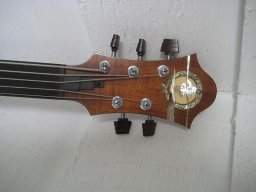
Most of my basses are set up with the bottom of the E about 2.4mm from the top of the 12th fret and the G at anywhere from 1.6 to 2mm. Low Bs are at around 3mm.
On fretless, I use the same measurements, but right to the board. I set the relief pretty flat - around .1 - .15mm measured between the top of the sixth fret and the sring while capoed at fret 1 and 13. Sometimes even less.
On fretless, I use the same measurements, but right to the board. I set the relief pretty flat - around .1 - .15mm measured between the top of the sixth fret and the sring while capoed at fret 1 and 13. Sometimes even less.
5/16ths at 12th fret is about home for me.
5/16?!? Really? You're a stronger man than I am!

My P-bass is equipped with .50 string set, when capo on the 1st fret, on the E string from the top of the 12th fret: 2.2 mm, G 1.8 mm. J-bass .45 set E 2.0 mm, G 1.5 mm.
The P has slightly more relief in the neck (TR is maxed out, maybe later I'll inser some washers or change to lighter gauges) and the 19th fret is a bit high, so (in theory) the action could be lower. But 0.2 mm is not significant, both basses are comfortable. Minimal fret buzz when playing hard, but when amped it cannot be heard.
The P has slightly more relief in the neck (TR is maxed out, maybe later I'll inser some washers or change to lighter gauges) and the 19th fret is a bit high, so (in theory) the action could be lower. But 0.2 mm is not significant, both basses are comfortable. Minimal fret buzz when playing hard, but when amped it cannot be heard.

Call me crazy, but aren't the measurements somewhat arbitrary given various techniques and thresholds for buzz? I've heard claims that there is a Fodera or two out there with 1mm at the 24th fret, but no clue how buzzy that is or if I could get it to sound clean with my medium-light technique.

5StringFool said:Fender's current procedure is no capo on the first fret and measure the action from the top of the 17th fret to the bottom of the string.
Fender's factory recommendations from 2.4-2.8mm bass side to 2.0 to 2.4mm treble side, depending on neck radius.
I would say anything lower than that could technically be considered a "low action".
My Jazz V needs to be about 3 to 3 1/2mm to keep my B string from buzzing. I would say that my attack is a bit harder than medium.
Latest posts
-

-

-
 Questions about added costs on selling used goods to Canada
- Latest: beaglesandbass
-

-
