BassHappy
Supporting Member

TalkBass has been independent since 1998. Add your voice.
Create a free account to reply to discussions, view embedded media, and browse with fewer display ads.
Join free Log in
Want zero display ads or expanded classifieds tools? Compare plans.

Thankyou. I see they ship abroad for only $72. I’d love one of those.It's a Wing bass. Here ya go...
Invalid Link Removed
Transparent green, with an Alder body so it is pretty light weight.Nice colour on that bass, what’s it called?
Wow, those Roscoe's are stunning as well.I found that because my #1 for over 20 years had 24 frets, I went up there quite a bit. It's the nature of the music I play. That means that on our tours I would have to have 24 frets to be sure I could duplicate and cover all the parts I created on the records over the years:
View attachment 3006812
The PRS became too valuable to take out of the house - so I retired it for stage use. My #1 and #2 stage basses became two identical Roscoe's that Keith made for me, both of course with 24 frets. Keith measured and duplicated the PRS neck precisely for me on the top bass - due to the birdseye maple top I call it "Birdy":
View attachment 3006796
With the buckeye burl top, I call the back-up "Bucky":
View attachment 3006800
Both basses have a built in midi out with a 13 pin jack to trigger the sounds I programmed in the VBass for "live" use, including very believable versions of upright and fretless sounds:
View attachment 3006808
This allows me to duplicate all the previously recorded sounds over really 40 years. The Roscoe's turned out to be very admirable replacements.
So yes, for my stage bass(es) it is absolutely critical for me to have 24 frets.
Wow, those Roscoe's are stunning as well.

He doesn't like those either! hahaha he's a purist.Ask him why do seven and eight string guitars that drop down into the bass range exist?
Why do baritone guitars exist?
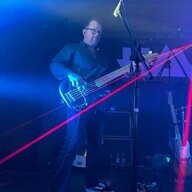
I play the full range of my instrument regularly. I’m often above the 12th fret, especially on the E and A strings, because the tone is fatter there. I also prefer to play low Bb to high D in the middle range of the neck versus the lower range for the same reason, and because I’m faster and more fluid there.When I read a large proportion of responses to this thread, I can see why there are also many threads about bass and bass players getting little, to no respect.
Being proud to use only a small potential of your instruments ability, and scope seems to feed that sort of low expectation attitude.




....or if you want to go higher using a 4 string you can play a 26 fret bass...IMO, if you can cover all your tunes with a 24 fret 4 string, why change?
And, if it's higher you want to go, with a 5 string, you can string it E-A-D-G-C.
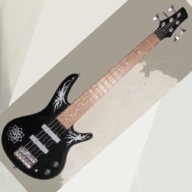

I downsized from a Yamaha 35” beadg w/24 frets to a standard Precision 4 string and 20 frets.
I do miss the range. 24 frets gives me a lot more comfortable chordal & solo options - perfect for certain gigs. Otherwise enjoying the simplicity of a regular 4 banger for now.
I have a 24 feet bass, and feel like I very much under-utilize that part of the neck. Maybe if I got super-into chording stuff. If I did go that direction, it would probably be time to get a 6-String and do it right.