• TalkBass has been independent since 1998. Add your voice.
    Create a free account to reply to discussions, view embedded media, and browse with fewer display ads.
    Join freeLog in
    Want zero display ads or expanded classifieds tools? Compare plans.

How long to adjust to a 5 string?

for me it was about 2 months of solid practice..I used it all the time practiced all the time with it...now I can't even imagine going back to a 4 string...I would like an Ibanez for doing slap but the band I'm in doesn't do any songs that require slap...I use the low B more to play higher up the neck...its way better in my opinion..made me a better bass player...
 
  • Like
Reactions: bumperbass
For me it's like going from one guitar with one neck profile and scale length to another.

The initial adaptation was all about technique on a 5 vs a 4 but once I got passed that it still takes a few minutes of warm ups just to get my head around a 5 string again and my hand positioning and technique adjusted to the wider neck. Probably 10-15 minutes or a couple of warm up tunes.
 
Thanks for all the replies. I'm going to:
Use ONLY the 5 until I get it down right.
I am going to do more practice standing up (and practice more than normal, BTW).
I am going to be more patient with myself.
Good plan.

Without going back through your thread, there are some technique things to assimilate in the process, mainly to keep the B string from ringing. Contrary to what a lot of TB’ers post, do not use the B string as a thumb rest. You need to learn a combination of floating your right hand thumb, meaning laid across the top of the B and E strings, and using your middle left hand finger, the longest, to mute the B string while you are playing the lines. Kind of like learning to drive a clutch. That makes the B string available as you learn to conceptualize the fingerboard and keeps the B string from ringing out when not being played.

If you commit to it, the concept will come around. Patience and persistence.
 
  • Like
Reactions: Fuzzbass
Late to the thread, probably adding redundant comments, but here goes anyway.

I played four string exclusively starting around 1975. Naturally, I felt the need for lower notes, and fairly quickly adopted the "D-Tuner", now the Hipshot Bass Xtender. It's a great device, I put them on all my four strings, learning how to transpose the low string, but it wasn't quite enough for my needs so in 2000 I finally decided to give 5-string bass a try.

Long story short, I now play 5-string exclusively; I no longer own any fours. I don't recommend abandoning four -- just sayin' that's how it worked out for me.

I was gigging on 5-string after a month, but it took me 2-3 months to get comfortable on it. One problem was knowing which string was which, another was keeping strings muted.

Here are a couple of things I did that helped:
  • I put my four strings aside and immersed myself in five string
  • Playing the same ol' songs on five string led to confusion. As it happens, I joined a new band in Y2K, and had to learn a whole bunch of new (for me) cover songs. I decided to do that on my five string. This helped me a lot: no "muscle memory" to throw me off; I was able to map them out fresh on my five string
  • I adopted "floating thumb" to mute the extra strings. I still can't say I've fully adopted it, but for some songs it's necessary
Once I became comfortable on five string, I realized all the advantages. It isn't just for the low notes (though it is great to do stuff like walk up to low E) -- it helps a lot even on songs on which I never travel below low E. I remapped numerous songs I'd played on four to take advantage of the additional range in each fingering position. That's basically why I decided to abandon four string, though again, I don't recommend that anyone else do that.

One final tip: don't be wary of the B string, or think of 5-string as "EADG plus one". Grok the entire instrument, keeping in mind that the B string is useful above the 5th fret, where it's in 4-string territory. Sure, you don't want to abuse those sub-E notes, but OTOH, don't be afraid to add them to classic/oldies tunes that don't go below low E -- sometimes they work beautifully.

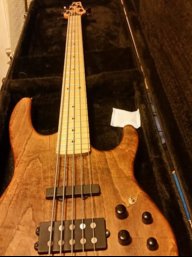
Floating thumb - frees up the hand once your used to it.
 
  • Like
Reactions: Fuzzbass
Been playing a 4 since the late 60's and now this new band I joined does 7-8 songs that would not cut it with a 4.

I've been learning a ton of tunes in the last three weeks, while at the same time trying to adjust to a 5.
I seem to be lost. when I look down at the fretboard, the notes do not register in my head.
The other day I was making notes for a few tunes. At one time I took my hand and covered up the B to my eye so my brain would lock on.

I've done 2 live shows so far with the 5. I've gotten embarrasiingly lost a few times. I have to stay on a strict track, it seems. I cannot take any chances in wandering around the fingerboard, fearing I'll get lost.
I'm also having trouble with left hand-right hand coordination, which means that sometimes I do not pluck the correct string. Othertimes, it's the other way around...I'll pluck the correct string but my fretting hand will be on the wrong string.

I bought a 5'er with 19mm string spacing, thinking it would be an easier transition from my PBass.

I'd guess I have 50-100 hours on the 5.

For those of you who have made the switch, how long did it take you to get comfortable, and
do you have any tips for an old rocker like me?

I have the gift of tenacity, but if the answer is simply "You have to keep doing it until it comes to you", I don't know if I have the time.
I'm wondering if it's worth it (literally.....how long will I be out there playing live?).
Is it worth the effort for a few more years of live playing?

First, just stop and take a breath. It's supposed to be fun. Then just start running your scales and let the fretboard come into your mind's eye and start messing around with the 4-string patterns and see how they expand on a 5-string. That B is just another 5.
 
There are no tunes that a 4 will not cut it on unless the object is play the exact notes on the record. D tuning for some songs makes sense buta 5 string is nothing but a pain in the ass.

Yes... But no. It's all what you're used to and it will vary for each individual. As a relative newcomer to 5ers I can tell you that even now I still have an occasional brain fart on 5 string but like that I don't have to change tuning to accommodate lower notes and find it fun to have them available from time to time. My 4 banger has a drop D, but it is so hard to remember when I've shifted into D and then remember that the note placement is different. So much easier just to play the B string because the notes are always in the same place. At some point I see myself even going to 6 string- but that's down the road after I become a full fledged bass player.
 
Yes... But no. It's all what you're used to and it will vary for each individual. As a relative newcomer to 5ers I can tell you that even now I still have an occasional brain fart on 5 string but like that I don't have to change tuning to accommodate lower notes and find it fun to have them available from time to time. My 4 banger has a drop D, but it is so hard to remember when I've shifted into D and then remember that the note placement is different. So much easier just to play the B string because the notes are always in the same place. At some point I see myself even going to 6 string- but that's down the road after I become a full fledged bass player.

6 strings are much fun. I went straight from a 4 to a 6... lol
 
20 years ago I would only play 4's bc they felt like home.
Now 5's feel like home.

You can't change my mind about Dennison's Chili vs Hormel, Sigs vs Glock, BMW vs Mercedes, Converse vs Nike, Popeye's vs KFC.

Some things are sacred.
 
On muting. IMO it's easier to adapt a 4 string technique to 5 string basses if you have an accurate style of playing. I'd make it a priority to focus on your right hand technique if you can overplay, get excited or regularly lose accuracy hitting more than one string when you are playing and then relying on muting to sort things out for you.

I move my thumb between the pickup, B string, E string or A string depending on the notes or line being played. I try to be as accurate as possible and not put more energy into plucking the strings than I need and I don't get any strings ringing behind the playing.

While you're tidying up your technique. . . never stretch your fingers or try to overreach. Your anchor points for both hands, your thumbs, should be constantly moving. Being placed in the correct position so your hand holds your fingers where they can play the next line without effort.
 
Has to be a four string. Its all pre-determined by numerology:

Guitar: six letters, 6 Strings

Banjo: five letters, 5 Strings

Mandolin: 8 strings

Twelve string: 12 strings

Bass: four letters- FOUR STRINGs

That pretty much cinches it.

Oh man! What a breath of fresh air this is compared to the standard "Jaco only needed 4 strings"!
 
Disagree... Your reference on a stringed instrument isn't visual. The reference string is always the first string, that's why it's called first.
There's nothing to disagree with. You reference is different than mine. That doesn't mean either of us do not know where we are and where we're going when we play.

You also contradicted yourself, as is indicated in bold type.
 
Think of a 5 or 6 string as the new instrument that it is. They aren’t 4 strings...

Exactly. So the way one "adjusts" to a 5 or 6 string bass is either to woodshed the daylights out of it just as you would if you decided to learn any other new instrument...OR... you can immediately sell it and go into all threads on TB saying you "tried a 5 once" an it was totally awful and it's clear nobody "needs" more than 4 strings.
 
  • Like
Reactions: tfer and chris_b
Exactly. So the way one "adjusts" to a 5 or 6 string bass is either to woodshed the daylights out of it just as you would if you decided to learn any other new instrument...OR... you can immediately sell it and go into all threads on TB saying you "tried a 5 once" an it was totally awful and it's clear nobody "needs" more than 4 strings.

Well you don't need more than 4 strings - the proof is in the pudding. Hundreds of thousands of recordings with 4 strings - before a 5 string even appeared. And great bass parts that would not have been heard on 60's recordings if they had been played on a five string. To play a few low notes - add 40lbs of GEAR - the wood shedding required is lifting the new amp - nope don't need that sort of work.
 
Well you don't need more than 4 strings - the proof is in the pudding....

... Except when you're playing a show or some arrangement and the arranger writes in low D's and C's.

Yeah... I know. You can install a Drop D. I did it. And it's just a pain to remember to shift and unshift into the Drop position and return to standard tuning. I didn't want to think that hard especially when I'm trying to stay with a conductor and keep singers in my head (cause they often have R.A.D.S.) yada yada. And that sent me on my journey for my first 5er. Heck, my Yamaha 605 is a full pound lighter than my 4 string jazz, and is super easy to get around on. I like my 4 a lot, but rarely pick it up any more. What's the point now that I'm used to 5ers?