• TalkBass has been independent since 1998. Add your voice.
    Create a free account to reply to discussions, view embedded media, and browse with fewer display ads.
    Join freeLog in
    Want zero display ads or expanded classifieds tools? Compare plans.

How long to adjust to a 5 string?

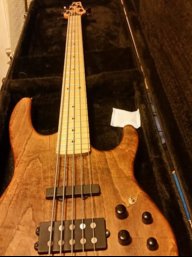
I got lucky or maybe my brain just works differently. The first time I played a 5 was an emergency sub. I knew the material and my sight reading was not bad also, but I would be late if I have to get my 4 string. And they only had a headless Steinberger closed spacing 5 string bass for me to use. Definitely different. I do think in notes and sing bass lines in my head instead of positions even to this day, so that helped. I also avoided the B for the first tunes except when an E flat and lower was needed but as the gig progressed , I would dip on the 5 and then it was easy. After that gig and a couple more, it took me 15 years to get a 5 Stingray and then a TRB-6, but I played them occasionally but never my own. I sold the 5 string in 2006 but getting one (Kiesel JB5) soon.
 
Oh good grief...

I go from my kid’s 3/4 size guitar to my 1 3/4 nut acoustics to my 1 11/16 electrics to my 4,5 and 6 string Basses with different string spacing all the time. It’s not that big of a deal guys...don’t over think it...

Brent... IF you go between instruments ALL THE TIME, yes it's no big deal. In my former symphony gig I used to have to go from C trumpet to piccolo or Eb or Bb or some other configuration of instrument, often within the same program with no time for warmup/orientation in that moment. IF you practice going between them then psycho-sensory adaptation takes hold and it takes but a second or two to adjust. But if you do not practice cycling between them, then it's like playing different instruments. No different on guitar and bass. IF you regularly go between instruments as I do it doesn't matter. But in my above illustration, NOT going between them in practice made it clumsy when it was time to go from one to the other. Obviously after a few minutes of practice the feel comes back to something you're familar with, just unpracticed with. But with a NEW instrument that may be a bit more foreign and not programmed for complete muscle memory it is a different ball game.

Overthink? You can't over-think something has hasn't yet been fully thunk.
 
I got lucky or maybe my brain just works differently. The first time I played a 5 was an emergency sub. I knew the material and my sight reading was not bad also, but I would be late if I have to get my 4 string. And they only had a headless Steinberger closed spacing 5 string bass for me to use. Definitely different. I do think in notes and sing bass lines in my head instead of positions even to this day, so that helped. I also avoided the B for the first tunes except when an E flat and lower was needed but as the gig progressed , I would dip on the 5 and then it was easy. After that gig and a couple more, it took me 15 years to get a 5 Stingray and then a TRB-6, but I played them occasionally but never my own. I sold the 5 string in 2006 but getting one (Kiesel JB5) soon.


This is normal. I also avoided the B string for the first 2 or 3 songs, then I started thinking 4+1. By the end of the gig it was normal.
 
I'm sorry, but I believe that those who think of their guitar strings in the above order are in the vast minority.

Couldn't disagree more. If your guitarist says "can you play your first string please?", which string do you play? Of course it's the G. Always been...

I own a (1972) Martin acoustic with a 1 11/16th" nut. I have a couple Taylors with a 1 3/4" nut. A few months back I was practicing exclusively with the Taylors for roughly a month. But when it came time to once again play the Martin, for a short while my fingers did not know where to land.

Sorry to hear. This is not common. Most people switch from guitar to acoustic guitar to fretted bass to fretless bass to mandolin with no problems whatsoever.
 
..

Sorry to hear. This is not common. Most people switch from guitar to acoustic guitar to fretted bass to fretless bass to mandolin with no problems whatsoever.

Yes... But with practice going between them. I do that myself and consciously cycle through my instruments in my practice sessions so that I can seamlessly transition. Without cycling practice, it takes longer to adapt. But to do this the brain has to be programmed for auto-response with a given instrument.
 
Yes... But with practice going between them.

Nope. Can you imagine you're in a session and the guy says "ok great, let's do the acoustic now" and you say "I need 30 minutes of practice". No such a thing in the real world.

I don't know what's your relationship with music or if you play for a living, semi-professionally or amateur, but this whole idea of extra time to adapt to minor things isn't a real thing in most environments. I mean, if you're a lawyer who plays Beatles songs in your garage with your friends while drinking some beer, I can totally see where you're coming from.
 
Just memorize the notes on the B string like you did on the other four. Your only adding five notes to your bass. They are all located between the open B and the 5th fret on the B string. You’re not incapable of learning those new notes..... you learned all the rest. Just focus on the notes you’ve added and memorize their names and where they are. It’s still tunes in 4ths and the bass you’ve been playing for 59 years is still there. Just had 5 lower notes added.
 
  • Like
Reactions: lowdownthump
I will add.....
When I am playing a song, especially when I'm with a band, I am not thinking NOTES. I am playing position. If I feel the need to stray a bit and add my touches to a song further up the neck especially, it's premeditated. That's when I think of notes, but it's instantaneous.
If I am adding small touches to a song, I instinctively know where I am going and how it's going to blend In.
 
  • Like
Reactions: lowdownthump