• TalkBass has been independent since 1998. Add your voice.
    Create a free account to reply to discussions, view embedded media, and browse with fewer display ads.
    Join freeLog in
    Want zero display ads or expanded classifieds tools? Compare plans.

How many basses do you ACTUALLY use?

Do you rotate gigging basses?

  • Oh yeah!

    Votes: 282 54.2%
  • Never, can't change the tone

    Votes: 49 9.4%
  • No one cares what the bass player does

    Votes: 189 36.3%

  • Total voters
    520
I disagree. Different basses have different tones, sure, but you're right that we can get around that. But different basses also have different numbers of frets (including none), different numbers of strings, different fretboard radiuses, and so on. They play differently. Some things are more easily or just better done on one instrument than another.
Yes but the things that you mentioned are all semantics. You can still do the job with one great instrument and a good rig to go with it. Here's a test: listen to any 50 recordings from the last 50 years and then tell me what basses were played on those recordings. See my point? A lot of the issues that musicians put into play about there sound and their playing are more psychological than anything about else. If you need extra girth you can use a 5 string. Equalization is the key.
 
  • Like
Reactions: TH63
I disagree. Different basses have different tones, sure, but you're right that we can get around that. But different basses also have different numbers of frets (including none), different numbers of strings, different fretboard radiuses, and so on. They play differently. Some things are more easily or just better done on one instrument than another.
Also, regarding what you said about the different feels and things of different basses, consider finding a bass that is great for you. One that feels great, looks great and plays great, then you'll only need that one with the EQ options you have at hand.
 
When I made my album, I used, I think, five different basses. I agree that probably no one would notice the difference, perhaps even if they were listening for it. But my point was that the basses felt different to me, and the bass lines were easier for me to play on one bas than on another. Soundwise, the results might have been the same, but I'm not sure that my playing would have been. Certainly, if I had to, I could use just one bass. That's all I really need, and I expect that's true for all of us, protestations to the contrary notwithstanding. Still, sometimes one tool is better for the job than another, even if the other could get the job done.
 
... different numbers of frets (including none), different numbers of strings, different fretboard radiuses, and so on.

Yes but the things that you mentioned are all semantics.
“Semantics”? Not by any definition or context I’ve encountered. Those (and others) are all physical attributes that affect how the musician interacts with his instrument. The better the player the more that nuance plays a part.
 
  • Like
Reactions: Gooney
I use maybe two basses, a cheapo Chinese P style bass and a Fender 60s' jazz bass. Honestly I just use the jazz bass, because I don't feel like using supreme force just to get the Chinese bass to ring for 2 seconds (has a bad bow in it).
 
I have one bass, my Carvin B5 that goes out with me probably 80% of the time. I have a Carvin LB75 that goes out the rest of the time. Most times both go, but we do a few songs in D standard tuning now so I have to take a bass for that now too. That bass will stay the same.

For playing around at the house, I have all of my basses on wall hangers so any of those are fair game at any time and I try to rotate through them each time I sit down to play.

BnB
 
“Semantics”? Not by any definition or context I’ve encountered. Those (and others) are all physical attributes that affect how the musician interacts with his instrument. The better the player the more that nuance plays a part.
Okay, I think you're missing my original point. Assuming that you've already found an excellent instrument you're happy with on all the points that you mentioned, then I would say as I did originally, EQ is the answer to all the other problems.
 
Okay, I think you're missing my original point. Assuming that you've already found an excellent instrument you're happy with on all the points that you mentioned, then I would say as I did originally, EQ is the answer to all the other problems.

How do I remove my frets with an EQ? How would I add harmonics and overtones with an EQ if they weren't picked up? How can an EQ increase dynamic range?

Guitars and basses sound different. EQ can help, but it just doesn't make a Fender Jazz sound like a MM Stingray or vise-versa.
 
How do I remove my frets with an EQ? How would I add harmonics and overtones with an EQ if they weren't picked up? How can an EQ increase dynamic range?

Guitars and basses sound different. EQ can help, but it just doesn't make a Fender Jazz sound like a MM Stingray or vise-versa.
Actually, EQ can make one bass sound like another. sound is frequencies. If you know how to adjust those frequencies you can get ANY sound your looking for. Granted, this is assuming that you already own an instrument that you are completely happy with meaning not needing fretwork or any such thing. That's as clearly as I can State my point. Good luck in your endeavors.
 
  • Like
Reactions: jim kane
Actually, EQ can make one bass sound like another. sound is frequencies. If you know how to adjust those frequencies you can get ANY sound your looking for.
For some reason you are fixated on frequency and equalization. Sound is much more than pitch (“frequency”) and a means to adjust the relative amplitude of pitches through an audio band (“equalization”). Until you gather more understanding of sound you are going to persist in sounding naive. Learning about timbre would be valuable.
 
  • Like
Reactions: Gooney
For some reason you are fixated on frequency and equalization. Sound is much more than pitch (“frequency”) and a means to adjust the relative amplitude of pitches through an audio band (“equalization”). Until you gather more understanding of sound you are going to persist in sounding naive. Learning about timbre would be valuable.
Okay I see you're in the mood to be salty but I am not . Happy trails.
 
4 basses that I use, 2 that I have gigged with. My #1 is a Franklin Fretless fender p-bass. It has a really good feel, and just plain looks cool and when I add some fuzz to it, you might not even know that I'm playing a fretless. Next is a Music Man fretless (there's a pattern here, you'll see!), which has active pick-ups, and can really cut through. I tend to use it in drop D situations a lot. These are the two that I have gigged with.

After that, my latest that is quickly gaining steam, is my first 5 string, a Ken Smith custom fretless. I am getting used to all the muting technique that comes with extra strings, and am gaining confidence for a live debut. And finally, a 4-string Supro short-scale fretless, that can sound really punchy with the piezo pick-up turned on.

So, all 4 do get used. And no, I am not obsessed with fretless, why do you ask?
 
  • Like
Reactions: ed morgan
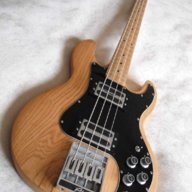
Fender American Professional and a Sterling SUB bass. I use both for gigs and practice; the p bass sounds best (by far) but the SUB, a bargain if there ever was one, has a more playable neck and is comfortable and light. I also own a 1981 Peavey T-40 (in EC) but I rarely use it.
 
Last edited:
  • Like
Reactions: cbbassman51
Reflecting back on the last 3 weeks...I played a jazz quartet gig, a mostly Motown gig and a straight up rock gig. While I try to not change basses during the set (too much time between songs, tuning, etc.) I do like to tailor the bass to the job. While I always take a second bass (on stage in case something goes wrong) on the jazz gig I played an SX P/J (cheap but incredibly effective) fretless with nylon wound flats. On the Motown gig it had to be my trusty MIA Fender P bass and the rock gig was the Schecter stiletto diamond series (18 volts of house rocking pleasure). I search out and buy basses based on anticipated need and while I love each of them dearly, they really are just another tool in the box. Snapper
 
  • Like
Reactions: cbbassman51