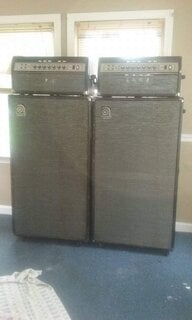
Right now I have a 10w practice amp.
And I was just wondering how much better your bass sounds depending on how many watts a bass amp has.
And yes I know most of the great tone etc. come from the fingers.
Also any amps in a $200 range that you recommend?
And 1 other thing what is the difference between amps that have heads? (I think that's what they're called.)
WOW...loaded questions there Aiden.
Yes a more powerful amp is going to give you better sound up to a point. Beyond that point, as long as you have cabs that will take you to the volume level you want, it doesn't make much if any difference. Then it depends more upon the amp designer and how he designed it to sound. Thus you have different sounds from different brands of amps and cabs.
10-watts is bedroom practice combo at best, but I started out by leaning the back of my bass against a closet door in 1965, and using that as a soundboard. It beat putting my ear against the body of the bass to hear it! The first amp I got was a giggable amp (1966 Fender Bassman) in 1966, which, at the time, was usable both indoors and out. I'd recommend that you save up for a bit and do the same thing - get something you can play in a group as your first amp purchase. I had to replace it when I started touring in 1971 because guitars and keys went to 120-watt amps.
I like to recommend a 210 cabinet (has two 10" speakers) or a 210 or 115combo if you must, with at least a 300-watt amp like the
Eden E-300. Better yet, get a 500-watt amp. Usually these amps have a minimum ohm rating of 4 ohms. Don't go below that or you can damage the amp. If you buy 8 ohm cabinets, then you can add a second cab at a later date because two 8 ohm cabs with a parallel connection (industry standard) results in a 4 ohm load. Typically, an 8 ohm cab will get about 1/2 the power (often a bit more) that the amp can deliver at 4 ohms. So a 500 watt amp will deliver between 250 and perhaps 300-watt rms into one cab. That's enough to make most single cabs loud enough gig with at small and medium venues.
When you start playing larger venues or outside, you will need to add another cab. If you add another 8 ohm 210 cab (or another 115 cab) to the first one, then your 500-watt amp can put out all 500-watts, which will be 250- watts to each cab and you will effectively have a 410, which you should be able to use almost anywhere. At that point the only thing you might want to do is get better versions of the same size cab for a better sound. But you won't be under pressure to do so quickly, because you'll already have a set-up that works.
I gigged with a 410+115 cab set up for years before I bought the DNS-410 that I thought would be my last cab purchase ever. It's cleaner, clearer, fuller, has a better bottom end and is far Louder than that 2-cab stack was. The stack isn't even in the same league as my one 410 cab. But it was NOT cheap. I bought mine for $999 in 2015 and now you can sometimes find them for $1,049. But you don't need that level now. If money was no problem I'd say go for it, but your just starting out with a very limited budget, so you're not at this level yet.
Two things will give you a louder set up. More amp, or more cabs. It's usually less expensive to get more cabs. You have to double your power to gain 3db improvement. 3db is technically twice as loud, BUT the human ear doesn't recognize "twice as loud" until you get a 10db increase. Doubling your speaker area (add a second 210 to the first one) will also give you a 3db increase in Sound Pressure Level (SPL - commonly thought of as volume). So if you double your power and double the speaker area you'll get a 6db increase in sound.
Cabs are less expensive than amps that are twice as powerful, so you really want to start out with something that will be usable right away and not have to do both - buy a more powerful amp and a new cab. 400-watts rms is OK, 500-watts is better, and 800-watts is probably the most you'll need in the foreseeable future. When comparing "watts" make sure you are comparing the "rms" wattage rating. Some manufacturers refer to their amps with "peak power" or "Instantaneous Peak Power" or two or three other terms. Those are all marketing attempts to make their amp sound more powerful than it is. Fender calls Peak Power "Program Power" and their "Continuous Power" is the rms rating.
An "RMS" wattage rating is "Root Mean Square" and is the amount of power that the amp can put on on a continuous basis. It will put out momentary or short duration peaks of power of twice that rating which is known as "peak power". That is why marketing departments of some companies like to tout their amp's Peak Power rating - it's twice as much as what it can normally produce and a 500-watt "peak power" amp sounds a lot more powerful than a 250-watt rms amp when in actuality they have the same amount of power. So if you don't see "rms" watts, did a little deeper to see what rating they are actually using.
Now, about separate head and cab or a combo. Combo is easy because it's all in one piece. You move one and you've moved both the amp and the cab. The problem with them is they are difficult and can be very expensive to upgrade.
Most combos include 8 ohm speaker(s) in the combo. That means the amp will only deliver about have the power rating because 8 ohms will only allow about 1/2 the power through that connection (think one lane in a two lane road). Add a second 8 ohm cabinet and it's like opening up a second lane in each direction and the amp can put through all it's power because it has about twice as much ability to move the power. Eden's E-series combos don't do that. They use 4 ohm loads internally so you get all the power out of the amp. If you plug in an extension speaker, it will disconnect the internal speaker so you don't hurt the amp. Only getting a 410 makes sense with this way doing it.
Let's look at the Fender Rumble series combos to start. All but the 100 will handle 4 ohms and the internal speakers generate an 8 ohm load. They are comparatively inexpensive, they look good, and they sound good. They can also be found used for about 1/2 the price of new. They aren't as tough as some, so you do have to be careful buying used, but that's with any used gear.
Fender makes 100-watt, 200-watt, and 500-watt combos. You can do small venues with the 100 watt and medium venues with 200-watt if the band isn't too loud and you can do medium venues with the 500-watt one with a fairly loud band. You'll need to add a second cab if you want to play larger venues or if the band has loud guitar or keyboard players. 100-watts is a lot of watts for a guitar and you'll need most of 400 or 500-watts to keep up with that on a bass.
The 100-watt combo doesn't have an "extension speaker" option so you can't upgrade it; you'd have to buy a whole new combo or new amp and cab(s). It will put out 100-watts into 8 ohms. Good for small venues, and duos, accompanying acoustic instruments, but not a loud band or a medium size venue.
The Rumble 200 will put out 140-watts into its 8 ohms 12" speaker or 200-watts into 4 ohms (ideally a second 12" speaker). Adding a second 8 ohm cab will send 100-watts to each cab. That's just a little more power than the 100-watt, but then it's like having two of the 100-watt ones when you just add a second cab. You can do medium size venues with an extension speaker if the band isn't too loud. Nothing you can really do to it to play with a loud band or in a large venue without a FOH system at the venue.
The Rumble 500 will put out 350-watts into its 8 ohm 2x10" internal speakers or 500-watts into 4 ohms (ideally a second 210 cab). That 210 combo is fine for small and most medium venues, but you'll want to add a second speaker cab for large venues and some "almost" large venues. If you HAVE to go with a combo, in my opinion, this Rumble 500 is a good choice as long as you are happy with the sound you get from your Fender gear. Problem is you don't have any other options if you want to try a different brand without buying a new amp and probably at least one new cab.
So I am very much in favor of getting a head and a cab separately. It's much easier to move up bit by bit if you have separates instead of a combo.
Personally I've worked my way up to an 800-watt rms Eden amp (WT500/800) and two DNS cabs (by DNA). Although I could, I don't need to use both cabs at once. I'll use my DNS-210 for indoor venues and my DNS-410 for outdoor venues and festivals. But it took me a long time to work my way up to that level of gear. Street price on the DNS-410 is ~$1,049 and the DNS-210 from about $869 to $949. I bought all of my gear from money I earned playing gigs. Occasionally you can find them used for about 1/3 less or so.
you can see my gear here:
Rip Van Dan's Gear
And I just gave you way too much info didn't I? Sorry 'bout that...