
I got a fender jazz bass requires me to take the neck off to tighten the truss rod. I've already had to fill the holes once with toothpicks and super glue. Seems like just about every time I change my strings I have to tighten the truss rod to get the action back to where it should be. Am I wrong? Thank you in advance

Enjoy the benefits of a premium membership!
Upgrade Account
-
TalkBass has been independent since 1998. Add your voice.
Create a free account to reply to discussions, view embedded media, and browse with fewer display ads.
Join free Log in
Want zero display ads or expanded classifieds tools? Compare plans.
You are using an out of date browser. It may not display this or other websites correctly.
You should upgrade or use an alternative browser.
You should upgrade or use an alternative browser.
How often do you tighten your truss rod
- Thread starter bump9987
- Start date
More options
Who Replied?
- Oct 7, 2000
- 18,619
- 38,941
- Disclosures
- Endorsing artist: Musicman basses
A few things...
1st and most importantly - I know a bunch of old Fenders and reissues had necks that had be taken off to adjust, BUT...
When I bought my late 90s P Deluxe, it had the carved pickguard where you could see the truss rod where the neck met the body. There was just no way for me to get at it without removing the neck. I called Fender tech support and was told by an idiot there that I did indeed have to remove the neck to adjust it. A month later a GC tech handed me a T-allen wrench, and laughed. I'm assuming you know what you're doing, but I didn't , so I'm putting this out there. You may very well have to take your neck off, but just in case.
2nd - I really only adjust my neck when I change strings, or if I haven't played a bass in a while and its either buzzing or the action got too high. Its different with different basses. Warwicks for some reason have necks that I think are made of cement. They're the only basses I really don't have to mess with. Wenge is the best IMO, though I have one with a different neck (don't know what it is) and its the same. They're just rock solid.
3rd - I forgot, cuz I spent so much time writing the above.
Hope that helps some.
[edit] Remembered! What are you jamming with toothpicks? The neck screws?
1st and most importantly - I know a bunch of old Fenders and reissues had necks that had be taken off to adjust, BUT...
When I bought my late 90s P Deluxe, it had the carved pickguard where you could see the truss rod where the neck met the body. There was just no way for me to get at it without removing the neck. I called Fender tech support and was told by an idiot there that I did indeed have to remove the neck to adjust it. A month later a GC tech handed me a T-allen wrench, and laughed. I'm assuming you know what you're doing, but I didn't
, so I'm putting this out there. You may very well have to take your neck off, but just in case.2nd - I really only adjust my neck when I change strings, or if I haven't played a bass in a while and its either buzzing or the action got too high. Its different with different basses. Warwicks for some reason have necks that I think are made of cement. They're the only basses I really don't have to mess with. Wenge is the best IMO, though I have one with a different neck (don't know what it is) and its the same. They're just rock solid.
3rd - I forgot, cuz I spent so much time writing the above.
Hope that helps some.
[edit] Remembered! What are you jamming with toothpicks? The neck screws?
So, first of all, lemme preface this by saying I'm not a 7ender owner, I've never owned one, I don't plan on ever owning one so I have ZERO experience adjusting those truss rods with the heel adjust.
That being said, there's lots of talk about this on the interwebs and even here on TB. You are correct that the "typical" method is...take the neck off, which is creating problems with the screw holes like you mentioned. I've heard of some guys just loosening the neck screws enough to be able to get in there with a short L shaped allen wrench and not actually taking the neck fully off. I'm not sure that totally fixes the problem, but it may slow it.
And yes, you are also correct in that some instruments will need a truss rod adjustment every time you change strings. It all comes down to the string gauge, tension, tuning and stability of said instrument neck. All of those things can create a situation where the truss rod needs adjusted more regularly. Throw in seasonal weather fluctuations and you have yet another ingredient that factors in too.
So what can you do about it?
Options range from trying methods such as not removing the neck fully as stated above, to selling that thing and buying a different instrument on the extreme side (maybe one with a headstock adjust) or possibly fitting one of those wheel adjusters to the end of your truss rod (which may take some modifications to the body to do).
That being said, there's lots of talk about this on the interwebs and even here on TB. You are correct that the "typical" method is...take the neck off, which is creating problems with the screw holes like you mentioned. I've heard of some guys just loosening the neck screws enough to be able to get in there with a short L shaped allen wrench and not actually taking the neck fully off. I'm not sure that totally fixes the problem, but it may slow it.
And yes, you are also correct in that some instruments will need a truss rod adjustment every time you change strings. It all comes down to the string gauge, tension, tuning and stability of said instrument neck. All of those things can create a situation where the truss rod needs adjusted more regularly. Throw in seasonal weather fluctuations and you have yet another ingredient that factors in too.
So what can you do about it?
Options range from trying methods such as not removing the neck fully as stated above, to selling that thing and buying a different instrument on the extreme side (maybe one with a headstock adjust) or possibly fitting one of those wheel adjusters to the end of your truss rod (which may take some modifications to the body to do).


3-4 times a year depending on how radically my environment changes.

If you don't already have a truss rod access route in the body and pickguard and don't want to route one then your options are to partially remove the neck by loosening the strings, loosening the neck screws enough to tilt the neck up and get to the truss rod adjusting nut then reattach. If you do need to remove the neck completely then, when starting the screws, turn them backwards until you feel the screw drop into the existing threads in the wood then tighten them up. That will help keep the screws from cutting new threads every time you thread them in.

If you get used to having your action a bit higher, frequent adjustments are less necessary.
Last week, I adjusted the truss rod on one of my basses for the first time in about 11 years, and that's only because I lowered the action and changed string gauges.
Last week, I adjusted the truss rod on one of my basses for the first time in about 11 years, and that's only because I lowered the action and changed string gauges.
Generally only once, or at least only once in a row. If you need to keep tightening the truss rod without ever loosening it then it isn't working correctly.

I think once in 9 years for the one that even has a truss rod.
Of course, it's had the same set of tapes on it for 8.99 of those 9 years (or is that 9.24 of 9.25?) and probably will for the next 20 or 30, since tapes are basically immortal. And it has an access channel since it's a Yamaha.
If you are chewing up your neck screw threads in the wood, you may not have "The Screw Trick" in your bag of tricks - for any screw, but especially a screw into something much softer than itself, always backturn until you feel the thread drop into the thread in the wood (or other softer material) so that you follow the original threads, rather than cutting new ones. If you're not sure you felt it, backturn another turn and feel for it again. It's pretty obvious if you pay attention.
You can fit or have fitted metal thread inserts, but by using "The Screw Trick" you can delay that a loooong time.
And @Jeff Siddall is correct - if you are always only tightening, something is very wrong in truss-rod-land.
Of course, it's had the same set of tapes on it for 8.99 of those 9 years (or is that 9.24 of 9.25?) and probably will for the next 20 or 30, since tapes are basically immortal. And it has an access channel since it's a Yamaha.
If you are chewing up your neck screw threads in the wood, you may not have "The Screw Trick" in your bag of tricks - for any screw, but especially a screw into something much softer than itself, always backturn until you feel the thread drop into the thread in the wood (or other softer material) so that you follow the original threads, rather than cutting new ones. If you're not sure you felt it, backturn another turn and feel for it again. It's pretty obvious if you pay attention.
You can fit or have fitted metal thread inserts, but by using "The Screw Trick" you can delay that a loooong time.
And @Jeff Siddall is correct - if you are always only tightening, something is very wrong in truss-rod-land.
Last edited:

I adjust truss rod just couple of times when I get bas guitar, to find ideal setup. After that, almost never. But I have favourite string type and thickness and never venture. As for weather changes, usualy raising or lowering strings at the bridge is enough.

I adjust the truss rod on all my basses twice a year - once in the spring, and once in the fall. I setup my action so my basses are on the threshold of fret buzz. In other words, if I dig in, I get a bit of fret buzz.
I live in Canada, so when the furnace kicks in, I adjust the truss rod. In the spring, when the a/c kicks in, I adjust the truss rod the other way. Usually it's less than a quarter turn.
My Geddy should have the neck removed to adjust the truss rod, but I modified the body so I don't have to remove the neck. I took a Demel and cut out a little channel in the body just below where the neck joins the body so I can access the truss rod. I then cut out a small channel in the pickguard, so now the truss rod is accessible without removing the neck.
I live in Canada, so when the furnace kicks in, I adjust the truss rod. In the spring, when the a/c kicks in, I adjust the truss rod the other way. Usually it's less than a quarter turn.
My Geddy should have the neck removed to adjust the truss rod, but I modified the body so I don't have to remove the neck. I took a Demel and cut out a little channel in the body just below where the neck joins the body so I can access the truss rod. I then cut out a small channel in the pickguard, so now the truss rod is accessible without removing the neck.

Why Fender doesn't have an access slot for basses with a heel adjust is a mystery. Well, no it's not. The Purists would have kittens if they did that.
On my Fbass I have had to adjust it once in 10 years; two years ago after a string change and I suspect the set of stings I had were somehow "off". Always use Fbass branded supersteps. Played them for a few months, then changed again (new strings, same make) and the difference was noticeable (which confirmed my suspicious that it was a "bad set". Reversed the change I made to the truss rod. Good to go.
Sadowsky, one adjustment since 2013. I live in Vancouver. No idea why I am lucky in this regard...I have heard there are people making seasonal adjustments.
Sadowsky, one adjustment since 2013. I live in Vancouver. No idea why I am lucky in this regard...I have heard there are people making seasonal adjustments.


In the late Spring/early Summer when the humidity goes up (Detroit), I loosen the truss rod on my StingRay 5 because the neck absorbs the humidity and "swells" just enough to decrease the height of my strings action. In the late Fall/early Winter when the air is drier, I will tighten the truss rod because the low humidity "dries out" the neck just enough to increase the height of my string action. Once humidity levels stabilize for the seasons, I never have to adjust the truss rod. FYI, the back of the neck on my Ray is unfinished which makes it more susceptible to humidity changes.
Some bassists will adjust for weather changes by adjusting the string height at the bridge, but that does not account for changes in the "bow" of the neck. I used to do that before learning to just adjust the truss rod and noticed that I would have problems with fret buzz and ended up adjusting the truss rod anyway.
The great thing about Rays is that the truss rod is so easily accessible and so easily adjustable that loosening or tightening is never a problem.
Some bassists will adjust for weather changes by adjusting the string height at the bridge, but that does not account for changes in the "bow" of the neck. I used to do that before learning to just adjust the truss rod and noticed that I would have problems with fret buzz and ended up adjusting the truss rod anyway.
The great thing about Rays is that the truss rod is so easily accessible and so easily adjustable that loosening or tightening is never a problem.
Last edited:
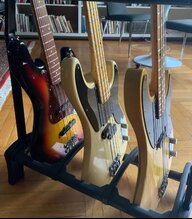
When I get a buzz. But I don't need to take the neck off any of my Fenders to adjust the truss rod.I got a fender jazz bass requires me to take the neck off to tighten the truss rod. I've already had to fill the holes once with toothpicks and super glue. Seems like just about every time I change my strings I have to tighten the truss rod to get the action back to where it should be. Am I wrong? Thank you in advance
Which model Fender Jazz Bass do you have?

If you have to tighten it every time, it's probably best to move it along.

Do you remove the strings all at once and replace all at once or do you change them out one at a time? One at a time, starting with the highest/lightest string, doesn't affect the neck relief as much as taking them all off and replacing them all at once.
On my 6 string Ibanez with a 5 piece wenge and bubinga neck, once in 24 years.
My jazz bass, maybe once a year, with super low action
My sire Fretless with really really low action, once every spring and again late fall
My jazz bass, maybe once a year, with super low action
My sire Fretless with really really low action, once every spring and again late fall
Latest posts
-

-
 Misled by Talkbass Seller on Recent Trade
- Latest: Bryan R. Tyler
-

-
-
