• TalkBass has been independent since 1998. Add your voice.
    Create a free account to reply to discussions, view embedded media, and browse with fewer display ads.
    Join freeLog in
    Want zero display ads or expanded classifieds tools? Compare plans.

How should I annotate 2 rests in a row

How should I annoate this ...

  • Picture 1

    Votes: 30 43.5%
  • Picture 2

    Votes: 26 37.7%
  • Picture 3

    Votes: 2 2.9%
  • Other..

    Votes: 11 15.9%

  • Total voters
    69
My understanding is that its considered bad form to put 2 rests back to back,( I may be wrong on this, won't be the first time) however I also hear varying opinions on using staccato for timing purposes. I assume making it a half note rest might make it harder to read (picture 3) Picture 2 is cleaner to me, Picture 1 clearly gets the point across. Since I don't sight read they all work for me. Thanks for voting ...

Picture 1
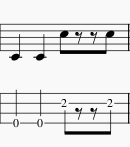
upload_2023-3-14_9-32-19.png


Picture 2
upload_2023-3-14_9-33-56.png


Picture 3
upload_2023-3-14_9-37-15.png
 
  • Like
Reactions: skycruiser
I don't know what is "correct", but I think #2 might convey what I would want to take away. 3 quarter notes together as a phrase, the 3rd one staccato, then an eighth note pick-up note into the next measure. But it's hard to say for sure without seeing what comes before and after. I don't like the look of #1 and #3 at all, especially if that last note is a pick-up note. It should be separated from the other notes, as it is in #2.
 
I don't know what is "correct", but I think #2 might convey what I would want to take away. 3 quarter notes together as a phrase, the 3rd one staccato, then an eighth note pick-up note into the next measure. But it's hard to say for sure without seeing what comes before and after. I don't like the look of #1 and #3 at all, especially if that last note is a pick-up note. It should be separated from the other notes, as it is in #2.

I'll leave my thoughts out for now

But to set the context
upload_2023-3-14_10-0-6.png
 

Attachments

  • upload_2023-3-14_9-58-28.png
    upload_2023-3-14_9-58-28.png
    9.7 KB · Views: 36
Your picture 1 and 2 in your original post are both acceptable, but don't necessarily convey the same thing. (I agree with you that there are varying opinions on how to interpret staccato markings.) That said, in some contexts, there may be no practical difference in the way they're interpreted and I would generally prefer to see #2. In fact, I played a show last month where I rewrote a chart to change extensive use of eighth notes/rests to staccato quarter notes for ease of reading.

Your picture 3 is wrong--don't use a quarter rest for a rest that starts on an upbeat.

I'll leave my thoughts out for now

But to set the context
View attachment 4998864

In your measure 26, you can use a quarter note on the upbeat of one, not tied eighth notes (and that would be my strong preference).
 
When would it be considered fine?
Well, in the very example you gave, for one.

Another example might be in grouping beats to avoid crossing the midline in a particular measure. Suppose you have a 4/4 measure that contains four 16th notes on beat 1, nothing on beats 2 and 3, and another four 16th notes on beat 4. I would use quarter note rests on beats 2 and 3 rather than a half note rest to cover both beats.
 
They are ALL correct, but different.

The note durations of A/C and B are different. In A and C, you are noting an 8th note. In B you are notating a quarter note. The durations of those notes are obviously different. You have the quarter note depicted as staccato, but a staccato quarter note should not be there to demonstrate an 8th note if that is in fact the duration of the note you require. So off the bat - Example B is out

Between examples A and C - It is normally not a good practice for rests to "cross the beat" with the exception of whole, dotted half, or half note rests. Example C does this.

There for A is your best notation example.
 
They are ALL correct, but different.

The note durations of A/C and B are different. In A and C, you are noting an 8th note. In B you are notating a quarter note. The durations of those notes are obviously different. You have the quarter note depicted as staccato, but a staccato quarter note should not be there to demonstrate an 8th note if that is in fact the duration of the note you require. So off the bat - Example B is out

Between examples A and C - It is normally not a good practice for rests to "cross the beat" with the exception of whole, dotted half, or half note rests. Example C does this.

There for A is your best notation example.

We would probably need to hear the music to see if it sounds like a staccato quarter or eighth note is more appropriate. If those 3 quarters form a phrase I think I would prefer the staccato quarter over the eighth note.
 
  • Like
Reactions: pmatz2
Between examples A and C - It is normally not a good practice for rests to "cross the beat" with the exception of whole, dotted half, or half note rests. Example C does this.

The general rule is that you need to show the beat that is two rhythm markings greater than the smallest rhythmic value in the measure. Since the smallest rhythmic value in that measure is an eighth note, you need to show the half note in that measure (i.e., the break in the middle of the measure), but you don't need to show the division between beats three and four, and a quarter note there is fine. However, it's bad practice to use a quarter rest on an upbeat. Thus:

upload_2023-3-14_13-55-59.png


If the smallest rhythmic value were a 1/16 note, you'd then need to show quarter note divisions and you would need to show the division between beats 3 and 4. So, for example, if there were 16th notes at the end of the measure in question, then you would need to break up the quarter note on the upbeat of 3 into two eighth notes to show the beats:

upload_2023-3-14_14-11-59.png
 
The general rule is that you need to show the beat that is two rhythm markings greater than the smallest rhythmic value in the measure. Since the smallest rhythmic value in that measure is an eighth note, you need to show the half note in that measure (i.e., the break in the middle of the measure), but you don't need to show the division between beats three and four, and a quarter note there is fine. However, it's bad practice to use a quarter rest on an upbeat. Thus:

View attachment 4999001

If the smallest rhythmic value were a 1/16 note, you'd then need to show quarter note divisions and you would need to show the division between beats 3 and 4. So, for example, if there were 16th notes at the end of the measure in question, then you would need to break up the quarter note on the upbeat of 3 into two eighth notes to show the beats:

View attachment 4999015
Thank you Sir !!
 
We would probably need to hear the music to see if it sounds like a staccato quarter or eighth note is more appropriate. If those 3 quarters form a phrase I think I would prefer the staccato quarter over the eighth note.

It's up to the composer, not the listener to decide. A staccato note has a different timbre on many instruments... so if this was the intention on the composer, Tha it is correct. If the composer was looking for another way to convey an 8th note, it is incorrect.
 
I would find it more legible if the eighth note ties did not cross the downbeats

View attachment 4999017

same with bar 26
Those are beams, not ties, and if you were going to break the beams here, you'd simply show flags on the eighth notes:

upload_2023-3-14_14-29-28.png


There are times when some people like to use stemlets, but I think they are disfavored generally and they're not necessary for a simple eighth note figure like this.
 
It's up to the composer, not the listener to decide. A staccato note has a different timbre on many instruments... so if this was the intention on the composer, Tha it is correct. If the composer was looking for another way to convey an 8th note, it is incorrect.

Possibly but in some cases we are notating something from recorded music and the music was never written down in the first place. You might have to dig up someone to find out the intent of the composer. In that case we are stuck with going with our ears and trying to interpret and convey to a reader what we think the composer intended. I have no idea if that is the case here. Even if it is not the case, good luck getting any composer who is still alive to answer your question about whether a dotted quarter or eighth note was intended in measure 25!
 
  • Like
Reactions: pmatz2
When would it be considered fine?
I’m fine with it, so anytime ;)

I would rather see the double rests in there, with a bar over the grouping, than to ever see a quarter note rest in between two 8th notes. Not good to split a beat on the beat. The staccato in 2 is ok, too. But whoever told you that two rests in a row is wrong, is wrong.
 
Last edited: