
• TalkBass has been independent since 1998. Add your voice.
    Create a free account to reply to discussions, view embedded media, and browse with fewer display ads.
    Join freeLog in
    Want zero display ads or expanded classifieds tools? Compare plans.

How should I fix this fingerboard???? Fender content

I got this neck. It is a 2002 Fender Jazz bass (made in Mexico). between the 7th and 8th fret there is a chunk of the rosewood missing. I was thinking of maybe taping it off and trying to fill it with epoxy or some kind of Bondo-like material then shaping the dry result with some files. Does this sound right to anyone?

By the way, I just bought a bass. It is a Lake Placid blue Mexico Jazz Bass. This is the original neck but the seller put a 1996 Mexico Jazz neck on it and gave me the original neck with it. I figure if I can get this extra neck working, I can use it for a project.
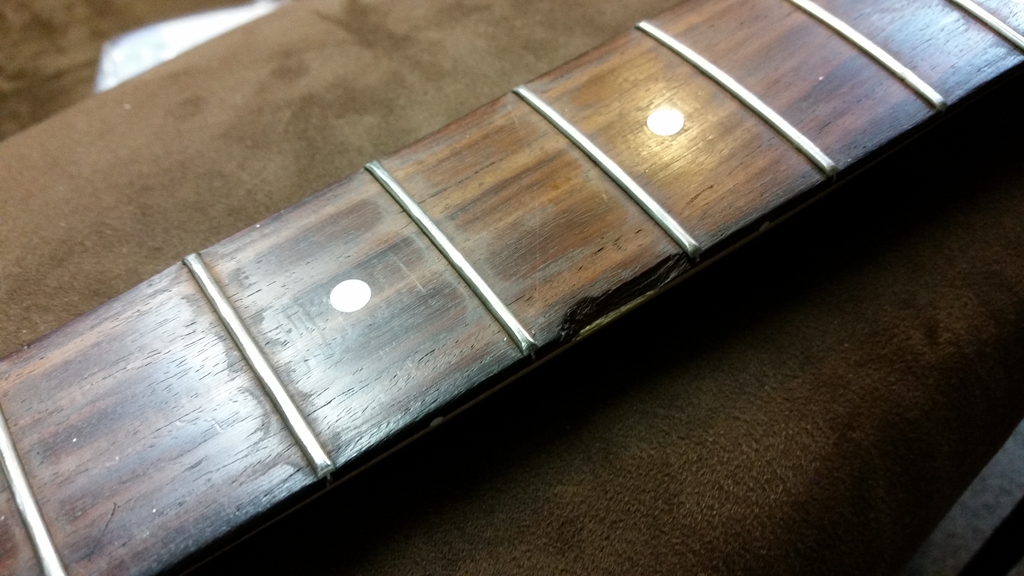
bass7_zps3ygcl62a.jpg
bass4_zpst3v8qy1z.jpg
bass8_zpsxngw45ns.jpg
 
Do you have any scraps of rosewood laying around?
I've actually had good results patching things at my shop (like furniture etc...) that were results of my guys screwing something up like tear out from a router bit etc...
Basically finding a piece of the same shade of wood & whittling a piece to fit in the tear out hole with a razor knife.
Maybe even modifying the hole a bit to take the patch better. But at the same time trying to keep it natural looking...like a grain line.
When I get the patch to fit nice & tight, attach it with CA (super glue) .
Maybe fill any left over voids with sanding dust & soak with liquid super glue. Then just sand it flush with the surrounding wood. It will come out darker where the glue is.... But its still way better than bondo or putty.
 
Do you have any scraps of rosewood laying around?
I've actually had good results patching things at my shop (like furniture etc...) that were results of my guys screwing something up like tear out from a router bit etc...
Basically finding a piece of the same shade of wood & whittling a piece to fit in the tear out hole with a razor knife.
Maybe even modifying the hole a bit to take the patch better. But at the same time trying to keep it natural looking...like a grain line.
When I get the patch to fit nice & tight, attach it with CA (super glue) .
Maybe fill any left over voids with sanding dust & soak with liquid super glue. Then just sand it flush with the surrounding wood. It will come out darker where the glue is.... But its still way better than bondo or putty.

This is what you want to do, if that is more work than you care to take on, then rosewood saw dust mixed in epoxy will work. The repair will be noticeable, but it would look way better than bondo or any other paste.
 
The only thing that I'd add is that if it were me, I'd pull the two frets on either side, rout out the broken area to get straight edges (keeping the size of the route minimal), and then fit the rosewood patch. Straight lines are easier to match cleanly and you hide the ends of the patch under the frets this way.

But if you are looking for the easiest fix, then yeah, rosewood dust with epoxy.
 
The only thing that I'd add is that if it were me, I'd pull the two frets on either side, rout out the broken area to get straight edges (keeping the size of the route minimal), and then fit the rosewood patch. Straight lines are easier to match cleanly and you hide the ends of the patch under the frets this way.

But if you are looking for the easiest fix, then yeah, rosewood dust with epoxy.

I don't know about pulling the frets, but I'd certainly take the patch from fret to fret.
 
You do know that the neck is perfectly workable in its present state, right? Unless you hook your thumb over the top of the neck in your technique, it's unlikely that it will hamper your playing.
If you really must...a good guitar repairman can fill that area with the appropriately coloured and textured filler. Much like filling the fret board divots in my old ES125. Also, the rougher and more jagged the hole, the better for keeping the filler in place.
 
Filler will not hold on a corner or edge long term. It will never look right, either.

Since the fingerboard is straight grained straight cuts will be fine.
  1. Make a squared cut with a saw on each end. Extend through fingerboard to neck.
  2. Chisel to meet the lines.
  3. Remove waste.
  4. Fabricate a filler strip from similar species. Be careful to choose a close grain match.
  5. Note that the filler should stand proud of the fingerboard.
  6. Glue and clamp in place.
  7. Scrape and sand level. Save the dust.
  8. If the gap is large, move the dust into the gap and apply liquid thin CA glue. It will wick in.
  9. Scrape/sand again.
  10. Restring, tune, and play.
It is unnecessary to take the filler to the frets. The repair will be nearly invisible if done correctly. Making the cuts close to the frets may jeopardize the stability of the frets and require additional work.

If you demand the repair to be completely invisible, remove the frets on either side of the repair. Extend the filler to the far edges of the fret slots. Recut the (now partially filled) fret slot, install new frets, and do a partial or full fret dress. If it sounds like a lot of work, it is.
 
You do know that the neck is perfectly workable in its present state, right? Unless you hook your thumb over the top of the neck in your technique, it's unlikely that it will hamper your playing.
If you really must...a good guitar repairman can fill that area with the appropriately coloured and textured filler. Much like filling the fret board divots in my old ES125. Also, the rougher and more jagged the hole, the better for keeping the filler in place.

A good repair man would replace the wood with a closely matched piece of rosewood, no filler would be used.
 
A good repair man would replace the wood with a closely matched piece of rosewood, no filler would be used.
A good repairman would do as he's told. Failing that he'd do no work at all.

A good filler, properly constituted, will be just as resilient and secure in its place as any piece of wood. It can be striated and coloured as appropriate to match its surroundings.

If I was doing it myself I'd probably use a piece of rosewood if I had some on hand. But don't discount other filler materials.
 
Last edited:
A good repairman would do as he's told. Failing that he'd do no work at all.
If someone came to me to fix that issue and "told" me I had to use a colored "filler".... Oh...And by the way, make the edges of the repair "jagged" .
And if I didn't do it that way, I wouldn't get the little PITA job from the PITA customer?

Then no.... I guess I would get no work ...
(from that particular pain in the a**);)
 
  • Like
Reactions: hdracer
A good repairman would do as he's told. Failing that he'd do no work at all.

A good filler, properly constituted, will be just as resilient and secure in its place as any piece of wood. It can be striated and coloured as appropriate to match its surroundings.

If I was doing it myself I'd probably use a piece of rosewood if I had some on hand. But don't discount other filler materials.

That is just wrong in so many ways. First of all, the reason people bring me repairs is because they do not have the skill to do the job themselves. If someone brought that bass to me and insisted that I fix it in a substandard manner I would simply decline to do the job. I don't want my name attached to sub par work. I would explain that replacing the wood is a better repair, and most rational people would trust my judgment.
 
  • Like
Reactions: hdracer and JIO