

Enjoy the benefits of a premium membership!
Upgrade Account
-
TalkBass has been independent since 1998. Add your voice.
Create a free account to reply to discussions, view embedded media, and browse with fewer display ads.
Join free Log in
Want zero display ads or expanded classifieds tools? Compare plans.
You are using an out of date browser. It may not display this or other websites correctly.
You should upgrade or use an alternative browser.
You should upgrade or use an alternative browser.
More options
Who Replied?

Did you ever wonder why your waste line in your house is vented? No? Has that ever stopped me from talking about it? Do you know that your waste line is vented? Do you know what a waste line is?
All the drains in your house are probably connected to a large pipe (vent) that runs to your roof. If they are not they are probably not draining very well. Did you ever change the oil on your car or drain the radiator? If you have you know that the oil or coolant runs out a lot quicker when you take off the cap of the oil filler or radiator. If you haven't done that take a can of beer or soda and put a hole in the side near the bottom. Liquid will start tricking out, when you pop the top on the can the liquid will gush out. We used to do this with beer when I was a teenager we called it shot gunning.
What is happening here? I don't know maybe someone else can explain how that works.
Okay, back to drains. One reason for the vent is so your waste lines will drain better. If you are having problems with your drains and you can't find any clogs try checking to see if the vent is clogged with debri.
Another reason is odors. As the liquid runs through the pipe it pushes odors forward. Having a vent on your roof allows those odors to escape far removed from your nose.
Have you ever seen the inside of an old drain? It is not pretty and it sure doesn't smell like roses. That is why we have traps under sinks and inside toilets. A trap is those U shaped pipes under your sink. They are designed to trap liquid in that space and create a barrier between sewer gas and your home. Waste lines angle downhill, it think the code is 1/4 per food but I don't remember for sure. The downhill slope on the drain pipe causes waste water to flow using the force of gravity. When the water flows it draws air in from the vent. If you didn't have a vent the draining liquid would create a vacuum and suck all the water out of the traps under your sinks. When that happens the odors from your sewer will find it's way back up into your house and that would not be good.
There you have it (if you are still reading) everything you never wanted to know about vents and waste lines. And you thought plumbing was all about wise cracks and overcharging customers.
All the drains in your house are probably connected to a large pipe (vent) that runs to your roof. If they are not they are probably not draining very well. Did you ever change the oil on your car or drain the radiator? If you have you know that the oil or coolant runs out a lot quicker when you take off the cap of the oil filler or radiator. If you haven't done that take a can of beer or soda and put a hole in the side near the bottom. Liquid will start tricking out, when you pop the top on the can the liquid will gush out. We used to do this with beer when I was a teenager we called it shot gunning.
What is happening here? I don't know maybe someone else can explain how that works.
Okay, back to drains. One reason for the vent is so your waste lines will drain better. If you are having problems with your drains and you can't find any clogs try checking to see if the vent is clogged with debri.
Another reason is odors. As the liquid runs through the pipe it pushes odors forward. Having a vent on your roof allows those odors to escape far removed from your nose.
Have you ever seen the inside of an old drain? It is not pretty and it sure doesn't smell like roses. That is why we have traps under sinks and inside toilets. A trap is those U shaped pipes under your sink. They are designed to trap liquid in that space and create a barrier between sewer gas and your home. Waste lines angle downhill, it think the code is 1/4 per food but I don't remember for sure. The downhill slope on the drain pipe causes waste water to flow using the force of gravity. When the water flows it draws air in from the vent. If you didn't have a vent the draining liquid would create a vacuum and suck all the water out of the traps under your sinks. When that happens the odors from your sewer will find it's way back up into your house and that would not be good.
There you have it (if you are still reading) everything you never wanted to know about vents and waste lines. And you thought plumbing was all about wise cracks
and overcharging customers.
Last edited:

The other reason for the P-trap (The U-shape pipe) is that sewage gas is flammable.

I sometimes get a kick out of learning old technology. For the past several weeks I have been in a training class to be a volunteer operator at the local trolley museum.
The wheel at the end of the trolley pole runs along a 600-volt DC wire and brings the current down into the controller. The controller has a lever that turns through several points or notches, and increases the trolley's speed by removing resistance from the circuit feeding the traction motors. There are usually five, but sometimes only four, series notches. Some cars then go into a like number of parallel notches. The first position of course is off, and no connection is made. The first notch after that puts all the grid resistors in the circuit, getting the motors off to a gentle start. Second notch bypasses some of the resistor grids, third notch bypasses more of the resistance, until the top series notch removes all the resistance, and each of the motors gets 300 volts (because they're in series). Then, on cars so equipped, the next notches start with all the resistance again, but the motors are now connected in parallel. Each successive notch removes more resistance until the grids are again bypassed completely, and each motor is now receiving the full 600 volts. Current of course returns through the wheels into the track and back to the power plant.
Braking is via a hand lever that controls the air brakes. The lever has several positions that release pressure from the brake cylinder, that hold whatever pressure is currently in the cylinder, that add air to the cylinder, and on what are known as safety cars, a door open position and an emergency position.
So far I have been able to operate not only a Connecticut car, but also trolley cars from New Orleans, Atlanta, Johnstown, and Montreal.
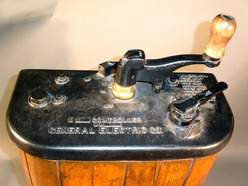
This is a typical controller. The large lever notches the power. The small lever is the reverser key (one does not typically operate in reverse except when necessary, and only at very slow speed and with the assistance of another operator watching the trolley pole lest it dewire and get caught up in the overhead wires, possibly causing serious damage). On double-ended cars, one changes direction by raising the opposite trolley pole, lowering the pole that had been in use, and removing the controller handle, brake handle, and reverser key from one end to the other.
The wheel at the end of the trolley pole runs along a 600-volt DC wire and brings the current down into the controller. The controller has a lever that turns through several points or notches, and increases the trolley's speed by removing resistance from the circuit feeding the traction motors. There are usually five, but sometimes only four, series notches. Some cars then go into a like number of parallel notches. The first position of course is off, and no connection is made. The first notch after that puts all the grid resistors in the circuit, getting the motors off to a gentle start. Second notch bypasses some of the resistor grids, third notch bypasses more of the resistance, until the top series notch removes all the resistance, and each of the motors gets 300 volts (because they're in series). Then, on cars so equipped, the next notches start with all the resistance again, but the motors are now connected in parallel. Each successive notch removes more resistance until the grids are again bypassed completely, and each motor is now receiving the full 600 volts. Current of course returns through the wheels into the track and back to the power plant.
Braking is via a hand lever that controls the air brakes. The lever has several positions that release pressure from the brake cylinder, that hold whatever pressure is currently in the cylinder, that add air to the cylinder, and on what are known as safety cars, a door open position and an emergency position.
So far I have been able to operate not only a Connecticut car, but also trolley cars from New Orleans, Atlanta, Johnstown, and Montreal.
This is a typical controller. The large lever notches the power. The small lever is the reverser key (one does not typically operate in reverse except when necessary, and only at very slow speed and with the assistance of another operator watching the trolley pole lest it dewire and get caught up in the overhead wires, possibly causing serious damage). On double-ended cars, one changes direction by raising the opposite trolley pole, lowering the pole that had been in use, and removing the controller handle, brake handle, and reverser key from one end to the other.
There's a small magnet at one end. They are very light, relative to the usual pickup. I guess the large aluminum bars are effectively the coil, and somehow the small magnet induces enough flux through the aluminum bar so that the string's vibrations are able to generate enough disturbance in that flux to create a current. It's just a very different way to do the same thing, according to the logic that works in my brain. Voltage/current just confuses me until I understand why the two methods would be different. The electrical theory behind the function is the same, as far as I can tell. So, I'm confused. But, it's been enough of an interest that I have been geeking out on it, unsuccessfully, for a long time. For what its worth, I have Alumitones in a guitar and a bass, and I like them very much. Whatever causes a pickup to have a specific "sound" is apparently in low supply in them. They are sensitive to pickup height and pickup location on the string far more than they would be if they had their own natural coloration. Using them is one thing. Understanding them completely is another.
Are you wondering why the signal is a voltage in the case of the conventional pickup and a current in the case of the Alumitone?
The difference lies not just on the conductors themselves, but also on how the conductors are terminated.
Imagine an Alumitone and conventional pickup with open circuited coils. Both will generate a voltage with no current flow. The only difference is that the conventional coil will generate a much higher voltage due to its massive number of turns. But the principle of induced voltage is the same.
Now imagine an Alumitone and conventional pickup with short circuited coils. We now have an induced current with no voltage present. The principle is really the same in that in both cases the varying magnetic field compelled electrons to flow in the conductor.
In the case of the open circuited coils, the electrons had no place to go. So it simply built up voltage potential at the open ends of the coil. In the case of the short circuited coils, the electrons moved freely and so no voltage potential built up.
It's like placing an impellor type water pump in the middle of a pipe filled with water. If you cap the ends of the pipe and turn on the pump, you will get a pressure difference between the ends of the pipe but no water flow. However, if you join the two ends of the pipe together, you get a large water flow with very little pressure difference. The compelling force is the same in both cases.
Because of these differences, there is also a difference in how we utilize the signals. In order to maintain the signal level of the conventional pickup, we need to keep the ends of the coil as "open" as possible. this means using high resistance value pots, and a high amplifier input impedance.
In the case of the Alumitone, we need to maintain the current level, so we couple it to a low impedance transformer primary winding. The secondary then provides the higher signal level needed by the instrument amp.
Not sure about the magnet at the end of the pickup. Aluminum does not conduct magnetic flux.
-

Here's a good place to start:
I thought the nerds said recently that this was true anymore. Seriously, wasn't there a news release some months back saying that scientists no longer think this is true?
Last edited:
I thought the nerds said recently that this was true anymore. Seriously, wasn't there a news release some months back saying goes that scientists no longer think this is true?
Yes .You are correct.
Right now they're more concerned about where all the mysterious radio signals are coming from.
You must have met my old friend Dewey Singebottom.The other reason for the P-trap (The U-shape pipe) is that sewage gas is flammable.
White courtesy telephone for @hbarcatI thought the nerds said recently that this was true anymore. Seriously, wasn't there a news release some months back saying goes that scientists no longer think this is true?

think the code is 1/4 per food but I don't remember for sure.
Really nice Freudian slip Slo!!
1/4 inch per burrito.Really nice Freudian slip Slo!!


Gaolee
Official leathers tester and crash dummy
Thanks. That actually makes a whole lot of sense. It's great to learn something.Are you wondering why the signal is a voltage in the case of the conventional pickup and a current in the case of the Alumitone?
The difference lies not just on the conductors themselves, but also on how the conductors are terminated.
Imagine an Alumitone and conventional pickup with open circuited coils. Both will generate a voltage with no current flow. The only difference is that the conventional coil will generate a much higher voltage due to its massive number of turns. But the principle of induced voltage is the same.
Now imagine an Alumitone and conventional pickup with short circuited coils. We now have an induced current with no voltage present. The principle is really the same in that in both cases the varying magnetic field compelled electrons to flow in the conductor.
In the case of the open circuited coils, the electrons had no place to go. So it simply built up voltage potential at the open ends of the coil. In the case of the short circuited coils, the electrons moved freely and so no voltage potential built up.
It's like placing an impellor type water pump in the middle of a pipe filled with water. If you cap the ends of the pipe and turn on the pump, you will get a pressure difference between the ends of the pipe but no water flow. However, if you join the two ends of the pipe together, you get a large water flow with very little pressure difference. The compelling force is the same in both cases.
Because of these differences, there is also a difference in how we utilize the signals. In order to maintain the signal level of the conventional pickup, we need to keep the ends of the coil as "open" as possible. this means using high resistance value pots, and a high amplifier input impedance.
In the case of the Alumitone, we need to maintain the current level, so we couple it to a low impedance transformer primary winding. The secondary then provides the higher signal level needed by the instrument amp.
Not sure about the magnet at the end of the pickup. Aluminum does not conduct magnetic flux.
-
It may not be a magnet at the end of the pickup. I don't actually know what it is, but I would expect there's got to be a magnet somewhere in order to generate the flux that causes the signal. Maybe I'm missing something else. I know there's no coil that goes the entire width of the pickup. Most of the pickup is nothing more than a bent aluminum bar.


Here is how to recover from alcohol addiction:
"Don't drink even if your ass falls off." Firefighter Tim
Yes, it is very simple but it is also extremely difficult.
In the same vein, I have a friend who is a clinical psychologist. People ask her all the time: "How can I quit smoking?" Her reply is always the same: "Quit putting cigarettes in your mouth and lighting them."

Alumitone, shoomitone... I want someone to explain how an eBow works!
So an eBow is a pickup, which is hooked up to an amp. The output of the amp is hooked up a coil with a magnet (basically, another pickup), but it's driven by the amp. The vibration of the string is picked up by the pickup, amplified, and then that output goes through the other coil, which induces a magnetic field, which excites the string. It's basically feedback.
Gaolee
Official leathers tester and crash dummy
A friend is now sober for just over a year. She says she's all clumsy all of a sudden. Apparently your nervous system goes through stages of recovery, and she's in a stage where motor skills are all wonky. She says she could have another six months before her coordination is reliable again. I don't know if that's all true, but it just goes to show how powerful a drug alcohol really is when you get addicted to it.Here is how to recover from alcohol addiction:
"Don't drink even if your ass falls off." Firefighter Tim
Yes, it is very simple but it is also extremely difficult.
So I got insulation installed this week, and part of the deal was a whole-house fan, which is in the bathroom ceiling. The dude said "This will come on every hour for a few minutes, and will keep air moving in the entire house. Doesn't matter if bathroom door is open or closed."
Doesn't matter if bathroom door is open or closed? What kind of sorcery is this?
Doesn't matter if bathroom door is open or closed? What kind of sorcery is this?
Gaolee
Official leathers tester and crash dummy
There's a gap below the bathroom door unless you installed some kind of seal to the floor. That's the kind of magic a construction knuckle dragger like me can understand.So I got insulation installed this week, and part of the deal was a whole-house fan, which is in the bathroom ceiling. The dude said "This will come on every hour for a few minutes, and will keep air moving in the entire house. Doesn't matter if bathroom door is open or closed."
Doesn't matter if bathroom door is open or closed? What kind of sorcery is this?

I never want to just know that things DO work, I want to know HOW they work.
Maybe that's why I get my hands into auto mechanics, electronics, plumbing, carpentry and I even sew a bit (primitive style.)
Maybe that's why I get my hands into auto mechanics, electronics, plumbing, carpentry and I even sew a bit (primitive style.)


