• TalkBass has been independent since 1998. Add your voice.
    Create a free account to reply to discussions, view embedded media, and browse with fewer display ads.
    Join freeLog in
    Want zero display ads or expanded classifieds tools? Compare plans.

How to achieve a matte finish?

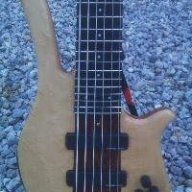
I’m refinishing a jazz bass and I’ve decided to go for a nitro matte black. How do I achieve the a finish like this one? Not looking to do the light relicing like this, just want that aged satin look. Would something like this be specific to the kind of paint, or would this be more in the clear coat? Any tips for achieving this finish would be much appreciated!

View attachment 3545267

you can take a scratch pad and turn a glossy finish into a matte finish
 
Extra fine steel wool (or Scotchbrite) does a lovely (and very fast) job of that.

Just be aware that abrasion wear will polish the finish in this case. E.g. where your forearm rubs the finish when playing.

You want to start with gloss and then knock it back using the steel wool IME. It allows you to achieve a smoother finish, and to correct/level any mistakes before the dulling process. When you spray an inherently satin product, you can't do any repair work or smoothing on it. Your final finish is exactly what lays down right out of the can.

The other benefit of starting with a gloss lacquer and then dulling it with steel wool is that you can very easily give the thing a brand new looking high gloss finish again if you change your mind, or if you want to sell it.
 
Seems to me like you could get the lacquer with whatever finish you wanted from matte all the way up to high gloss...

If you want a matte finish, then get lacquer with a matte finish and save yourself a bunch of sanding.

But maybe not — with all these folks recommending sanding maybe they know something i don't.
My thoughts as well. An old trick is to put chalk dust in gloss paint to soften the gloss. I’ve seen it used with acrylic lacquer in a robins egg blue. It worked, but the guy doing it had forgotten more about paint than i’ll ever know. That said, i’m sure you can get black in a matte or semigloss.
Last, my matte black lacquer highway 1 jazz is starting to gloss up in areas where my right arm rubs against it while playing.
 
matte black lacquer highway 1 jazz is starting to gloss up in areas where my right arm rubs against it while playing.
Precisely why I don't feel that "stopping short" of a full polish... or simply scuffing gloss, is such a keen idea.
From my understanding, a proper matte that lasts is achieved with an additive ...(powder).
.... it has a "texture".
 
Gray Scotchbrite or sand with 1000 to 3000 grit depending how dull you want it. The higher number grit you sand with, the shinier it will be. Always start with around 1000 and work your way up until you get your desired finish.

I recently matted a shiny black pickguard, and I would say start from 2500-3000, then use lower number grit if necessary. Easier that way.

Glossy black starts taking a visibly dull gray tint very quickly when scoffed, especially if you have some gloss black parts next to it. In my case 1500 looked too gray and 2000 is definitely still flat. For satin black, I think closer to 3000 would be right. Of course as a smart person I started from 800 and had to work my way up to 2000 again :whistle:

I agree that painting a flat finish might be a good idea. When you scoff the surface, only the thin surface layer is matt and any light scratches go through and show easily. Painted flat finish probably doesn't show scratches as easily, if the flattening agent like chalk is evenly distributed in the whole layer.
 
Last edited:
Since the OP is talking about satin black paint - I had my hot rod painted with "Hot Rod Flatz Black" and coated with "Hot Rod Flatz Clear" and decided to do a bass to match. My car restorers sprayed it for me. Apparently it's not the easiest material to spray, but they didn't have any problems. Haven't had any issues of the paint becoming 'shiny' where it wears so far, but it's only been about 10 years.

Hot Rod Black - Hot Rod Flatz Urethane Automotive Flat Car Paint, 1 Quart OnlyDefault Title

It's poly and pricey but so far so good:

Hot-Rod-Bass.png


Be sure and pick up some of this and don't even CONSIDER using anything else on the finish. This Rat Wax is incredible.

Screen Shot 2019-09-23 at 8.35.19 AM.png
 
Last edited:
All my basses are done with satin poly as the last couple of coats. Minwax (yes, the rattle can stuff) works very well, provided you don't try to put too much one at once. A good satin finish is much easier to do than a gloss one. I use gloss poly for the initial coats of clear (gloss poly is harder and tougher than satin), I let it dry a couple of days, then hit it with 600 grit to knock the nubs off, and provide some texture for the final couple of coats to grab. Then I shoot it with satin for the last couple of coats. I can do the clear on a bass in 2 working evenings, separated by 48 hours (and then another 48 or more for the final coats to cure).

Over time, the satin finish will gloss up a bit where your fingers move about on the instrument a lot, but I've never had one wear through - a thin coat of polyurethane is a very tough finish. Even where you get little dings, the finish stays with the wood.
 
  • Like
Reactions: Rôckhewer
Precisely why I don't feel that "stopping short" of a full polish... or simply scuffing gloss, is such a keen idea.
From my understanding, a proper matte that lasts is achieved with an additive ...(powder).
.... it has a "texture".
I'm guessing it's the hardness of the top coat rather than the additives that determine how long a finish lasts.
 
The additives reduce the hardness of the top coat - why I use initial gloss coats under my satin finishes.
Sure... makes sense.
Especially if you're doing a transparent satin over figured wood. You wouldn't want it overly "milky" anyway.

But I'm not going to send out a build to a client that's supposed to be "satin"... that's just scuffed gloss
... and what?... ..send along a worn out scotch pad for the inevitable shiney spot under the forearm... and anywhere the thumb might rest??
..."yeah bro.... just give it a little scuff from time to time"... :rollno::rollno::rollno:

I might do it to my own bass.... and maintain it...
Wouldn't expect a client to.
 
Last edited:
I might do it to my own bass.... and maintain it...
Wouldn't expect a client to.

A satin finish, if you rub it enough, won't be satin where you rub it forever. A gloss finish...will never be free of fingerprints. Neither finish is perfect - it's just a different tradeoff. So long as your client knows what he or she is getting, it should be OK either way.

But yeah, I've seen "scuffed gloss" finishes. While I've done that for a neck to make it less grabby (works great for that), I wouldn't do it for a body - it never looks as good as a sprayed satin finish.
 
I recently took one of my instruments to a luthier and whatever he used to clean it with, left white residue spots. This bass has a rough matte finish and I wanted to ask you guys how to get these white cloudy patches off and what I should use in the future? Someone mentioned naphtha but I’m hesitant. Any help would be greatly appreciated. Thanks!
 

Attachments

  • 0ED22041-BEC3-463D-9186-30B73464ACFC.jpeg
    0ED22041-BEC3-463D-9186-30B73464ACFC.jpeg
    938.6 KB · Views: 119
I recently took one of my instruments to a luthier and whatever he used to clean it with, left white residue spots. This bass has a rough matte finish and I wanted to ask you guys how to get these white cloudy patches off and what I should use in the future? Someone mentioned naphtha but I’m hesitant. Any help would be greatly appreciated. Thanks!
I haven't personally used this but I have buddies that have used it on their cars to good effect,
Invalid Link Removed
 
This is exactly my experience, from the shiny to the flat to the worn shiny to the buffed shiny again.
Good times. ;)

Extra fine steel wool (or Scotchbrite) does a lovely (and very fast) job of that.

Just be aware that abrasion wear will polish the finish in this case. E.g. where your forearm rubs the finish when playing.

You want to start with gloss and then knock it back using the steel wool IME. It allows you to achieve a smoother finish, and to correct/level any mistakes before the dulling process. When you spray an inherently satin product, you can't do any repair work or smoothing on it. Your final finish is exactly what lays down right out of the can.

The other benefit of starting with a gloss lacquer and then dulling it with steel wool is that you can very easily give the thing a brand new looking high gloss finish again if you change your mind, or if you want to sell it.
 
I wanted to share my recent matte experience to contribute to this thread. The product I used was Crystalac Brite Tone Matte. After some research on application techniques, I decided to try brushing with a White China bristle brush (found some people who swear by this type for clears). I was planning on spraying it if this didn't work.

I brushed the product directly on (no retarder or thinning). I tried to get the thinnest coat I could but still maintain even coverage. The product went on easy, but looked really thick!
20191227_134327.jpg

20191227_151357.jpg


At this point, I didn't know what to expect. It's so shiny when you apply it that it is hard to imagine it as matte. However, as time went on, the magic began. It started to flow out and dry, and after about an hour it looks flat out amazing.
IMG_20191227_150022_01.jpg

20191227_165106.jpg


Definitely worth trying IMO.