• TalkBass has been independent since 1998. Add your voice.
    Create a free account to reply to discussions, view embedded media, and browse with fewer display ads.
    Join freeLog in
    Want zero display ads or expanded classifieds tools? Compare plans.

How to Approximate an Upright w/ an Electric?

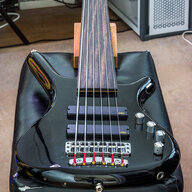
I do this often. Tilt neck up, pluck strings with side of your finger at the neck. I don't like traveling with my upright but cover many old blues tunes where the drummer switches to brushes and upright tone is preferred. Sounds best on my Bruce Johnson fretless but I can do it with a fretted ric/fender or anything.
 
  • Like
Reactions: HaphAsSard
You can tweek fretted basses however you want to make them sound less "electric", if that makes
sense. Nothing sounds like a DB except a DB. And retless basses are better at approximating the tonal
character.
But... an inexpensive alternate is to get an acoustic bass guitar, fretless is best, off Amazon. They sound pretty
good, but definitely need to be amplified. I think you can get them for under $200.
But unless you want to spend "any" dollars for this, just forget about the tone tricks and play in the same
manner as a DB player would. The way you construct your bass-lines, using your fingers to produce
the feel of the music.
I have struggled with your same problem for a few years now. MY solution (outside of acquiring another DB) was to de-fret and add hard finish to the fingerboard...in my case this was 10 coats of Tung oil. I get a nice rich tenor to the strings, a more woody sound. But most bass players don't want a project-- they just wanna play.
And that's what it's about, anyway.
 
4. Probably more important than any thing else, is...HOW you play. Duplicating how people play an upright - as closely as you can - will go a very long way to getting the sound you want. I'd imagine that just doing that, with your bass as it is now? It might just surprise you...:cool:
This for sure.
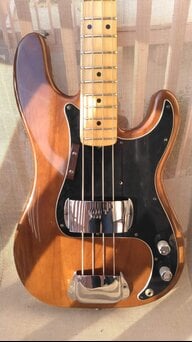
I use a Pbass with flats. A Rob Allen Mouse 30 fretless will also get you there, but for many thousands of dollars if you can even find one.
 
nice stuff, @djmay --- that big band sounds great (as does your playing!) and it's refreshing to hear...a neat surprise!


edit: per the OP: study the DB parts you want to approximate with the axes you already have, and cop the attitude and note choices/styles you hear. strings and mutes might help, but it's more like 'a way of playing' than anything else. good luck! :thumbsup:
 
Last edited:
  • Like
Reactions: djmay and SteveCS
A Fender precision with flats and highish action will get you there -- the sound of a plywood bass with gut or weed whacker strings (nothing wrong with plywood basses -- some people prefer them, that's why old Kays fetch so much money ) The only think difficult is rockabilly slap sounds.

It's playing in that style that will get you there .
 
Was looking for the same thing for a long time, however my solution was getting an Ibanez UB-804. I know, it's an EUB and it doesn't sound "exactly" like an upright, but I kind of like it. It's also highly portable and being a 34" it's relatively easy to play. But to each its own - this may or may not work for you.
 
nice stuff, @djmay --- that big band sounds great (as does your playing!) and it's refreshing to hear...a neat surprise!


edit: per the OP: study the DB parts you want to approximate with the axes you already have, and cop the attitude and note choices/styles you hear. strings and mutes might help, but it's more like 'a way of playing' than anything else. good luck! :thumbsup:

I am glad you like it. I was trying to communicate to the OP that it is possible to “approximate” the character. He did not say that he was trying to sound like a double bass.
 
  • Like
Reactions: yodedude2 and JRA
Perennial question here with the same answers given, which, to me, are completely unsatisfactory.

It is basically like asking which clarinet will sound like an oboe, or which trombone will sound like a euphonium.

Bass guitar and double bass are different instruments that play in the same register with completely different tonal pallettes.

Rather than trying to turn a hammer into a screwdriver, just use the hammer well.

Play the right notes with the right dynamics and articulation, in time and in tune. That's 99.9999% of the battle in any situation, regardless of the instrument you're holding.
 
  • Like
Reactions: Ric Vice
Given the bass that you have, and the style you want to play, if you use a nice fat set of flatwounds and use only the neck pickup, you will be halfway there. You don't need a foam mute; you will get better results with palm muting, using the heel of your hand to mute while plucking strings with your index or middle finger. If you have longer fingers, this will help, because although you might be muting the strings right by the bridge, you want to pluck as far away from the bridge as you can comfortably reach. And don't be shy about shaping the tone with amp EQ until you get something that sounds as natural as possible. I actually find that i need to cut the lows and low mids a lot (palm muting tends to focus the vibrations of the strings in a way that enhances the lower frequencies). Of course, what you will need to do EQ-wise will depend on the particular amp/speaker cab you're using, as well as the environment you're playing in.

Getting the bloom and decay of the notes to be shaped right via palm muting takes a bit of practice, but not a lot, really, as the immediacy of hearing the results of what you are doing makes it pretty intuitive. Fretting hand technique (e.g., the way you release the strings between notes) in conjunction with your muting and plucking technique can help vary the feel of the bass line to make it fit each particular song (or part of the song)...
 
I play booth electric and upright (jazz). First of all, think more about the feel than the sound. Sound wise there is no normal electric bass that sounds like an upright but most of them can fill the same role! If you are playing walking bass, sometimes some kind of dampening can help (palm mute/foam) but in the end it’s more about the feel I would say. Don’t play too busy and focus on the quarter notes being even, groovy and melodic.
 
Let me save you a lot of disappointment later: none of them do. But some sound closer than others. The closest I ever heard was the old DeArmond Ashbory bass, with silicone strings. Give it a listen in the link below, and see what you think.


I’ve been playing them professionally since 1993. Started with the Guild Ashbory. This is okay but it can be played with more finesse.:)

It was designed to do this job it’s nothing like a Bass Uke. Sad thing is the poly strings on the Uke don’t help it’s purpose. Some very creative folks are getting them to work for them.

Gig last Sat an attendee walked up and said, “man that sounds just like an upright, cool.”
I get called for live or studio with, “be sure to bring that little bass.” :)
 
Last edited:
I’m another doubler here - in my current band, there’s maybe 6-10 songs that I play on upright. when I need to, I can do all but one (where bowing is required) on a P bass with flats. Playing technique is key - not much to what others have said, for me its a less aggressive style of playing, maybe a bit more bass on eq and roll of a bit of high roll off. I Tried foam mutes and didn’t like it - as others stated, DB has lots of sustain. Your bass should be fine, try flatwounds (I like LaBella Low tension or Pyramid flats) or tapewounds - although I find tapes a little too one dimensional for me.
 
I am glad you like it. I was trying to communicate to the OP that it is possible to “approximate” the character. He did not say that he was trying to sound like a double bass.

I’ve always wondered what we would hear if the bassist were placed behind a screen so we couldn’t see what instrument he/she was using.
On Michele Camilo’s big band album Once More Once, Anthony Jackson plays his Fodera Contrabass Guitar and to my ears sounds very much like
a Double Bass an instrument that I play. Just my take of course.

 
Last edited: