• TalkBass has been independent since 1998. Add your voice.
    Create a free account to reply to discussions, view embedded media, and browse with fewer display ads.
    Join freeLog in
    Want zero display ads or expanded classifieds tools? Compare plans.

How to convert your bass into fretless - tutorial.

Please don't use wood filler as shown in this video. Use a tight-fitting veneer or plastic strips, both glued in. Wood filler compresses too easily and can lead to instability of the neck under string tension.
 
  • Like
Reactions: /\/\3phist0
Please don't use wood filler as shown in this video. Use a tight-fitting veneer or plastic strips, both glued in. Wood filler compresses too easily and can lead to instability of the neck under string tension.

Absolutely. Wood filler is a bad idea and an inappropriate material. I like much of what I see here, and the idea of transferring the fretboard radius to a sanding block is excellent. There are two things I disagree with:

1) It's not necessary to remove the nut. You probably will need to file the string slots a bit lower, but the nut can be in pace for that.
2) The wood filler is a bad idea. Use solid material like wood veneer or thin plastic styrene strips glued in place.
 
Last edited:
1) It's not necessary to remove the nut. You probably will need to file the string slots a bit lower, but the nut can be in pace for that.
If the nut is plastic it's better to do so. They are often hollow (see the video, mine was). If you file down the slots you may get to that hollow part and the nut is ruined.

To wood filler enemies - bring some evidence. Maybe it's not an ultimate method but it works in my case. My neck feels nicely stable. And I haven't seen any complaints from people who actually DID use wood filler in their conversions.
 
Last edited:
@medawc: I don't think anybody is saying that you have definitely done anything bad using wood filler. Rather, they are playing the odds. Without frets, the nut slots become a bit like acoustic guitar bracing, which is notched specifically so it can bend. When you are working with wood, there are no guarantees, so it is better to "play the odds" and put a solid material in the fret slots. I'm not sure anybody can say that using wood filler or other, softer material will make 1 in 5 necks or 1 in 10,0000 necks go bad. The are saying that if you use a harder material, 0 in 5 and 0 in 10,000 necks will go bad because of the filler material used. You wouldn't want a neck to become flexible in any way resembling this:

[Invalid or Expired Link Removed]

...no need to be defensive with the "bring some evidence" rebuttal, and the wood filler may never causes any problems with your bass neck, or a thousand others. That isn't to say that there aren't a thousand necks out there that would be ruined by using wood filler though, because wood is wood. It compresses and it flexes. I can't see where it makes any sense to make it any easier for wood to move in directions you don't want it to.
 
I tend to agree with what wvbass is saying. It's not that your neck will be unstable for sure if you use wood filler. But it's not unusual to see problems. Over the 50+ years I have been repairing instruments, I have had to replace the filler in many de-fretted necks with better material many, many times. I've never had to replace any veneer in fret slots. So I still implore you not to use wood filler since I don't think the risk is worth it.

Perhaps this will help you understand. One of the methods of introducing a slight backbow in a neck (so that it straightens out under string tension) is called compression fretting. That's where the fret slots are cut a tiny bit narrower than the frets that go in it. The cumulative effect of all those frets being forced into a "too-tight" slot is that it introduces a bit of backbow in the neck. Now consider that even in normal fretting, the frets are forced into the slots. A certain degree of back pressure is caused. That too helps to stiffen the neck against the pull of the strings. The strength of the fingerboard was compromised when the slots were cut for the frets, and a slight compression helps restore the lost rigidity.

When you put wood filler in the slots, there is no pressure created to restore the fingerboard rigidity. In fact most filler shrinks slightly as it dries - even the "non-shrinking" fillers (they just shrink less). And they crush under pressure.

Here's something you can try. Apply some filler onto a flat surface and spread it out until it is the thickness of a piece of veneer. Let it dry. Then put the filler sheet into a vise and see how much force it takes to crush it. Try the same with a piece of veneer that's been coated with glue and allowed to dry.

So if you want to play the odds, which do you choose? If you say filler is good enough, you certainly take more risks with your instrument than I would.
 
  • Like
Reactions: Goatrope
I agree, with you, that generally speaking a veneer or plastic is a better material. But if you say A, say B too. With that method you meet two major problems:
1. How to match the bottom of the slot, so there are no hollows left? In this guide: LINK the guy shows a good method using a fretsaw. How many non-technicians own one?
2. What to do if frets chip the fretboard a bit while being pulled?
My tutorial is adressed to 'ordinary' guys, not technicians, luthiers etc. It's for DIY, usually with a CHEAP instrument. As you can see filling with solid material requires more skill and a specific tool to be done properly and it is way easier to screw things up.

Here's something you can try. Apply some filler onto a flat surface and spread it out until it is the thickness of a piece of veneer. Let it dry. Then put the filler sheet into a vise and see how much force it takes to crush it. Try the same with a piece of veneer that's been coated with glue and allowed to dry.
That's not a good test. When compressed in a vise the strain of the material is unrestricted, while within the fretboard it is. Wood filler is an agregate material. When an agregate material strain is restricted it can withstand a lot more when compressed (same applies to concrete for example). Within the fretboard the filler also matches the surface perfectly, so it is not getting any stress peaks. It IS getting them in a vise, due to micro-irregularities at contact surfaces.
 
This is one of the best reasoned discussions on the topic that I have seen on TB. I appreciate both positions although I still support the use of solid material as a higher quality solution. If you pay a pro to do this, they will use solid material. I may not be a pro but I take enough pride in my work that I use the more reliable solution.
 
That's not a good test. When compressed in a vise the strain of the material is unrestricted, while within the fretboard it is. Wood filler is an agregate material. When an agregate material strain is restricted it can withstand a lot more when compressed (same applies to concrete for example). Within the fretboard the filler also matches the surface perfectly, so it is not getting any stress peaks. It IS getting them in a vise, due to micro-irregularities at contact surfaces.

This argument just doesn't stand up. There are more micro-irregularities in a fret slot than there are in a vice face, unless you are using a serrated jaw. My test will still work with smooth jaw faces or any other crushing or pinching force. It takes LOT less force to crush a thin piece of wood filler than the same size piece of hardwood veneer. But perhaps a better test is by using a plain-faced set of pliers for the crushing force. The fretboard as it flexes will exert more pinching force at the surface of the fretboard than at the bottom of the fret slot. The non-parallel faces of the pliers will more accurately reproduce the forces involved. But the result will be the same - the wood filler crushes pretty easily compared to the maple veneer.

Case in point is a bass in my shop right now. The frets had been removed and the slots filled with wood filler. The neck had excessive bow and the owner said he had to put additional tension on the truss rod far more often than when the neck was fretted. He tried to stabilize the neck by applying epoxy to the fingerboard thinking that this would harden the fingerboard and reduce flex. It didn't work.

I removed the epoxy and the wood filler and installed maple fret lines. It's been strung up now for the past two months and the neck has held 12 thou relief without further adjustment. And that's not just a one-off story. The same thing has happened on so many other similar jobs I have done over decades.

You can say that the average Joe doesn't have the means to install veneer because of the shaping required, which BTW can be done with a fret saw, or a knife, or sandpaper. I've never used a fret saw for this task, but I have used a knife and I have used sandpaper. Hardly specialized tools. And its pretty easy to shape the plastic inserts, even with scissors.

It could be that because I am a pro, I am just trying to discourage DIY'ers so I can make more money. Fact is, I don't need more work - there's more than I can handle now. Consequently I encourage DIY'ers , but I will never encourage them to use inferior methods that have been shown in so many cases to be risky. I'm glad it has worked for you. You took the risk. You won. Many didn't. My "cheap" Bass cost me $1200. I'm not going to take that risk with it. If it were a $600 bass, why would I risk it for a few dollars and a bit more effort?
 
This is one of the best reasoned discussions on the topic that I have seen on TB. I appreciate both positions although I still support the use of solid material as a higher quality solution. If you pay a pro to do this, they will use solid material. I may not be a pro but I take enough pride in my work that I use the more reliable solution.
Maybe that's because it's a mechanical engineer vs experienced guitar technician discussion :).

Getting back to wood filler crushing:
1. In my opinion neither vise nor pliers simulate properly the stress distribution. In both cases you put in a jaws an already dried off piece, whereas in a fretboard you put liquid material, which firstly fulfills any micro-irregularities and then sticks to the material itself. To get anywhere near proper simulation for that you need to apply a liqiud filler in between two blocks of wood for example, let it dry off and then put the whole thing in vise.
2. Remember about my second note - the filler's deformation within the fretboard is restrained (both by the bottom of the slot and adhesive connection i mentioned in point 1), while in a vise/pliers it isn't. Since it's an agregate material, the more restrained it is the stronger it gets, especially when compressed.

About the case in your shop - I'm not there to say for sure, but that may be caused by an inpropoer filling, where the owner didn't compress the filler while applying it and left some hollows. That compromises both conditions mentioned above - and yes, filler gets awfully weak and susceptible to cracking.

Lastly - I'am not here to disappreciate years of your experience, skills etc. But I will stand for method i used as long as I have arguments for it. If they are cast down - I'll eat my words of course.
 
Getting back to wood filler crushing:
1. In my opinion neither vise nor pliers simulate properly the stress distribution. In both cases you put in a jaws an already dried off piece, whereas in a fretboard you put liquid material, which firstly fulfills any micro-irregularities and then sticks to the material itself. To get anywhere near proper simulation for that you need to apply a liqiud filler in between two blocks of wood for example, let it dry off and then put the whole thing in vise.

OK I'll try that.
 
Seriously though, how is it any more difficult for a DIYer to use a wood filler instead of just doing the job properly with veneer? It takes little effort to glue in a veneer, and even less to trim them and sand them flush with the fret board.
 
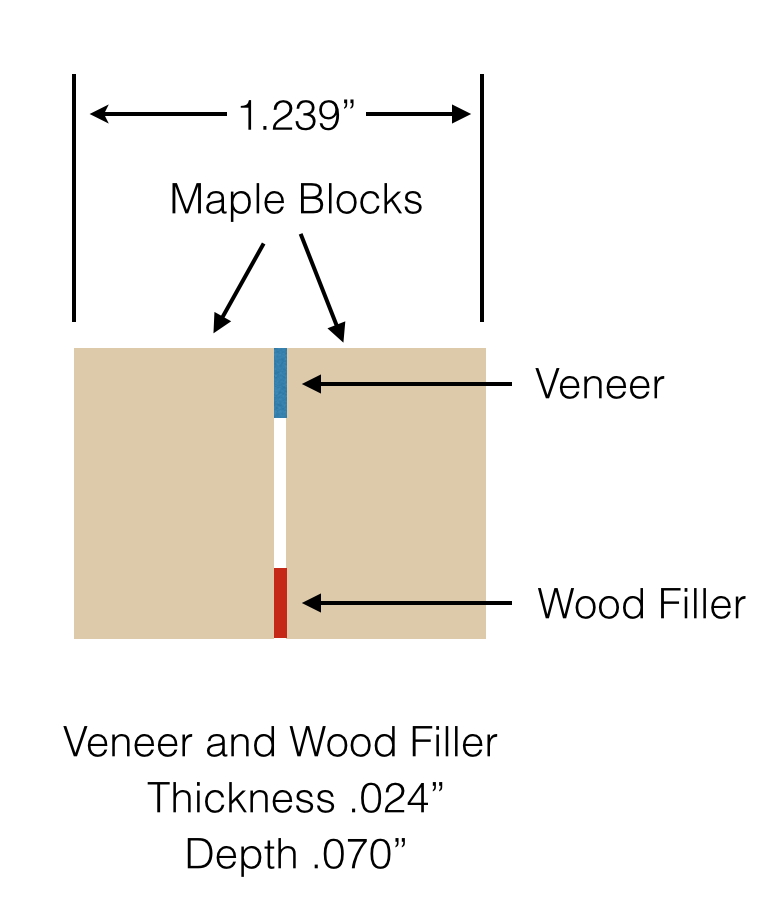
OK here's how I am going to test. I have taken two blocks of maple and some maple veneer that's .024" thick and have glued a strip about the width of a typical fret slot depth between the blocks. On the other side I have packed in some wood filler ( a very popular brand) to the same thickness and depth. Here's an illustration, looking at the end of the blocks:


The entire assembly measures 1.239" thickness at both the veneer side and the wood filler side. Once the wood filler is dry (I'll give it 24 hours) I will apply the same force to both sides using a torque wrench to ensure equal pressure is exerted, and measure the thickness of the assembly on both sides. That should tell us if the wood filler resists the crushing force as well as the glued in maple veneer. Should be a good test as both the veneer and the filler will be subject to the same conditions.

Stay tuned for the result.
 
I look at it this way - the fingerboard is made of wood. So if another material behaves was well as wood, it should be a good choice for a fret slot filler. If it doesn't, then it's not as good a choice.

The question remains, what is good enough? If filler turns out to be not as strong as wood, I'm not sure it is a good choice - why would you want a fingerboard that has regular weaker sections all along it's length? If the filler turn out to be just as strong (or stronger) it may be a good choice.

We don't need to know the precise degree of pressure involved. We know that wood is strong enough. Anything less is a bit of a gamble - maybe OK, maybe not. My experience says "not", others say OK. Perhaps this test will shed more light.

The reason I am taking this tack is the same reason I founded the Pro Bench forum. There seems to be a lack of credibility in conventional wisdom and the experience of practiced professionals. So rather than just expressing our experiences, I thought we could actually do some tests and measurements. Gets rid of the "that's just your opinion" argument.
 
Last edited:
simple logical conclusion, wood filler is NOT a solid, rather a viscous putty (wood putty as it is also known) and is designed to be COSMETIC rather than structural.
as in an earlier illustration, to increase the ability of a semi-rigid fibrous material to bend (EX: wood), one can:
Allow the outer area of the bend to stretch, (heat, moisten) to increase malleability/elastic properties...
OR remove material on the inner surface to DECREASE the compression of material (making area with decreased material thinner) therefore to MAINTAIN the rigidity of the structure (IE:the fretboard laminate of the neck)
replace the material removed (the fret, made of METAL) with something with nearly the compression resistant properties of at least the surrounding material (wood) would be preferred.

will it work with PUTTY!!!??? YES.

Will there be issues and lost stability in the structure? YES!!!
With the putty be more susceptible to environmental issues besides squirting out as the neck flexes due to mechanical changes, and it's less than perfect adhesion to the slots and oily wood.
Ya fer sher yu becha!

Has it been done 10000 times with few reported issues YEP!
is it worth all the effort? NO
a fretless neck from EBAY would be a better solution.

to OP thanks you for the detailed post your methods look to be well considered, and are sufficiently sound for most intents and purposes.... just not sound "best practice"

a good if not BETTER solution would be a strong 2 part epoxy filling the gaps, being fluid nearly ALL of the gap, assuming air bubbles do not form, and surface tension will allow ingress sufficiently via capillary action (harder than the wood without the "sawdust" component to weaken the structure) colorant would not be necessary but could be kind of cool and while at all this effort float the entire surface with epoxy :).....
or buy an ebay neck for 100.00 (i repeat myself)
 
Last edited:
The one time I converted a bass to fretless I used a light colored two part epoxy. Had to mix small amounts at a time
because of the drying time but it worked great. Where I live I just could not find appropriate material for fret markers.
Maybe epoxy is a good alternative because it dries very hard? Still have the bass and it plays great.