

Enjoy the benefits of a premium membership!
Upgrade Account
-
TalkBass has been independent since 1998. Add your voice.
Create a free account to reply to discussions, view embedded media, and browse with fewer display ads.
Join free Log in
Want zero display ads or expanded classifieds tools? Compare plans.
You are using an out of date browser. It may not display this or other websites correctly.
You should upgrade or use an alternative browser.
You should upgrade or use an alternative browser.
More options
Who Replied?
Run your scales using the major scale box and the four fret, four finger format.How do I increase the strength of my little finger?
Major scale box showing scale degree numbers and the root note on the 4th string.
........Index...middle..Ring...Little
G~~|---2---|-------|---3---|---4---| 1st string
D~~|---6---|-------|---7---|---8---|
A~~|---3---|---4---|-------|---5---|
E~~|-------|---R---|-------|---2---|4th string
The pattern takes place over four frets and you have four fingers.
Now for those that need it.........
Major scale spelling is R-2-3-4-5-6-7-8
Natural Minor scale spelling is R-2-b3-4-5-b6-b7-8
The b3, b6 and b7 are one fret back toward the nut.
Start with the major scale. For the F major scale place the box's R @ the 4th string 1st fret and the notes of the F major scale await you within the box. Yep you get a Bb. G @ the 4th string 3rd fret. And you get an F#. A @ the 4th string 5th fret, etc. The correct sharps and or flats fall into place automatically as long as you stay within the box's pattern.
About a zillion times should do it.

Last edited:

heh, heh...or just play " whipping post " for an hour every day.

heh, heh...or just play " whipping post " for an hour every day.
Or "give it to me baby" by Rick James.

buldog5151bass
Kibble, milkbones, and P Basses. And redheads.
Nothing special, just play scales and riffs that ytilize it. When I practice, I am very careful to use proper technique, so I don't have to think about it when playing.

Set up a short practice routine on the 12 fret and practice major scales and the relative minor scale using one finger one fret.
Move down to the 7th fret and then play back to the 12 fret.
Mix up the major and minor scales.
After a few weeks take it down from the 7th fret and as the frets spacings get wider you will now incorporate a bit of stretching as well.
Just do not over do the practice, 5- 10 mins a day should be good, or do it as a warm up, so 5 mins or so before you start playing anything.
Check out the clip, please note i am going down the fretboard because i have the finger strength and dexterity to do so.
You should start off from the 12th fret and work to the 7th fret, then when you feel stronger move from the 7th to open.
Move down to the 7th fret and then play back to the 12 fret.
Mix up the major and minor scales.
After a few weeks take it down from the 7th fret and as the frets spacings get wider you will now incorporate a bit of stretching as well.
Just do not over do the practice, 5- 10 mins a day should be good, or do it as a warm up, so 5 mins or so before you start playing anything.
Check out the clip, please note i am going down the fretboard because i have the finger strength and dexterity to do so.
You should start off from the 12th fret and work to the 7th fret, then when you feel stronger move from the 7th to open.
Last edited:

Set up a short practice routine on the 12 fret and practice major scales and the relative minor scale using one finger one fret.
Move down to the 7th fret and then play back to the 12 fret.
Mix up the major and minor scales.
After a few weeks take it down from the 7th fret and as the frets spacings get wider you will now incorporate a bit of stretching as well.
Just do not over do the practice, 5- 10 mins a day should be good, or do it as a warm up, so 5 mins or so before you start playing anything.
Check out the clip, please note i am going down the fretboard because i have the finger strength and dexterity to do so.
You should start off from the 12th fret and work to the 7th fret, then when you feel stronger move from the 7th to open.
Nice video and exercise - Thanks.
Hard to tell on the video but for the major scale and arpeggio I think your playing across all 4 strings - R 2 3 4 5 6 7 8 9 10 11 10 9 8 7 6 5 4 3 2 R 3 5 7 8 7 5 3 R
Is that right?
Harder for follow for the relative minor.
Hard to tell on the video but for the major scale and arpeggio I think your playing across all 4 strings - R 2 3 4 5 6 7 8 9 10 11 10 9 8 7 6 5 4 3 2 R 3 5 7 8 7 5 3 R
Is that right?
Harder for follow for the relative minor.
The exercise playing scales and Arps moving in 4ths.
The reason for this is intervals only go from the lowest note to the highest....never back or down, always forward or up.
Regardless of the instrument design A - D is a 4th as is D -G 4th as is most of the movement of the warm up exercise sequences.
So the major scale is R 2 3 4 5 6 7 8 7 6 5 4 3 2 R 3 5 8 5 3 R every time, try and say the notes as you play them for more info to take in.
The minor scale is the natural or a relative minor scale is R 2 b3 4 5 b6 b7 8 b7 b6 5 4 b3 2 R b3 5 8 5 b3 R again try and say the notes for more info.
It should be part of basic scale construction that if you know the major scale you should know the relative minor by default.
So the major scale keys are G D F Bb Eb Ab Db Gb B E A
Natural minor scale keys are C# F# B E A D G C F A#
You will find that the box shape used for each Major scale is the same for every Major scale, and the box shape for the natural minor scale is the same for each natural minor scale. Use you ears listen to the notes.
If you say the note names and look at their positions you will learn the fret board as you go and where to find notes all over it.
But try and get a feel for where the notes are and stop looking at the neck as you get better at the exercise/warm up.
This exercise can be played all over the fret board...because in its simplest form, to see and visually reference, we play all the spaces for Major and all the dots for minor, as well as get an introduction of where to find the basic chord tones related to each scale via the Arps, which relates to the keys listed above.
I hope you find this interesting rather than confusing, but write it out and read it a few times...it is basic scale construction with some chord tone construction.
Happy to answer any other questions this raises for anyone.
I used to play drill riff.
Like blues-rock type of bass line.
G|---------------------------------5---7---5--------
D|----------5--7--5-----------7---------------7----
A|-----7-------------7----5-------------------------
E|--5-----------------------------------------------
etc
At first using index and ring and then do it again using middle and pinky only.
Put your index on a fret of your choosing then use your pinky to do a trill. Then put your middle on a fret and use the pinky to do a trill. again with the ring on a fret and use the pinky to do a trill.
Now, using the box pattern, put your index as the root on the 8th fret of the E string and then do the scale degree in one position without moving your hand to force you to use your pinky.
In 3rd : R-3-2-4-3-5-4-6-5-7-6-8-8-6-7-5-6-4-5-3-4-2-3-R-2-7-R
In 4th : R-4-2-5-3-6-4-7-5-8-8-5-7-4-6-3-5-2-4-R
In 5th : R-5-2-6-3-7-4-8-8-4-7-3-6-2-5-R
In 6th and 7th : R-6-2-7-3-8-7(bellow the root)-7(bellow the 8th)-R
Like blues-rock type of bass line.
G|---------------------------------5---7---5--------
D|----------5--7--5-----------7---------------7----
A|-----7-------------7----5-------------------------
E|--5-----------------------------------------------
etc
At first using index and ring and then do it again using middle and pinky only.
Put your index on a fret of your choosing then use your pinky to do a trill. Then put your middle on a fret and use the pinky to do a trill. again with the ring on a fret and use the pinky to do a trill.
Now, using the box pattern, put your index as the root on the 8th fret of the E string and then do the scale degree in one position without moving your hand to force you to use your pinky.
In 3rd : R-3-2-4-3-5-4-6-5-7-6-8-8-6-7-5-6-4-5-3-4-2-3-R-2-7-R
In 4th : R-4-2-5-3-6-4-7-5-8-8-5-7-4-6-3-5-2-4-R
In 5th : R-5-2-6-3-7-4-8-8-4-7-3-6-2-5-R
In 6th and 7th : R-6-2-7-3-8-7(bellow the root)-7(bellow the 8th)-R
The exercise playing scales and Arps moving in 4ths.
The reason for this is intervals only go from the lowest note to the highest....never back or down, always forward or up.
Regardless of the instrument design A - D is a 4th as is D -G 4th as is most of the movement of the warm up exercise sequences.
So the major scale is R 2 3 4 5 6 7 8 7 6 5 4 3 2 R 3 5 8 5 3 R every time, try and say the notes as you play them for more info to take in.
The minor scale is the natural or a relative minor scale is R 2 b3 4 5 b6 b7 8 b7 b6 5 4 b3 2 R b3 5 8 5 b3 R again try and say the notes for more info.
It should be part of basic scale construction that if you know the major scale you should know the relative minor by default.
So the major scale keys are G D F Bb Eb Ab Db Gb B E A
Natural minor scale keys are C# F# B E A D G C F A#
You will find that the box shape used for each Major scale is the same for every Major scale, and the box shape for the natural minor scale is the same for each natural minor scale. Use you ears listen to the notes.
If you say the note names and look at their positions you will learn the fret board as you go and where to find notes all over it.
But try and get a feel for where the notes are and stop looking at the neck as you get better at the exercise/warm up.
This exercise can be played all over the fret board...because in its simplest form, to see and visually reference, we play all the spaces for Major and all the dots for minor, as well as get an introduction of where to find the basic chord tones related to each scale via the Arps, which relates to the keys listed above.
I hope you find this interesting rather than confusing, but write it out and read it a few times...it is basic scale construction with some chord tone construction.
Happy to answer any other questions this raises for anyone.
Thanks Fergie - I know all of that stuff, I was just trying to figure out exactly what you were playing in the video. It looks like at least for the major scale you are playing across all 4 strings so you are not stopping on the octave but continuing on to notes on the G string.
But now also curious why you aren't playing the 7th on the arpeggio?
Ariana Cap (One of my favourite YouTube teachers) just released a video about Pinky finger strengthening exercises. Check it out:
And then check out this link for a hundred other videos about different exercises and stuff to strengthen and make your pinky more useful in your playing: pinky finger bass - YouTube
And then check out this link for a hundred other videos about different exercises and stuff to strengthen and make your pinky more useful in your playing: pinky finger bass - YouTube
Thanks Fergie - I know all of that stuff, I was just trying to figure out exactly what you were playing in the video. It looks like at least for the major scale you are playing across all 4 strings so you are not stopping on the octave but continuing on to notes on the G string.
But now also curious why you aren't playing the 7th on the arpeggio?
No probs, the info is for others to read as well that may not get the actual theory and reasoning behind it.
As for not using the 7th....i don't know...i developed this routine 40+ years ago.
I can only assume in my thinking that i liked the idea of moving up a 4th from the 5th on the Arp as it means another finger has to occupy the same line straight after the 5th and again straight after the 8th....but as i said i put no stock in what finger i use, or used, because that part is variable depending on where i have come from, or are going to, regarding the flow of the piece/exercise/chart i am playing.
Other Arp exercises i use and teach will see the ring finger play the 7th in that exercise, but as i have exercises that use different fret maps for scales then any finger can play any note depending on its use.
In my opinion, the best way to strengthen that pinky is through proper technique. "Strength" in bass playing is structural, not muscular. It is about keeping your hands relaxed and applying proper leverage.
One of the best exercises to practice good leverage and relaxation is to play lots and lots of octaves. For example, next time you practice your 12 major scales, play them as octaves instead of single notes. Use your 1st finger for the root and 4th finger for the octave.
One of the best exercises to practice good leverage and relaxation is to play lots and lots of octaves. For example, next time you practice your 12 major scales, play them as octaves instead of single notes. Use your 1st finger for the root and 4th finger for the octave.
No probs, the info is for others to read as well that may not get the actual theory and reasoning behind it.
As for not using the 7th....i don't know...i developed this routine 40+ years ago.
I can only assume in my thinking that i liked the idea of moving up a 4th from the 5th on the Arp as it means another finger has to occupy the same line straight after the 5th and again straight after the 8th....but as i said i put no stock in what finger i use, or used, because that part is variable depending on where i have come from, or are going to, regarding the flow of the piece/exercise/chart i am playing.
Other Arp exercises i use and teach will see the ring finger play the 7th in that exercise, but as i have exercises that use different fret maps for scales then any finger can play any note depending on its use.
Excellent. Thanks again for the video and the explanation.
I brought something like this over from guitar:
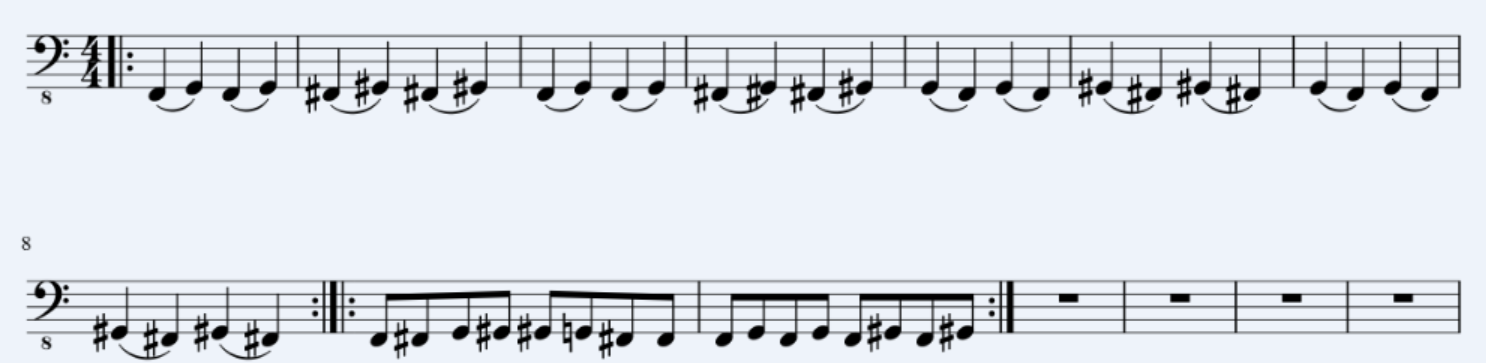
I think the best exercises involve practicing things that seem hard at first. I do like that video from TalkingTechnique posted above and will have to give that a try.
I think the best exercises involve practicing things that seem hard at first. I do like that video from TalkingTechnique posted above and will have to give that a try.
Use your pinky when you play. It's the only way. There are no shortcuts.
Just an FYI: Your little finger is stronger than the ring finger.How do I increase the strength of my little finger?
At a certain point, most players want to strengthen their ring finger.
John Patitucci's "spider exercise" is great.
Experiment with your own variations , too.
ariana cap is extremely skilled and deeply educated musically. she teaches across the bay from me.


