

Enjoy the benefits of a premium membership!
Upgrade Account
-
TalkBass has been independent since 1998. Add your voice.
Create a free account to reply to discussions, view embedded media, and browse with fewer display ads.
Join free Log in
Want zero display ads or expanded classifieds tools? Compare plans.
You are using an out of date browser. It may not display this or other websites correctly.
You should upgrade or use an alternative browser.
You should upgrade or use an alternative browser.
More options
Who Replied?
Yes, this is what I called "learning by example".
It does not however have to be done by oneself
(though that may be best, as things you figure out on your own stay with you best)
For those who think feel/groove is something you "have or don't":
How does someone just starting out determine if they "have it"?
How can the OP tell if his trouble "just feeling it" is because he "doesn't have it"?
How can tell if it's NOT perhaps because he hasn't yet logged the hours building his musical rudiments and a robust muscial vocabulary?
I just wouldn't pay for lessons where someone gives me examples to learn from for groove. I didn't need someone to do that for me. For technique or music theory related examples? Sure, but not for groove. It is most definitely about logging in the hours of experience. I don't think that feel/groove is something you either have or you don't. If you don't, other more seasoned musicians will tell you, though. Also, I don't think that feeling a groove, or grooves, is about musical rudiments, or a robust musical vocabulary. Groove can be felt from one note. Playing a lot of notes, or knowing a lot of music theory doesn't mean you have groove/feel, though.
P.S.
1. ) The OP has not responded to any of the TB-ers' comments in this thread. I hope he/she is OK.
2. ) To all those TB "impatient" members - this post WILL BE DELETED in order to maintain our TB forum decorum.
-------------------------
In short.
Conceptually, I agree with Lownote38, but realistically, I wholeheartedly support mambo4's educational ideas about GROOVE.
Here is my unedited(!) version/understanding about GROOVE.
Groove as
a dynamically-articulated,
persistently-repeated pattern (grouping),
based on some rhythmic/microrhythmic(!) tension/release (strong/weak beats) effects/nuances between the players/musicians
in order to create forward motion/propel the music along.
(P.S. But what if there is only one musician, let's say, a piano player?
Then, ...effects/nuances between his left and right hands.
But what if the piano player plays only with one hand?
Then, ...effects/nuances between the fingers of that one hand, etc...)
Having said it, I think there are a lot of elements of GROOVE that could be and SHOULD BE TAUGHT.
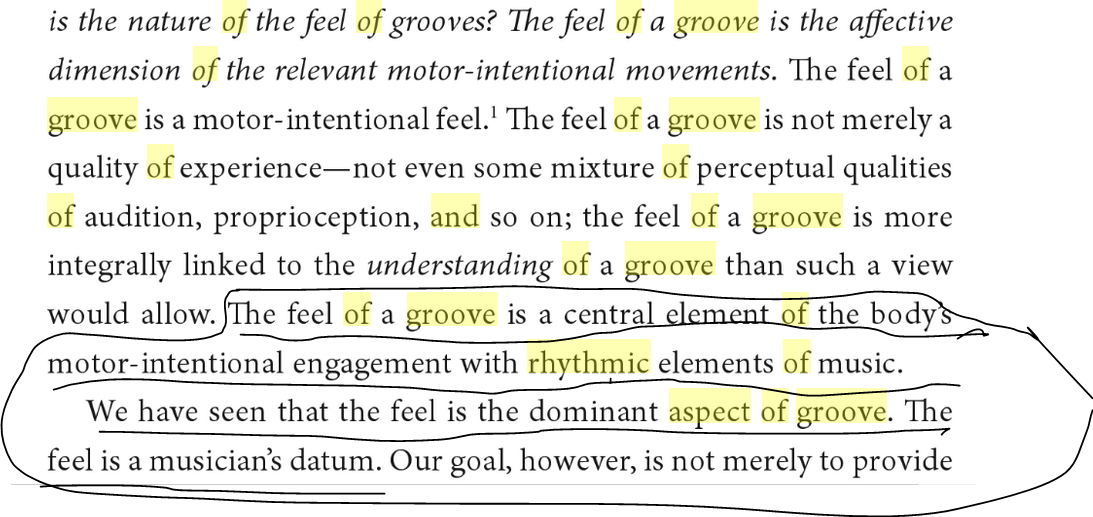
I think you've read the following book, "Groove: a phenomenology of rhythmic nuance"
By Tiger C. Roholt
Groove: a Phenomenology of Rhythmic Nuance: Tiger C. Roholt: 9781441104182: Amazon.com: Books
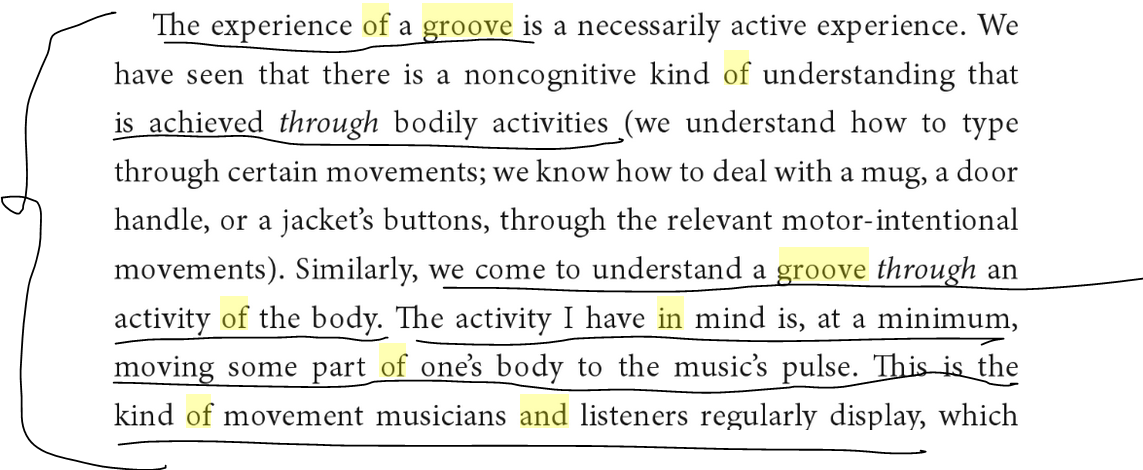
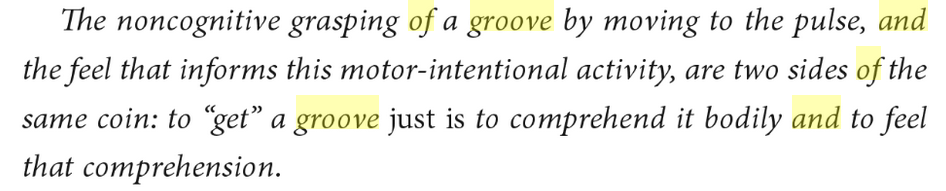
" T. Roholt explains why grooves, which are forged in music's rhythmic nuances, remain hidden to some listeners. He argues that grooves are not graspable through the intellect nor through mere listening; rather, grooves are disclosed through our bodily engagement with music. We grasp a groove bodily by moving with music's pulsations. By invoking the French philosopher Maurice Merleau-Ponty's notion of "motor intentionality," Roholt shows that the "feel" of a groove, and the understanding of it, are two sides of a coin: to "get" a groove just is to comprehend it bodily and to feel that embodied comprehension."
From that book.
Could you just elaborate more about that "one-note-groove"?
1. ) The OP has not responded to any of the TB-ers' comments in this thread. I hope he/she is OK.
2. ) To all those TB "impatient" members - this post WILL BE DELETED
in order to maintain our TB forum decorum.-------------------------
In short.
Conceptually, I agree with Lownote38, but realistically, I wholeheartedly support mambo4's educational ideas about GROOVE.
Here is my unedited(!) version/understanding about GROOVE.
Groove as
a dynamically-articulated,
persistently-repeated pattern (grouping),
based on some rhythmic/microrhythmic(!) tension/release (strong/weak beats) effects/nuances between the players/musicians
in order to create forward motion/propel the music along.
(P.S. But what if there is only one musician, let's say, a piano player?
Then, ...effects/nuances between his left and right hands.
But what if the piano player plays only with one hand?
Then, ...effects/nuances between the fingers of that one hand, etc...)
Having said it, I think there are a lot of elements of GROOVE that could be and SHOULD BE TAUGHT.
I just wouldn't pay for lessons where someone gives me examples to learn from for groove. I didn't need someone to do that for me.
I think you've read the following book, "Groove: a phenomenology of rhythmic nuance"
By Tiger C. Roholt
Groove: a Phenomenology of Rhythmic Nuance: Tiger C. Roholt: 9781441104182: Amazon.com: Books
" T. Roholt explains why grooves, which are forged in music's rhythmic nuances, remain hidden to some listeners. He argues that grooves are not graspable through the intellect nor through mere listening; rather, grooves are disclosed through our bodily engagement with music. We grasp a groove bodily by moving with music's pulsations. By invoking the French philosopher Maurice Merleau-Ponty's notion of "motor intentionality," Roholt shows that the "feel" of a groove, and the understanding of it, are two sides of a coin: to "get" a groove just is to comprehend it bodily and to feel that embodied comprehension."
From that book.
It's a beautiful expression.Groove can be felt from one note.
Could you just elaborate more about that "one-note-groove"?
Last edited:
As an Amazon Associate, TalkBass may receive commissions from qualifying purchases made via links on this site.
Check this out:
It's amazing how you can stack simple parts to create a complex whole. But it also seems to me like the "Tenor" guitar part is almost like a second bass line. It might make for an interesting exercise to/for me since I play a 6 string bass with a looper to program the drum part into a drum machine, then loop the bass line, tenor guitar part and rhythm guitar line, then practice improvising/soloing over it.
C/S,
Rev J
It's amazing how you can stack simple parts to create a complex whole. But it also seems to me like the "Tenor" guitar part is almost like a second bass line. It might make for an interesting exercise to/for me since I play a 6 string bass with a looper to program the drum part into a drum machine, then loop the bass line, tenor guitar part and rhythm guitar line, then practice improvising/soloing over it.
C/S,
Rev J
In my case I could play by feel but saddly some stuff was too complicated to be by feel, so I was off. No matter how hard I tried, it just didn't work. Until, until I worked on rythm with a teacher and with sheet music. Reading rythm, with a metronome, with my voice and then playing and listening to more complex music, helped me hear and count beats.
I also played some motown even though I didn't like it, it humbled me. the rythm isn't very complex but it is steady, syncopated and always changing and it is a little more interesting than some unmusical exercice
I also played some motown even though I didn't like it, it humbled me. the rythm isn't very complex but it is steady, syncopated and always changing and it is a little more interesting than some unmusical exercice
Here is another thing that helped me. I took some lessons from Kai Eckhardt and asked him to teach me Konnikol. Here is a video explaining the concept for guitar:
C/S,
Rev J
C/S,
Rev J
Here is another thing that helped me. I took some lessons from Kai Eckhardt and asked him to teach me Konnikol. Here is a video explaining the concept for guitar:
C/S,
Rev J
I've learn something similar at music school when reading rythm
It takes time to even *hear* the pocket, let alone play in it. Listen to lots of music with good groove - that will help.
Thanks u all TB-ers!!! I didn't expect so many responses from u as I think the question may sound quite naive to mature musicians. It took me quite a while to read through all yr replies, as there are so many different views and opinions. As a wrap up, It seems that the feel of groove seem can only come from an extensive period of endeavor in time and ear-training, to perceive the wisdom of groove from groovy musics...and for TBers saying "either hv it or not" my understanding is that u're meaning the "sense of groove" can't be developed with a particular method/set of steps. It just come at a certain point of yr music journey, i.e. U just get it. This thread is really a whole lot of collective wisdoms from u awesome TBers!!! There are so many things included in this thread so I'm still "digesting" yr shared "gems". Sorry I hv kept silent for these few days. I'm just stunned by so many wisdoms shared here
P.S.
1. ) The OP has not responded to any of the TB-ers' comments in this thread. I hope he/she is OK.
2. ) To all those TB "impatient" members - this post WILL BE DELETED
-------------------------
In short.
Conceptually, I agree with Lownote38, but realistically, I wholeheartedly support mambo4's educational ideas about GROOVE.
Here is my unedited(!) version/understanding about GROOVE.
Groove as
a dynamically-articulated,
persistently-repeated pattern (grouping),
based on some rhythmic/microrhythmic(!) tension/release (strong/weak beats) effects/nuances between the players/musicians
in order to create forward motion/propel the music along.
(P.S. But what if there is only one musician, let's say, a piano player?
Then, ...effects/nuances between his left and right hands.
But what if the piano player plays only with one hand?
Then, ...effects/nuances between the fingers of that one hand, etc...)
Having said it, I think there are a lot of elements of GROOVE that could be and SHOULD BE TAUGHT.
I think you've read the following book, "Groove: a phenomenology of rhythmic nuance"
By Tiger C. Roholt
Groove: a Phenomenology of Rhythmic Nuance: Tiger C. Roholt: 9781441104182: Amazon.com: Books
" T. Roholt explains why grooves, which are forged in music's rhythmic nuances, remain hidden to some listeners. He argues that grooves are not graspable through the intellect nor through mere listening; rather, grooves are disclosed through our bodily engagement with music. We grasp a groove bodily by moving with music's pulsations. By invoking the French philosopher Maurice Merleau-Ponty's notion of "motor intentionality," Roholt shows that the "feel" of a groove, and the understanding of it, are two sides of a coin: to "get" a groove just is to comprehend it bodily and to feel that embodied comprehension."
From that book.
View attachment 832677View attachment 832678
View attachment 832695
It's a beautiful expression.
Could you just elaborate more about that "one-note-groove"?
I haven't read that book. It seems to be treating groove like it's rocket science as far as terminology is concerned. As for elaborating on the "one-note-groove", I mean that it's how you play that note. It's how you feel it, and it's how it makes other people feel. Like I've said before, it's easier to just listen to different grooves until they sink in rather than try to be taught with words.
As an Amazon Associate, TalkBass may receive commissions from qualifying purchases made via links on this site.

While some of us love to disagree about the nature of "groove"
We're all unanimous that logging the hours playing and listening is the best solution.
We're all unanimous that logging the hours playing and listening is the best solution.
On Scotts Bass Lessons Scott defines our bass playing into 3 major categories:
1. Rhythm
2. Notes
3. Articulations
Notes are more about harmony and melody aspect of playing. Articulations are all the little things that make two bass players sound different even when playing the same bassline and the same bass amp eq combination. Articulations include ghost notes, note length, dynamics, slides, trills, hammer ons pull offs etc....
I think we can safely say that the notes category has little to do with groove.
This leaves us with Rhythm and Articulations. I would argue that Rhythm is the most important driver to groove because even though articulations are important, let's face it, in most live settings alot of those subtle things just won't be heard in the mix.
In my opinion it is best to isolate the rhythm by keeping the notes variable constant and simple. So pick a note simple groove but focus solely on the rhythmic feel. Our instrument is unique in that we are more closely related to drums yet we still play notes (best of both worlds in my opinion and why I love it so much).
Check out one of the most funkiest bands called "The Meters" for how groove sounds.
Also check out Bobby Vega. May the groove be with you.
1. Rhythm
2. Notes
3. Articulations
Notes are more about harmony and melody aspect of playing. Articulations are all the little things that make two bass players sound different even when playing the same bassline and the same bass amp eq combination. Articulations include ghost notes, note length, dynamics, slides, trills, hammer ons pull offs etc....
I think we can safely say that the notes category has little to do with groove.
This leaves us with Rhythm and Articulations. I would argue that Rhythm is the most important driver to groove because even though articulations are important, let's face it, in most live settings alot of those subtle things just won't be heard in the mix.
In my opinion it is best to isolate the rhythm by keeping the notes variable constant and simple. So pick a note simple groove but focus solely on the rhythmic feel. Our instrument is unique in that we are more closely related to drums yet we still play notes (best of both worlds in my opinion and why I love it so much).
Check out one of the most funkiest bands called "The Meters" for how groove sounds.
Also check out Bobby Vega. May the groove be with you.
I haven't read that book. It seems to be treating groove like it's rocket science as far as terminology is concerned. As for elaborating on the "one-note-groove", I mean that it's how you play that note. It's how you feel it, and it's how it makes other people feel. Like I've said before, it's easier to just listen to different grooves until they sink in rather than try to be taught with words.
Thanks for replying to my question.
About that book.
It's written by a drum player, and trust me, it does not treat GROOVE as some rocket science.
Here is the Intro part.
Further down, the author writes that even the punk music listeners feel groove through their bodies.
"one-note-groove", I mean that it's how you play that note. It's how you feel it, and it's how it makes other people feel.
I completely understand what you mean, and agree with you. It's just your wording could be confusing for other TB members.
As I've mentioned previously, conceptually I agree with you but realistically, I support and promote mambo4's point that groove can be explained and taught, in terms of "teaching the groove elements" - as Dynamically-Articulated rhythmic grouping of notes just in one bar, in two bars, etc...
Yes, you can feel that GROOVE through your body but without enough skills of your instrument, it could be difficult to create it.
Thanks for replying to my question.
About that book.
It's written by a drum player, and trust me, it does not treat GROOVE as some rocket science.
Here is the Intro part.
View attachment 833243 View attachment 833244
Further down, the author writes that even the punk music listeners feel groove through their bodies.View attachment 833264
I completely understand what you mean, and agree with you. It's just your wording could be confusing for other TB members.
As I've mentioned previously, conceptually I agree with you but realistically, I support and promote mambo4's point that groove can be explained and taught, in terms of "teaching the groove elements" - as Dynamically-Articulated rhythmic grouping of notes just in one bar, in two bars, etc...
Yes, you can feel that GROOVE through your body but without enough skills of your instrument, it could be difficult to create it.
I agree that you need enough skills before you understand what groove is, and you can be taught those things, but that's not teaching groove. The book quotes you posted attempt to explain what a groove is, but to me, how to play with a groove isn't explained. Dynamically-Articulated rhythmic grouping of notes? That can be interpreted with a groove, but it can also sound as square as... well a square! I stand with Jeff Berlin on the subject of groove. Don't read a book. Don't pay a teacher. Listen.
True, studying rhythm will take OP from point A to point B, not all the way to point Z. Yes, he could be stuck on B forever, playing with good rhythm but poor groove. Agreed.I agree that you need enough skills before you understand what groove is, and you can be taught those things, but that's not teaching groove. The book quotes you posted attempt to explain what a groove is, but to me, how to play with a groove isn't explained. Dynamically-Articulated rhythmic grouping of notes? That can be interpreted with a groove, but it can also sound as square as... well a square! I stand with Jeff Berlin on the subject of groove. Don't read a book. Don't pay a teacher. Listen.
Still, he'd better get to point B somehow. No one gets groove if they can't perceive rhythm well. It's not the whole package, but it's an important part.
Agreement, disagreement? Anyone know someone who can groove but can't keep a beat? I don't.
True, studying rhythm will take OP from point A to point B, not all the way to point Z. Yes, he could be stuck on B forever, playing with good rhythm but poor groove. Agreed.
Still, he'd better get to point B somehow. No one gets groove if they can't perceive rhythm well. It's not the whole package, but it's an important part.
Agreement, disagreement? Anyone know someone who can groove but can't keep a beat? I don't.
I totally agree with you. Rhythm is important, but it isn't groove. Z is a feeling and a way of interpreting B (using the letters you did).
... but that's not teaching groove.
I'm not arguing with you. It's kind of "describing the effects of some "medicinal treatment".
Each body/individual is different.
Dynamically-Articulated rhythmic grouping of notes?
It's MY expression how to interpret the foundation of GROOVE.
Let's take swing. Almost EVERY TB member knows and feels it, but each musician could interpret that sense of SWING slightly different.
What used to take a long and "emotional" debate many years ago, now it could be easily demonstrated with the help of the Internet, DAW.
Here is a web-site where you can listen to several "swing options":
Invalid Link Removed
"The main swing option in Logic dispenses with percentages altogether, offering a choice of six settings instead. In the case of 16th-note swing, these are called 16A through to 16F.
The manual defines those settings by swing percentage, using the same convention (50% = straight timing) as Linn:
16A: 50%
16B: 54%
16C: 58%
16D: 62%
16E: 66%
16F: 71%
Here's the effect those swing settings have on the timing of 16th notes, with 16A at the top and 16F at the bottom. The higher the level of swing, the more the evenly numbered 16th notes (highlighted in red) are delayed."
I think, those swing percentages, remind me our "argument" about GROOVE in this or any other TB threads.
One side (including me) says this,
"At a 60% swing setting, the first beat would take 60% of that 8th note."
The other side (including me) says this,
"I hate that 60% swing setting. Don't tell me how to set my swing setting. My preference is 78.3579345%."
And here is my point.
I'm not to force anybody to set their swing preferences to 66.66%. I'm to help understand what that percentage of SWING means and HOW TO achieve it.
Rhythm is important, but it isn't groove.
100% agree. You can really GROOVE but not be 100% perfect time wise.
In some other thread, Don Kasper posted Sade's song. As you know,
Sade - it's GROOVE, with all those Mr. Paul Spencer Denman's simple but "GROOOOVYYYYY" bass-lines.
I've decided to listen to Sade's LIVE concert in Argentina, and YES, the rhythm is there but I cannot say the same about the band's GROOVE.
Does it mean that Sound, Timbre, Tone, Mix is ALSO important when you play in the band?
I'm not arguing with you. It's kind of "describing the effects of some "medicinal treatment".
Each body/individual is different.
It's MY expression how to interpret the foundation of GROOVE.
Let's take swing. Almost EVERY TB member knows and feels it, but each musician could interpret that sense of SWING slightly different.
What used to take a long and "emotional" debate many years ago, now it could be easily demonstrated with the help of the Internet, DAW.
Here is a web-site where you can listen to several "swing options":
Invalid Link Removed
"The main swing option in Logic dispenses with percentages altogether, offering a choice of six settings instead. In the case of 16th-note swing, these are called 16A through to 16F.
The manual defines those settings by swing percentage, using the same convention (50% = straight timing) as Linn:
16A: 50%
16B: 54%
16C: 58%
16D: 62%
16E: 66%
16F: 71%
Here's the effect those swing settings have on the timing of 16th notes, with 16A at the top and 16F at the bottom. The higher the level of swing, the more the evenly numbered 16th notes (highlighted in red) are delayed."
I think, those swing percentages, remind me our "argument" about GROOVE in this or any other TB threads.
One side (including me) says this,
"At a 60% swing setting, the first beat would take 60% of that 8th note."
View attachment 833295
The other side (including me) says this,
"I hate that 60% swing setting. Don't tell me how to set my swing setting. My preference is 78.3579345%."
And here is my point.
I'm not to force anybody to set their swing preferences to 66.66%. I'm to help understand what that percentage of SWING means and HOW TO achieve it.
I would never suggest to someone the idea of swing in percentages. If you're in a group that plays swing, everyone has to swing the same, or it won't work, and I doubt they discuss percentages. In music school, a teacher would just say, "You're not swinging!" if you weren't tight with everyone. The only way to swing is to listen to those who did it well. Computers don't do it well in my opinion. Computers don't groove, and swing is a groove. The only thing you can even write on a chart that denotes swing is the word "swing" and a tempo.
Having taught bass in the past, I know very well that everyone is different, and I would instruct different students in different ways. I can teach someone how to play a bass line, but it's on the student to make it groove.


