• TalkBass has been independent since 1998. Add your voice.
    Create a free account to reply to discussions, view embedded media, and browse with fewer display ads.
    Join freeLog in
    Want zero display ads or expanded classifieds tools? Compare plans.

How to use compression

I'm starting to record and mix my band rehearsals, and I think it's time for me to understand compression. I think I understand the basic idea (i.e. it takes the lowest sound and increases the level) but I've never really used it before. I'm on a Tascam Model 24 which has built in compression on most of the channels and I find that when I'm doing my mixdown to 2-channels I'm having to ride the faders a lot because the level from myself and the guys in the band is all over the place. I've been recorded enough times to know that it's important to give the engineer a consistent level to work with, which isn't happening here. Can compression help? The 24 lacks motorized faders and so I can't write automation, and I'd rather not dump the recordings into the DAW and work with them there. Learning a DAW is on my list but I'm too busy right now, and the 24 doesn't integrate very well with it anyways. We generally jam once a week, so I'm trying to turn these mixes around on that timeline.

I guess a further question is, when recording live off the floor how much of the dynamics in the performance should come from the band and how much should come from the mix engineer? The guys in the band are very receptive to constructive criticism, so if I tell the bass player (I'm on drums) that I need him to play more consistently that won't be an issue, for example.

Also just to clarify, I'm not interested in the use of a compressor for ambiguous "tone" qualities...I'm solely concerned with trying to get a better and more consistent balance in my mix.

 
I thought that a limiter reduced the higher level and a comp increased the lower level?

Both compressor and limiter reduce the signal 'peaks.' The only difference is that a limiter has infinite 'ratio' (like hitting a brick wall) whereas compressors have a softer ratio.

Does your Tascam have a light or meter for the compressor? If so, you should notice the light comes on when you play loud (not when you play quiet) same as a limiter.

Hypothetically if the compressor were "increasing the lower levels" then it would work opposite (the compressor would activate when you play quiet).
 
Last edited:
I'm starting to record and mix my band rehearsals, and I think it's time for me to understand compression. I think I understand the basic idea (i.e. it takes the lowest sound and increases the level) but I've never really used it before. I'm on a Tascam Model 24 which has built in compression on most of the channels and I find that when I'm doing my mixdown to 2-channels I'm having to ride the faders a lot because the level from myself and the guys in the band is all over the place. I've been recorded enough times to know that it's important to give the engineer a consistent level to work with, which isn't happening here. Can compression help? The 24 lacks motorized faders and so I can't write automation, and I'd rather not dump the recordings into the DAW and work with them there. Learning a DAW is on my list but I'm too busy right now, and the 24 doesn't integrate very well with it anyways. We generally jam once a week, so I'm trying to turn these mixes around on that timeline.

I guess a further question is, when recording live off the floor how much of the dynamics in the performance should come from the band and how much should come from the mix engineer? The guys in the band are very receptive to constructive criticism, so if I tell the bass player (I'm on drums) that I need him to play more consistently that won't be an issue, for example.

Also just to clarify, I'm not interested in the use of a compressor for ambiguous "tone" qualities...I'm solely concerned with trying to get a better and more consistent balance in my mix.
Gain stage everything in the green. Don't worry about levels...at all. Just set everyone at a good signal, so that they aren't clipping. Mixing, is done in your DAW. Do not add compression pre input. Just trust me. You will not like your results. You can't work a bad recording in to anything but a bad recording. It's a turd. It will never be anything but a shiny turd.


Just to clarify, compression doesn't take the low sounds and make them louder. Compression takes loud sounds, and makes them quieter. It has absolutely no effect on anything under it's threshold.

You set a threshold. Anything that crosses that threshold, gets a gain reduction according to the rate of compression. 2:1 4:1 10:1 up to infinite (which is a limter. A limiter knocks everything over the threshold, down to the threshold).

Edit:

2:1 compression means that for every 2 over the threshold, it only lets 1 over. As in, your threshold is set at 10. Once your signal hits 12, it brings it down to 11. If it hits 14, it brings it down to 12. Get it?

4:1 means that for every 4 over, it only let's 1 over. Once it hits 14, it brings it down to 11. And so on.


What this does is allow you to bring up the volume, because the peaks are getting knocked down, and not causing clipping. But, then your loud parts become just as loud as your quiet parts.


Attack, is how fast your compressor kicks in. Fast attack, means that it squashes your sound, and eliminates your high end when it does so. Think of popping your string while muting it. Slow attack means it kicks in after the spike. Like popping your string, then muting it.

Release is how long it holds the signal. Fast release, means that the signal gets quiet, then gets louder. Slow release would keep it squashed. Too slow release, would hold it into the next spike.


Compression is an engineer's greatest asset. But with inexperience, it's also your greatest enemy. But how do you get experience? Time and practice.


(Yeah, I said it wrong to begin with. The next guy said it right)
 
Last edited:
Both compressor and limiter reduce the signal 'peaks.' The only difference is that a limiter has infinite 'ratio' (like hitting a brick wall) whereas compressors have a softer ratio.

Does your Tascam have a light or meter for the compressor? If so, you should notice the light comes on when you play loud (not when you play quiet) same as a limiter.

Hypothetically if the compressor were "increasing the lower levels" then it would work opposite (the compressor would activate when you play quiet).

Yes, 12 channels on the board have a compression knob with a light. No meters unfortunately. I'll have to read the manual to see how it's set, there's no attack/release/ratio controls.
 
2:1 compression means that when your signal hits the threshold, it knocks it down 2db. As in, your threshold is set at 10. Once your signal hits 11, it brings it down to 9. If it hits 14, it brings it down to 12. Get it?

4:1 means that it brings it down 4db for every 1 over. Once it hits 11, it brings it down to 7. And so on.

This is totally wrong. A compressor that worked like that wouldn't sound very good (test it in your DAW and see for yourself). It would be hard for studio musicians to give a good dynamic performance, with a type of compressor that hypothetically worked like that. As a thought experiment, imagine what a 20:1 ratio would sound like.

How it actually works once your signal crosses the threshold is: (input - threshold) / ratio

If your threshold is 10dB and your ratio is 4:1 then a signal of 11dB gets compressed to 10.25db, a signal of 14dB is compressed to 11dB, a signal of 18dB is compressed to 12dB, etc.

(If you know graphing, a compressor's ratio changes the 'slope' of the equation above the threshold.)

And a limiter has infinite ratio, so it's like there is a 'brick wall' and it never gets louder than the threshold (10dB in our example).
 
Last edited:
This might be helpful...


This guy tends to explain things in layman's terms, I use Cakewalk and he has a lot of tutorials for that DAW. He also has good overall tutorials.

One other thing that will be helpful is to understand the concepts of mastering, basically once you have your main mix sounding ok applying EQ, compression, etc... to the master tracks (main mix).

Cheers
 
Last edited:
How it actually works once your signal crosses the threshold is: (input - threshold) / ratio

If your threshold is 10dB and your ratio is 4:1 then a signal of 11dB gets compressed to 10.25db, a signal of 14dB is compressed to 11dB, a signal of 18dB is compressed to 12dB, etc.

(If you know graphing, a compressor's ratio changes the 'slope' of the equation above the threshold.)
.

The above is the right explanation of ratio...if its set to 4:1 for example, it will take a signal 4 db louder than threshold for the comp to let it go 1 db above threshold. In other words, the compressor will let 1 db through for a signal that is 4db above threshold.
One-knob comps usually implement a continuously lower threshold + higher ratio as you turn the comp knob up, and continuously shorter attack + longer release as you turn the comp knob up.
 
There's a lot of good info above.

Here Some Odds and Ends:
"Kick Drum and Bass Guitar Side Chaining" - this is usually done through compression. It keeps the bass drum + bass from over driving the bass regions.

"MultiBand compression" - Especially if you do slap, and you find you're loosing some low end on the thumb, and picking up too much snap on the finger pull.

"Waves Bassrider" - Not a compressor, but it can ride the gain like a recording engineer might do. Just watching it do it's work can help you mix the bass levels.

Isotope is one company that has a huge range of tools to analyze your mix and make suggestions on making it sound "popular". Find a recording of a song you like, it can profile it, and then make suggestions for your own mix. Expensive, but very valuable.
 
Technically, compression does not make the signal louder, as others have said. However, it allows you to mix a given instrument so that the average level is louder without the peaks being excessive or distorting.

I believe the most likely explanation for the belief that compression makes things louder comes from how compression was used in FM radio mastering.

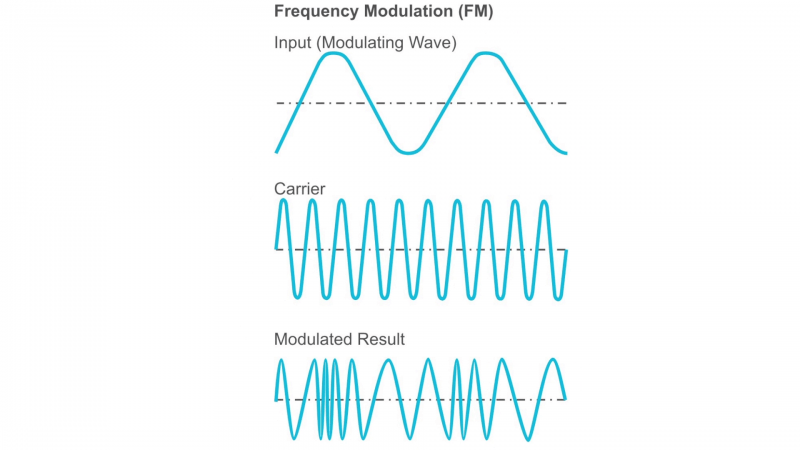
FM means frequency modulation. To encode a sine wave, the frequency changes.
Image-7-800x450.png

The upper peaks of the waveform produce the highest frequency, and the lower peaks in the waveform produce the lowest frequency.

The way to make an FM broadcast sound louder in a receiver to increase the modulation (how much the frequency varies up and down. However, FM radio stations are only allowed so much bandwidth. If the station modulates the signal so much that it produce frequencies that are higher or lower than the channel limits, the station can receive a very large fine from the FCC.

Back in the day, popular FM radio stations wanted to produce the loudest possible signal. The idea is as you tune different channels, the loudest channel will sound best, and presumably get the most listeners.

Compression is used to allow the FM station to increase the average modulation: Making the channel sound louder; while simultaneously compressing the peaks so the carrier stays within the bandwidth allocated to the channel.

Compression can be used in pretty much the same way in a mix. The compressor cuts off the peaks and you push up the make-up gain. In effect you are reducing the dynamic range, so the softer parts are louder and the louder parts are softer, and the average volume goes up.

This can help the bass sit in the mix. In other words the bass does not disappear when it plays too soft or blow out the mix when it plays too loud.

As a bass player I don't generally use compression on stage. I want my stage sound to cut through, so I can hear what I am doing.

As an audio tech, I used compression on most channels. Using appropriate compression helps make the mix sound smoother and more polished/refined.

IMHO compression is probably most important on vocals. Most people don't actually sing all that well. Applying light compression can smooth out a lot of imperfections. However, it's important to avoid compressing the vocals in the singer's personal monitor(s). If the vocals are compressed in monitors, it makes the singer feel disconnected from their voice. They are likely to compensate by over singing, which may result in them loosing their voice.

I don't generally use compression as an effect, so I keep the ratio fairly low. About the highest ratio I remember using is 6:1. I have used this on some vocals, but with most I use 4:1 or lower. I believe I typically set the threshold so the max compression was in the range of about 10dB with 4-6dB of makeup gain. These numbers may not be 100% accurate, as it has been quite awhile since I mixed.
 
Last edited:
Your “basic understanding” of what compressors do is almost exactly wrong. I’m not saying that to be rude or condescending. It’s just one of those really bad bits of information about compressors that i see on tutorials and videos all over the internet by people who have no idea how compressors work, so it’s not surprising this is how it was explained to you. People don’t need any sort of credentials or actual understanding of audio engineering or signal processing to have a YouTube channel about signal processing. :(

Compressors reduce dynamic range. That is what they do. That is all they do. That can be used in various ways to create different characteristics in the sound. Reducing dynamic range is also a form of level reduction. Compressors make things have less volume. I have links below to my really good explanation of what compressors are, how they work, and why people mistakenly think they make things louder. Definitely give it a read. It’ll help understand compressors, I promise: ;)

This is my detailed yet understandable explanations
of what compressors actually do and how to used them.

Here’s a little deeper on compressors.

And then just a little bit more for better understanding.
 
I always thought of a compressor as a tube of toothpaste. It's tall when you lay it on its side. When you squeeze it, the paste gets longer and shorter as it escapes from the tube. A compressor does that with a signal. It takes the "height" (extreme peaks) and squishes down into a more manageable space resulting in the aural sensation of increased sustain as the note decays. A good example of this is BTO's "Takin' Care Of Business". When the instruments stop, and it's just drums and vocals the drums seem to get louder. Without the other instruments to compete with, the drums are at their normal volume. When the other instruments come in, the drums fade almost into the background to make room for them. The mix itself is what is most important, not the individual instruments. (Your show-off guitarist will hate this concept. ;)) What seems to work best for a recording is to have a soft knee. That makes the compression less noticeable to the listener. When using a compressor just for your bass (as part of your pedalboard) a hard knee is usually better. You can adjust it so the finger noise and background interference are reduced. Hope this helps.
 
Ok. I’ve done the recording rehearsal scenario with past bands, to a daw, iterating mixer settings week to week to improve the inputs.

The likely result is clear recording of what the band sounds like and a way to revisit “jams”.

if the results are wildly inconsistent that is the player’s fault mostly. Recording rehearsals puts everyone under a microscope, which is mostly good in my opinion, especially if the microscope reveals a need to get better as players and as a band that performs together.