This is something I've been thinking about quite a bit. I have a few connections and some heavy hitter scientific type friends who could help me pull it off.
The idea is to design and execute a double-blind tonewood study. I'd like to get some ideas from the others around here.
Here is what I have come up with already.
Because of the sheer number of species used in bass production, the study would necessarily be limited to hardwoods commonly used in the manufacture of solid-body electric bass guitars.
Here's the general idea:
Using automated tools wherever possible, build 20 sample bass bodies out of billets of each designated test species.
Test species would include: alder (Alnus rubra), ash (Fraxinus pennsylvanica), swamp ash (also Fraxinus pennsylvanica), basswood (Tilia americana), genuine mahogany (Swietenia macrophylla), african mahogany (Khaya ivorensis), and soft maple (Acer rubrum).
So that's 140 bass bodies. The lumber should be selected either randomly or based on a strict set of quality control parameters. If we further specified only domestic American hardwoods, it'd be 100 bodies.
Each body would then be sealed, painted, and given a clear coat. To ensure as far as possible identical finishing jobs, the bodies should be weighed between each step, and the same amount of sealer, paint, and clear coat should be applied to each body. They'd have to be painted to maintain a blind recording. If the musician can recognize the species of wood when recording on sight, the whole thing is sunk.
A serial number inside the electronics cavity should be the only identifying mark, and the serial number should be a bar code encoding of a random string of numbers and letters, so that there's no chance of the musician figuring out what it is.
After the finishes have been allowed to fully cure, recording would begin.
The same neck and hardware should be used on all bass bodies. I think there should be no controls...just a pickup and an output jack.
Each recording should begin with a new set of strings.
I'd need a few musicians willing and able to record the same test bass line about a zillion times. I'd want at least 10 recordings of the same test bass line on each bass, so that's 1400 recordings per musician. An extensive questionnaire should immediately follow each performance, including a question about which species the musician thinks the bass was. At no point should the musician ever be told that he/she is right or wrong about anything.
The test bass line should fully exploit the frequency range of the instrument. A part of each track should be mixed with a pre-recorded band, so that the test also includes the sound of the instrument when mixed with other instruments.
After all the recording is done, a small army of listeners (both musically educated and musically "ignorant") should be recruited to listen to each track.
I'm not really certain what they should be looking for, other than exaggerated or attenuated frequency bands. I'm not a tonewood believer. Any questions regarding "full" or "open" or "bright", or "dark", or whatever other adjective you want should be reformulated to describe what those terms actually mean, in language that any listener can understand. If you can't explain the question, it's not a valid question.
Thoughts? Opinions (other than how stupid I am, because I already know that)? Ideas? Suggestions?
Thanks.
The idea is to design and execute a double-blind tonewood study. I'd like to get some ideas from the others around here.
Here is what I have come up with already.
Because of the sheer number of species used in bass production, the study would necessarily be limited to hardwoods commonly used in the manufacture of solid-body electric bass guitars.
Here's the general idea:
Using automated tools wherever possible, build 20 sample bass bodies out of billets of each designated test species.
Test species would include: alder (Alnus rubra), ash (Fraxinus pennsylvanica), swamp ash (also Fraxinus pennsylvanica), basswood (Tilia americana), genuine mahogany (Swietenia macrophylla), african mahogany (Khaya ivorensis), and soft maple (Acer rubrum).
So that's 140 bass bodies. The lumber should be selected either randomly or based on a strict set of quality control parameters. If we further specified only domestic American hardwoods, it'd be 100 bodies.
Each body would then be sealed, painted, and given a clear coat. To ensure as far as possible identical finishing jobs, the bodies should be weighed between each step, and the same amount of sealer, paint, and clear coat should be applied to each body. They'd have to be painted to maintain a blind recording. If the musician can recognize the species of wood when recording on sight, the whole thing is sunk.
A serial number inside the electronics cavity should be the only identifying mark, and the serial number should be a bar code encoding of a random string of numbers and letters, so that there's no chance of the musician figuring out what it is.
After the finishes have been allowed to fully cure, recording would begin.
The same neck and hardware should be used on all bass bodies. I think there should be no controls...just a pickup and an output jack.
Each recording should begin with a new set of strings.
I'd need a few musicians willing and able to record the same test bass line about a zillion times. I'd want at least 10 recordings of the same test bass line on each bass, so that's 1400 recordings per musician. An extensive questionnaire should immediately follow each performance, including a question about which species the musician thinks the bass was. At no point should the musician ever be told that he/she is right or wrong about anything.
The test bass line should fully exploit the frequency range of the instrument. A part of each track should be mixed with a pre-recorded band, so that the test also includes the sound of the instrument when mixed with other instruments.
After all the recording is done, a small army of listeners (both musically educated and musically "ignorant") should be recruited to listen to each track.
I'm not really certain what they should be looking for, other than exaggerated or attenuated frequency bands. I'm not a tonewood believer. Any questions regarding "full" or "open" or "bright", or "dark", or whatever other adjective you want should be reformulated to describe what those terms actually mean, in language that any listener can understand. If you can't explain the question, it's not a valid question.
Thoughts? Opinions (other than how stupid I am, because I already know that)? Ideas? Suggestions?
Thanks.



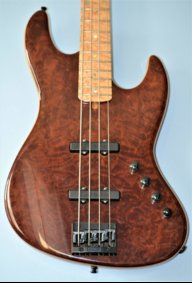
 ) not even get a vote on sound? I suppose if he could see the wood, there's a variable right there.. it could affect his playing (oooo, wenge! sweet! Ewww, basswood. Ghetto bass). But I'd guess that a darkened studio (and/or blindfolded musician) would introduce far fewer variables than paint. How about one of those guitar body sleeves, like a beer koosie?