
Enjoy the benefits of a premium membership!
Upgrade Account
-
TalkBass has been independent since 1998. Add your voice.
Create a free account to reply to discussions, view embedded media, and browse with fewer display ads.
Join free Log in
Want zero display ads or expanded classifieds tools? Compare plans.
You are using an out of date browser. It may not display this or other websites correctly.
You should upgrade or use an alternative browser.
You should upgrade or use an alternative browser.
I 3D printed a bass!
- Thread starter MrCoolsville
- Start date
More options
Who Replied?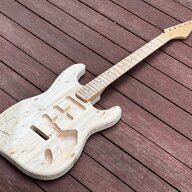

If you print it again, perhaps use PETG. I know the designer of the PrusaCaster said to not use PETG as it has more creep than PLA, but he is wrong. PETG has less creep than PLA. There are a few YouTube tests proving that. That being said, I was planning to use PLA.
If this ends up warping, I can design the model so that you pause the print, insert square steel tubing, and then continue the print.
By the way, here is one of the two guitars I made for my son out of 2x4s. The hardest part was actually painting them.
If this ends up warping, I can design the model so that you pause the print, insert square steel tubing, and then continue the print.
By the way, here is one of the two guitars I made for my son out of 2x4s. The hardest part was actually painting them.
Attachments


Very cool - I liked it blue lol ..as a side note ..we use a plastic bonding agent in the sign industry called Weld On - as it sounds..it legit melts the two plastics together - i highly doubt they wont have a product that would work ..AND its' clear. May want to use that next time - and in a well ventilated area ...really neat build - Enjoy.
Hmm. It may be actually cheaper to buy a $110 cheap bass from Amazon and take the parts of it, though it is kinda weird to take a working bass and scrap it just to replace the wood with 3D printed shape of lesser quality. But a cheap bass is not interesting unless I make it myself.
I'd bet a CNC'd wood bass would be much cheaper and easier to put together albeit not as unique.
I have done it both ways. The CNC requires flipping the wood and aligning it. I did that with dowel pins, but it was a lot of mental energy. I did one of them with optimized tool paths, and the other wood one I just used an STL and 3D surfacing - which was way easier.
I bought a $60 Alderwood blank and decided to practice on 2x4s glued together. I still have the nice wood blank and may use it later.
Personally I consider printing a lot easier than CNC.
Here is how the pine/fur 2x4 ones came out. One I painted with enamel spray cans, and one with lacquer. That was a nightmare. I got the finish bubbling up and had to redo it many times.
Hmm. Now I just noticed one doesn't have a truss rod on the neck. Bought it before I knew anything.
Attachments


If you print it again, perhaps use PETG. I know the designer of the PrusaCaster said to not use PETG as it has more creep than PLA, but he is wrong. PETG has less creep than PLA. There are a few YouTube tests proving that. That being said, I was planning to use PLA.
If this ends up warping, I can design the model so that you pause the print, insert square steel tubing, and then continue the print.
By the way, here is one of the two guitars I made for my son out of 2x4s. The hardest part was actually painting them.
Yea, I'll probably do PETG next time if only for heat resilience. Any little warping in the body is bad, so PETG's higher melting point and stronger rigidity would be helpful.
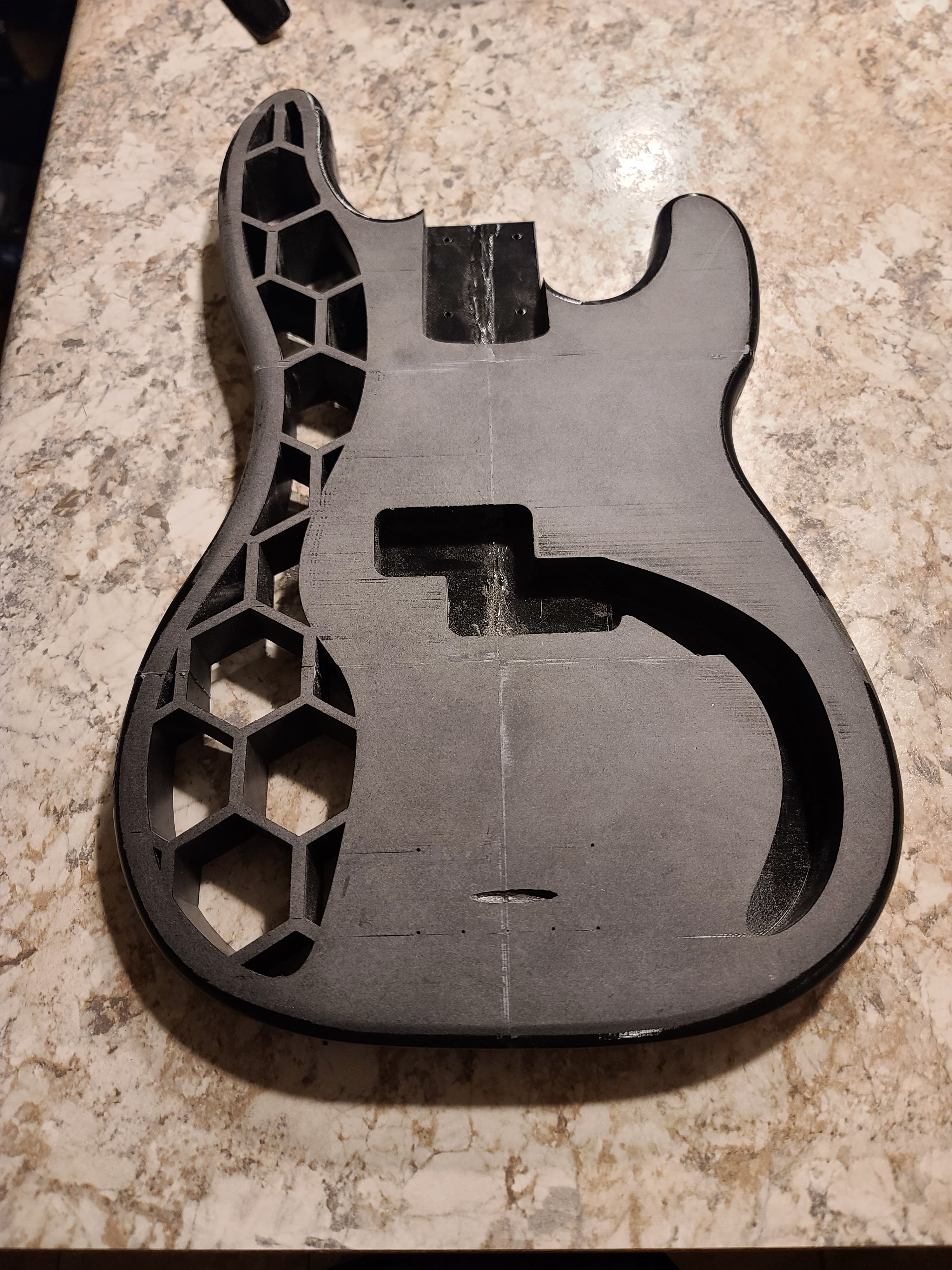
How has the bass held up for the past year or so? I am starting the sanding process and it seems to be going well so far. I bought some carbon fiber rods instead of using the printed ones, printed with PETG, and used JB Weld Plastic Bonder to fill gaps and glue it together. I'm pretty confident it will hold up, but I keep thinking back to your break and am considering putting the steel spine in as you did. I'd like to use automotive filler primer, then paint the whole thing honey yellow but keep the insides of the hexagons black. Trying to figure out now how to sand the inside of the hexagons. Maybe a Dremel?
As an Amazon Associate, TalkBass may receive commissions from qualifying purchases made via links on this site.
How has the bass held up for the past year or so? I am starting the sanding process and it seems to be going well so far. I bought some carbon fiber rods instead of using the printed ones, printed with PETG, and used JB Weld Plastic Bonder to fill gaps and glue it together. I'm pretty confident it will hold up, but I keep thinking back to your break and am considering putting the steel spine in as you did. I'd like to use automotive filler primer, then paint the whole thing honey yellow but keep the insides of the hexagons black. Trying to figure out now how to sand the inside of the hexagons. Maybe a Dremel?
View attachment 5308775
I printed with PLA and it hasn't held up well. I mentioned it a few comments above, but last summer it got really hot in my studio while I was on vacation and the body warped just a little. It's not noticeable to the eye, but it's enough to make the string height almost unplayable. Your print in PETG should avoid that problem, but I can't speak to how strong the joints will be without the steel spine I installed.
As for sanding inside the hexagons, I didn't even bother. You can only tell when you're looking very closely, and I kind of like the idea of seeing print lines there to remind you that the whole thing is printed

As an Amazon Associate, TalkBass may receive commissions from qualifying purchases made via links on this site.
Man, sorry to hear about your bass. I sanded the whole thing down to 3k today but didn't even try to sand inside the hexagons. Is there a trick to painting inside the smaller holes?I printed with PLA and it hasn't held up well. I mentioned it a few comments above, but last summer it got really hot in my studio while I was on vacation and the body warped just a little. It's not noticeable to the eye, but it's enough to make the string height almost unplayable. Your print in PETG should avoid that problem, but I can't speak to how strong the joints will be without the steel spine I installed.
As for sanding inside the hexagons, I didn't even bother. You can only tell when you're looking very closely, and I kind of like the idea of seeing print lines there to remind you that the whole thing is printed
Man, sorry to hear about your bass. I sanded the whole thing down to 3k today but didn't even try to sand inside the hexagons. Is there a trick to painting inside the smaller holes?
Not sure I did it the best way, but I just carefully sprayed in there while the bass was suspended in mid-air. Be careful not to overspray, or else you’ll get runs in there!
I have been wanting to print one for my dad, he's a 77 year old blues bass player. I have been in all kinds of different electrical / mechanical jobs my whole life, just started getting into 3d printing. I was thinking of maybe making the center section of a piece of milled aluminum and the just connecting the body and neck to that.
If i come up with something I will post it here.
If i come up with something I will post it here.

As I was reading the 1st post, what came to my mind was the tension.
Expected to see your exact results with the body snapping.
I would find a neck through body bass and take it to the band saw and experiment with the next design.
Expected to see your exact results with the body snapping.
I would find a neck through body bass and take it to the band saw and experiment with the next design.

Hi
My 2 cents.
I had printed 4 guitars and now I am working on printed bass.
PETG is the best. PLA will get soft in hot car trunk.
First I printed core too, but now I am using wood core from neck to bridge. 2 are bolted on, last bass is glued on. No movement regarding action even on 7 string multiscale.
Don't make body super light. I made one and it was unplayable. Crazy neck dive. I had to scrap that body and print new heavier one.
I printed one neck. Installed CF rods, truss rod, frets, it is useless. I would need to print fret board in one single piece or install wood fret board. There is no intonation at all on this neck due to gluing pieces together.
My 2 cents.
I had printed 4 guitars and now I am working on printed bass.
PETG is the best. PLA will get soft in hot car trunk.
First I printed core too, but now I am using wood core from neck to bridge. 2 are bolted on, last bass is glued on. No movement regarding action even on 7 string multiscale.
Don't make body super light. I made one and it was unplayable. Crazy neck dive. I had to scrap that body and print new heavier one.
I printed one neck. Installed CF rods, truss rod, frets, it is useless. I would need to print fret board in one single piece or install wood fret board. There is no intonation at all on this neck due to gluing pieces together.


