• TalkBass has been independent since 1998. Add your voice.
    Create a free account to reply to discussions, view embedded media, and browse with fewer display ads.
    Join freeLog in
    Want zero display ads or expanded classifieds tools? Compare plans.

Double Bass I am curious, why don't more people play 5 string upright?

Aug 30, 2014
1,869
1,614
58
I am really curious. After researching, it is obvious that not a lot of people play the 5 string upright.

Why?

I would think the high C or low B would come in very handy, especially when soloing in jazz. Also, one could avoid moving up and down the neck all the time.

Some have said that the:
1. extra string tension from the 5th string kills the tone.
2. extra mass in the neck and fingerboard kills the tone.
3. extra width and girth makes it too difficult to play.

I am sure all these are facts and not some truth according to one or two personal experiences.

Is the 5 string upright so difficult to make correctly?

I know that on an electric, the low B string sounds different than the other 4 strings (fragmented) and if it is, it makes it very difficult to make it sound natural when trying to incorporate it into passages. The high C on the other hand is relatively easier to incorporate into the overall tone.

Anyway, why won't more people get on the 5 string train?

 
I am really curious. After researching, it is obvious that not a lot of people play the 5 string upright.

Why?

I would think the high C or low B would come in very handy, especially when soloing in jazz. Also, one could avoid moving up and down the neck all the time.

Some have said that the:
1. extra string tension from the 5th string kills the tone.
2. extra mass in the neck and fingerboard kills the tone.
3. extra width and girth makes it too difficult to play.

I am sure all these are facts and not some truth according to one or two personal experiences.

Is the 5 string upright so difficult to make correctly?

I know that on an electric, the low B string sounds different than the other 4 strings (fragmented) and if it is, it makes it very difficult to make it sound natural when trying to incorporate it into passages. The high C on the other hand is relatively easier to incorporate into the overall tone.

Anyway, why won't more people get on the 5 string train?
I would think that adding a low B, would require extensive changes to the body, top and bracing. I wonder how many luthiers have the resources to research and prototype purpose-build a great 5-string upright, never mind make one that competes with so many generations of 4-string tradition.

There's a tradition of using C extensions on upright as well. Perhaps that's all that's needed in many cases, for the rare occasions when extra range is needed.

Also, players of traditional instruments tend to be more conservative about innovation.

I hear you about the poor integration of the B-string on electric bass, although I believe a lot of people overlook the influence of amplification in this. There are a lot of great conventional bass cabs (and heads) that aren't B-string friendly.

However, these days there are lots of excellent options out there for EB. Check out a late-model Dingwall Combustion, for instance.
 
Funny, here in Germany I'm wondering why nobody uses extensions.

It's more about traditions and availability. Everybody in the US is used to seeing extensions everywhere, so it sits in each student's mind that it's the standard. Because of that, there are tons of basses already fitted with extensions and plenty of luthiers trained to install new ones. 5 stringers are rare, and the conversion process is expensive, complicated, and harder to undo.

It's the opposite issue here. 5 strings are easy to find and none of the luthiers I know are equipped to make extensions.
 
It's a regional thing.
At the end of the nineteenth century, German orchestras accepted the 5-string bass while the Brits started fitting basses with extensions. Here in Japan, like in Germany, extensions are extremely uncommon. Most sections are a majority 5 string basses.
I personally don't like the feel of the neck on those big German basses. 5-string basses are not usually built as general purpose instruments - they are big basses conceived for orchestra playing. Solo playing on these big basses is generally unheard of.
 
I would welcome a bass with a high C string for jazz if I found the right bass and became convinced that there was a viable option for the high C string. I think the low B string can be cool when other people use it but never really wanted one for myself.
 
Anybody know about those hatpeg tuners in the Lamarre video? I want those!
Media

Yeah, the details he works into the design are insane - and each bass is unique! Diana Gannett's Venus bass has sea shell motifs on the tuners, tailpiece, button and saddle.

There's an article about those pegs from the Strad magazine. He's designing and carving them himself to match the theme of the bass
Then, as you can see in the article at the bottom of the page, he modifies the machines so you can wind the peg freely like a violin to speed up string changes and then put the peg back in the machine. So, the hat pegs actually serve a purpose. Really cool!
 
One of the stumbling blocks for usage in the states is the problem of availability / learning curve. If you want a fiver in the states, they're not terribly easy to find and advanced four-stringers are a little apprehensive about making the switch. I special ordered my first one (a beautiful Christopher Hybrid with Bussetto corners) and traded it in for my current bass.
Set up can be challenging for luthiers who aren't used to working on them (for example: getting the bridge/fingerboard curve dialed in for arco playing is really critical).
 
Wasn't the old Kay Chubby Jackson 5 string tuned with a high C?

Yes, all Kay five-string models (M-51, M-5, M-5B, S-51, S-51B, S-58, S-59) were designed for the high C. I use them mainly for jazz improvisation, as someone else mentioned, but they can be handy in other situations where you'd rather not be jumping into thumb position.

Kay five-strings are built exactly as the fours are, excepting the wider fingerboard and nut, tuning machines and tailpiece. In my experience the fives don't speak as fully as the fours given the same setup. I think modern strings tend to carry higher tension than those the basses originally employed, and I get better results with lower-tension strings. The wider fingerboard doesn't bother me at all, I think it improves the thin Kay neck.
 
Contrast an extension with a low fifth string.

The extension gives you:
. Regular neck width
. Regular string spacing
. No alteration to bracing
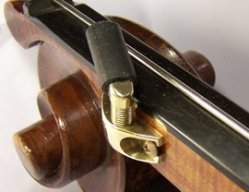
. With a modern extension, completely reversible installation
. With capos, some different options for drones
. Truer-sounding low note, i.e. less 'flap'

The low B string gives you:
. Play double-stops (in a range where some double-stops might not sound so well)
. Play some lines without shifting up to the extension
. Guaranteed fit in your current case / bag
 
Contrast an extension with a low fifth string.

The extension gives you:
. Regular neck width
. Regular string spacing
. No alteration to bracing
. With a modern extension, completely reversible installation
. With capos, some different options for drones
. Truer-sounding low note, i.e. less 'flap'

The low B string gives you:
. Play double-stops (in a range where some double-stops might not sound so well)
. Play some lines without shifting up to the extension
. Guaranteed fit in your current case / bag
There's some repertoire which only works with one or the other. Plenty of composers today like those low rumbling double stops. A few composers want natural harmonics only available with extension capos, while others want B-string harmonics. Or even double stopped B and E string harmonics.

That's why I have both. But I'm probably the only one here dealing with that specific issue on a regular basis.
 
Here in the UK these days there's a mixof C extensions and 5 string basses. Personally - and it's only my view - I've never met a 5-string that I'd want to play every day. Can't get on with the shap and size of the neck and fingerboard. They just feel cumbersome to me. But then I have a Pete Barnaby mechanical C extension which I love, and that's a pretty niche viewpoint. My 4-string sounds great with the C extension, better than any 5 I've played. But what do I know?
 
  • Like
Reactions: Whippet
I have a NS CRM5 that I love playing. I think for me it was Eberhard Weber that got me started.
Saw him a few times on a similar 5-string EUB and I was hooked. YMMV

However the cost of replacing windows and wine glasses due to hitting the low B with gusto
played thru a Mesa Eight-88 > 2x Berg NV115 cabs is starting to get expensive... :)
 
Media...
... Then, as you can see in the article at the bottom of the page, he modifies the machines so you can wind the peg freely like a violin to speed up string changes and then put the peg back in the machine. So, the hat pegs actually serve a purpose. Really cool!
That's what I was getting at. I've seen "quick-release" style hatpeg tuners a few times in my life and wondered why they aren't all like that. String changes are so much easier and faster.
 
However the cost of replacing windows and wine glasses due to hitting the low B with gusto
played thru a Mesa Eight-88 > 2x Berg NV115 cabs is starting to get expensive...

I found the resonant frequency of Red Hook, NY with mine thanks to a really good PA. It's Db.

Other than that, I've found the extra string to be in the way more than anything, to be honest.
 
I would welcome a bass with a high C string for jazz if I found the right bass and became convinced that there was a viable option for the high C string. I think the low B string can be cool when other people use it but never really wanted one for myself.

I 'd think that the high c would be very useful for jazz. Along with a B string. But yet, most people play 4 strings.
 
  • Like
Reactions: matthewbrown
Here in the UK these days there's a mixof C extensions and 5 string basses. Personally - and it's only my view - I've never met a 5-string that I'd want to play every day. Can't get on with the shap and size of the neck and fingerboard. They just feel cumbersome to me. But then I have a Pete Barnaby mechanical C extension which I love, and that's a pretty niche viewpoint. My 4-string sounds great with the C extension, better than any 5 I've played. But what do I know?

Many say that the neck is just too cumbersome. Is it the width or the thickness for you?