• TalkBass has been independent since 1998. Add your voice.
    Create a free account to reply to discussions, view embedded media, and browse with fewer display ads.
    Join freeLog in
    Want zero display ads or expanded classifieds tools? Compare plans.

Double Bass I am curious, why don't more people play 5 string upright?

I found the resonant frequency of Red Hook, NY with mine thanks to a really good PA. It's Db.

Other than that, I've found the extra string to be in the way more than anything, to be honest.

All kidding aside, for most AUB playing, and most EUB playing, the 5th string is not worth the extra $/effort/width.

But just try to make that point with the EB posters on TB :)
 
A few composers want natural harmonics only available with extension capos,
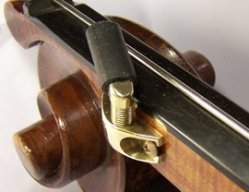
Can you give examples?

I had an extension for a couple of years. It was fun for a lot of repertoire, but the were far too many contemporary pieces I played, where it was was almost useless, because someone clearly wrote for a five string bass. Double stops, harmonics, scordatura,... I guess almost all contemporary European composers write with a five string bass in mind.
That's why I got a five string bass.
 
  • Like
Reactions: Whippet
That's what I was getting at. I've seen "quick-release" style hatpeg tuners a few times in my life and wondered why they aren't all like that. String changes are so much easier and faster.
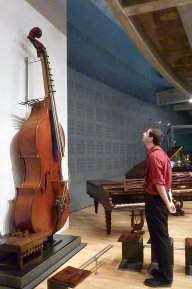
Well Rob, you are more capable then most of following the steps in Lammare article- perhaps Basscapos will start offering "quick-release" hatpeg tuning machines in the future?
 
Can you give examples?
It's pretty rare. There's a handful of American composers writing for it. There's occasional requests for E-flat scordatura which is made easier with an extension. I have a few tricks that only work with extensions, as well.

But you're right. European composers are much more interested in extended techniques, and they base them on what's available. As far as existing repertoire goes, five strings have an advantage. But only if you want to play things like Lachenmann and Aperghis.
 
  • Like
Reactions: Whippet
Can you give examples?

I had an extension for a couple of years. It was fun for a lot of repertoire, but the were far too many contemporary pieces I played, where it was was almost useless, because someone clearly wrote for a five string bass. Double stops, harmonics, scordatura,... I guess almost all contemporary European composers write with a five string bass in mind.
That's why I got a five string bass.

You think there's a legitimate future in 5 string db? Is the future of DB slowly going to the 5 string?
Not saying it's going to be the only future since surely 4 strings will always be around and classic pieces over the centuries will surely be played on a 4 string. .

I have heard several luthiers, including Tokiwa, an industry giant that makes OEM and specialized parts for practically every major electric guitar company from Fender to tiny boutiques say that the future of electric bass is in 5 string and more.

Tokiwa makes a limited run of their own 5 string bass guitar with technology so advanced it's in a different league. And it sounds incredible. And these guys told me that 4 strings will always be around but they just can't see the market advancing due to saturation and the fact that music is now being written by a new generation of people that are growing up on 5 string. They see 5 strings as an inevitable frontier because 4 string is just too crowded and over chewed.

Please keep in mind, Tokiwa is an OEM maker that makes what companies ask them to fabricate. They set their own trend with technology but they also see what the industry wants. I know that this is electric guitar but as you wrote, many contemporary pieces are written with a 5 string bass in mind and this must mean builders have to eventually start thinking about this more and more. This is no different than the quick release system the guys above were talking about. It might make it's way down because people will see something legit in this mechanism and demand more and more.

Do you think the mindset is slowly but surely changing?
 
You think there's a legitimate future in 5 string db? Is the future of DB slowly going to the 5 string?
Not saying it's going to be the only future since surely 4 strings will always be around and classic pieces over the centuries will surely be played on a 4 string. .
...
I know that this is electric guitar but as you wrote, many contemporary pieces are written with a 5 string bass in mind and this must mean builders have to eventually start thinking about this more and more. This is no different than the quick release system the guys above were talking about. It might make it's way down because people will see something legit in this mechanism and demand more and more.

Do you think the mindset is slowly but surely changing?
It's not like that. This music isn't meant for the masses. I'd love to live in a world where experimental composers were household names and could fill stadiums, but that's not how it works. There's a handful of special techniques and noises which only work on the 5th string, but they're mostly useless in any other form of music. Gimmicks, if you will.

Makers only have to think about it if a player asks for it.

For the most part, the practical differences between five strings and extensions are slim to nil. 99% of the repertoire works on both, and that other one percent is mostly music which classical players everywhere are ignoring and will continue to ignore. It's fine.
 
Do you play solo rep on your five string?
Me? I do.
Stuff like Bottesini or Dittersdorf works definetely better on four strings, but I never play these pieces in public, just for my own study. I do play a lot of contemporary solo rep on it. It works for me. But it is a different sound ideal. Maybe less penetrating, but more resonant sound. Not ideal for Koussevitzky, but not bad for Kurtag.
 
Many say that the neck is just too cumbersome. Is it the width or the thickness for you?
It's a combination. Not so much the thickness, my 4 has quite a thick neck, but combine it with the fingerboard width and amount of radius you need for arco (I'm not a jazzer, only orchestral/chamber music) and it just ends up too difficult. For the number of times you need the lower register, it's a high price to pay. I find my playing becomes (even more) clumsy and disjointed on a 5. Just my view, but I know a lot of players feel the same, hence the willingness to drop £1000 on a C extension!

Neil
 
  • Like
Reactions: Whippet
For what it's worth, I feel the same way about electric bass. I don't have a 5, never found one I liked, never ever thought "this song really needs a nice flappy, grainy farty low B right now". I like the agility and speed around a 4 string neck, and the extra range simply doesn't compensate for the loss of that. If you don't believe me, ask Jeff Berlin. In his words "there's nothing worth playing that can't be played on a 4 string"

Neil
 
  • Like
Reactions: Jeshua and Whippet
Do you play solo rep on your five string?

Only when needed. Perhaps most notably in Aperghis' Parlando and Rebecca Saunders' Fury.

The problem here is that very few 5 string basses are set up well enough for solo playing. These are excellent pieces, but almost nobody has the right equipment to play them.
 
  • Like
Reactions: Whippet
I've avoided voicing my opinion so far, but here it is. The only 5-string I've played extensively was a Pöllmann Busetto made in '95. It was an excellent orchestra bass. The neck and "action" was superb and super easy. It was incredibly even across the strings, and you could do very quiet stuff, especially spiccato, much more easily than on any of my four stringers. BUT, playing loud was more than a chore. My colleagues would play FF tasto with a lot of bow speed. I just couldn't abide the sound that approach produced, and tried to do it with pressure, right up at the bridge. It worked - the sound is there if you're willing to work for it - but I was constantly injuring myself. And, the pizz was worthless, and I couldn't imagine soloing on that thing.

I did play a 5-string at the Prague convention made by Andrew Pitts which was really easy to play, and had that softer feeling of a nice four-stringer. That said, I saw maybe twenty solo recitals at the event. There was an amazing collection of new instruments there, which were pretty much available to all, but only one performance was done on a 5-string - by Donovan Stokes on his own bass.

I'm a hidebound orchestra player with a side dish of jazz, so I don't know Aperghis or Saunders. What I will say is that certain early 20thC orchestral works are definitely way easier on a five string than with a gated extension. Strauss Tone Poems come to mind. Other than that, though, I feel that you are much better equipped with a fingered extension with gates. You can still play your Strauss, but you can also play your solos, chamber music, and even, jazz!
 
Last edited:
Why not?

1) Scale length of 4-string allows fundamental note production with open string. Adding low-B string without increasing scale length precludes fundamental note production for low B.

2) Additional neck width and depth may not seem to be playing issues by themselves, but may become more challenging in context of maintaining traditional neck radius and string spacing.

3) Challenges of potential increases in weight, bracing, acquisition cost, maintenance.

4) Nontraditional instrument may or may not be accepted in traditional playing situations.

5) 5-string is not required/called for in repertoire.

6) 4-string upright mastery is challenge enough.

I think you are Ortsom.
1) Agree
2) I don't understand
3) Somewhat agree, excepting maintenance. Those Pöllmanns are at least as robust as the Kevlar armour provided to American soldiers in the Iraq war. I saw one fall forward onto its bridge with almost no damage. Pretty freakin' bullet proof:D
4) Well, what is traditional? The German orchestra I played with for many years at first didn't want me to use my extension-equipped Pfretzchner, but they insisted upon it for a certain pops concert with a lot of pizzicato. Lucky I was there!
5) Well, what is "called for"? Yes, a lot of music is not written below E, but that only means that the composers didn't write below E because of a practical constraint. The opening of Brahms' 2nd Symphonie is almost a one finger salute to the practice of the day.
6) Nah. If you can play a four string, then a five string is no big deal, as long as the neck isn't stupidly huge:)
 
Last edited:
I would also add that I've always been bothered by the aesthetics of extensions versus a five-string. The extensions almost always look like after-thoughts (there are some notable exceptions - Lamarre, etc).
If you accept that extensions are ugly, then why deal with the cost, learning curve and difficulties of playing a five-string?
For me, there are a few moments in the orchestral literature where the basses get one of those thunderous low c's that make the whole enterprise worth it.
 
  • Like
Reactions: Whippet
FWIW, I made the switch to 5-string a year ago (orchestral playing), and I love it. I bought a 5-string Shen from Bob Beerman's shop, and the setup was absolutely on-point (which, as has been noted, is critical).

In terms of the neck, I've tried several 5-stringers with necks that felt cumbersome and disorienting in terms of muscle memory; however, there's something about the neck geometry of my bass that makes it feel more like a four string bass. I don't know exactly what it is; perhaps the ratio of thickness to width(?), but it feels great, and I've found the change to be really easy. (The only time I've felt disoriented has been during some pizz passages where I lose track of which string the right hand is trying to find. Some easy technique mods have helped to solve that issue.)

For me, it feels more natural to play the low end on the 5th string, rather than trying to fumble around with capos. The right string choice is important, too. I don't think I've seen many 5-stringers that have a complete matched set top-to-bottom. My bass is wearing Belcantos on the top three, matched with Helicore orchestrals on the bottom two. The bass has a nice big voice in the section.

In terms of solo playing, it isn't out of the question. Andy Anderson plays five-stringers and manages to get around quite well. And don't forget about Renaud Garcia Fons.


Last edited:
In terms of solo playing, it isn't out of the question. Andy Anderson plays five-stringers and manages to get around quite well. And don't forget about Renaud Garcia Fons.



Yeah, Andy has 2 of those Pöllmann 5ers. I know another guy who has one here, and that bass sounds awesome. They are much more friendly to play than the Rubners and the Meyer that my orchestra owns.