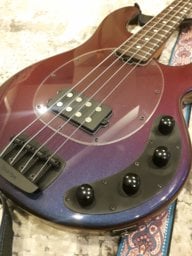
I am a firm believer that you will be stricken from the book of life if you put flats on a Ray. But I am also a firm believer that strings are a personal choice.
Right there with you. For me, on a Ray, it should be bright strings—rounds or even stainless steel rounds. Not tapes, flats, or even 'tweeners like Pressurewounds (which I love on other basses, BTW). You don't buy a Ray for a dull high end, right?
+1 for DR Hi-Beams
I played these strings for 10 years on the same Stingray. Nothing sounds better.
Oh, and flats on a Stingray is sacrilege (ymmv)
Just research what Bernard Edward's used ....flats and dead rounds I believe.
I could be wrong, but I believe Louis Johnson also used flats.
I've always personally favoured stainless steel round wounds, for their brightness, and clarity.
But I was really surprised a while ago, when I found some old 4-track portastudio demos, that I recorded with some completely dead Roto 66's, and used EQ to put some life back : one of my favourite tones I've ever recorded (given how crummy those demos were).
It got me rethinking about the tone I typically use, and I'm really digging what I'm getting by suppressing the treble more than I normally would, and boosting the upper mids a lot more than I normally would (at the amp).
Of course, until my band has gigs again, I've yet to try this in anger, and tweak accordingly - but I'm liking it at home, and on a handful of recordings (although it does feel really wrong removing most of that laser beam clarity, when you know, and enjoy what a StingRay is capable of).
As much as I love Bernard Edwards tone, it's not something I'm striving for, and would probably not work too well in any context I tend to operate, but for what it's worth :
The StingRay originally shipped with flat wound strings (GHS Brite Flats, if I recall correctly), from '76, until Ernie Ball took over in 1984/5, and put Super Slinkys on them.