Hello everyone! I've already seen multiple discussions regarding this question but I'm now even more confused. My original question was how to play middle c on bass. After reading MANY lengthy threads about music theory, and bass being written an octave lower, and middle c sounding like the 17th fret on the bla bla bla but actually being the 5th on the bla bla bla... I am so lost. My question is simple. I just want to be able to play bass from sheet. I can read sheet, I understand music theory. Please do not explain this to me. I need a starting point. If I am reading the music and see G as the note on the bottom line of my bass clef staff, where is it played in the bass? I hope I am clear enough. Thank you for your help.

Enjoy the benefits of a premium membership!
Upgrade Account
-
TalkBass has been independent since 1998. Add your voice.
Create a free account to reply to discussions, view embedded media, and browse with fewer display ads.
Join free Log in
Want zero display ads or expanded classifieds tools? Compare plans.
You are using an out of date browser. It may not display this or other websites correctly.
You should upgrade or use an alternative browser.
You should upgrade or use an alternative browser.
I just want to read sheet music.
- Thread starter Msky
- Start date
More options
Who Replied?

The G on the bottom line of the bass clef staff is the third fret on the E string.

I don't understand your confusion. You even say you know that bass is written one octave higher than it sounds and that you can read sheet music.
If you play the low G conventionally, that is if it were written with string bass in mind, it's third fret on the E string.
If you have like, a Tuba part, it's one octave higher, fifth fret on the D string and you go from there... (Tuba parts are nasty because if they do play in BG range, they have all those ledger lines)
If you play the low G conventionally, that is if it were written with string bass in mind, it's third fret on the E string.
If you have like, a Tuba part, it's one octave higher, fifth fret on the D string and you go from there... (Tuba parts are nasty because if they do play in BG range, they have all those ledger lines)
This chart is correct for piano, but wrong for bass! Bass is a "transposing" instrument that sounds 1 octave lower than written. The note C on the 3rd fret of the A string is C2 (not C3 as your chart implies).
"Middle C" or C4 is located at the 17th fret of the G string.

Your confusion would best be addressed by proper instruction. A good teacher and a copy of Simandl has been the go-to answer for many of us.
Edit: Although the book was written with DB in mind, it also works excellent as an EB resource.

Edit: Although the book was written with DB in mind, it also works excellent as an EB resource.
Last edited:
I am one of those people who cannot read music, makes no sense to me. Luckily i don't play for a living but it's still frustrating.....call it dyslexia maybe. To quote the great Stevie Ray Vaughn, my way of playing comes down to "Roll and i'll just feel something" kind of works for me.
Thank you so much!The G on the bottom line of the bass clef staff is the third fret on the E string.
QI don't understand your confusion. You even say you know that bass is written one octave higher than it sounds and that you can read sheet music.
If you play the low G conventionally, that is if it were written with string bass in mind, it's third fret on the E string.
If you have like, a Tuba part, it's one octave higher, fifth fret on the D string and you go from there... (Tuba parts are nasty because if they do play in BG range, they have all those ledger lines)
Thank you all for the music theoryThis chart is correct for piano, but wrong for bass! Bass is a "transposing" instrument that sounds 1 octave lower than written. The note C on the 3rd fret of the A string is C2 (not C3 as your chart implies).
"Middle C" or C4 is located at the 17th fret of the G string.
Thank you for the recommendation. You're absolutely right, I think some quality reading is what's going to work best for me. If you have any other books you'd recommend please let me know. As for the teacher that would be my dad and since he can't read sheet I'm out of luck.Your confusion would best be addressed by proper instruction. A good teacher and a copy of Simandl has been the go-to answer for many of us.
View attachment 3428706

Bass sounds an octave lower than written (or, to put it another way, music written to be played by bass is transposed up an octave compared to the same note on the piano).
So, here is middle C on music written for piano:
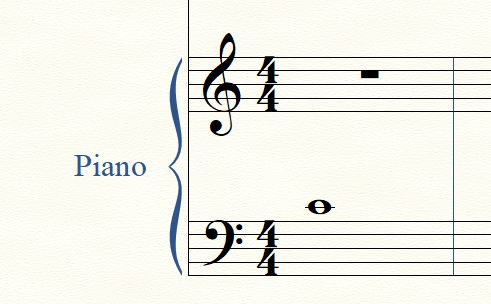
Here is the way same note would be shown in music written specifically for bass (two different ways shown of writing the same note):
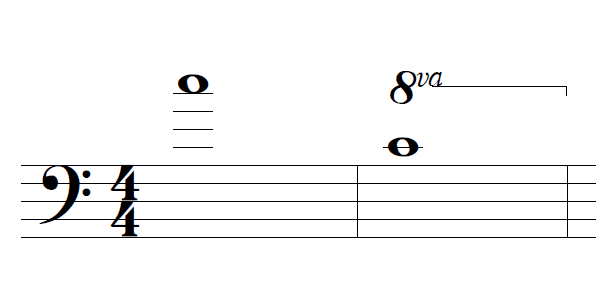
So, here is middle C on music written for piano:
Here is the way same note would be shown in music written specifically for bass (two different ways shown of writing the same note):
Last edited:
For voice, saxophone, and keyboard I learned sheet. I also took too much music theory. I kinda broke my music button for a moment getting caught up at looking at it all as theory. I wish I could just pick up and play what sounds nice but that just doesn't work for me. I envy those who do!I am one of those people who cannot read music, makes no sense to me. Luckily i don't play for a living but it's still frustrating.....call it dyslexia maybe. To quote the great Stevie Ray Vaughn, my way of playing comes down to "Roll and i'll just feel something" kind of works for me.

As a teacher, I'd recommend you get a beginning band electric bass book. Like one of these.
Search beginning electric bass | Sheet music at JW Pepper
Search beginning electric bass | Sheet music at JW Pepper
This does help, I need to find more music written specifically for bass. Do you have any recommendations as to where to find it? I am an absolute beginner to this instrument.Bass sounds an octave lower than written (or, to put it another way, music written to be played by bass is transposed up an octave compared to the same note on the piano).
So, here is middle C on music written for piano:
View attachment 3428757
You would play that note on the third fret of the A string.
Here is that same note (third fret on the A string) in music written specifically for bass:
This is perfect thank you for the recommendation!As a teacher, I'd recommend you get a beginning band electric bass book. Like one of these.
Search beginning electric bass | Sheet music at JW Pepper

Hi Msky 
Welcome to TB!!!
We have a subforum for all your questions!
General Instruction [BG]
may the bass be with you
Wise(b)ass
Welcome to TB!!!
Hello everyone!
We have a subforum for all your questions!
General Instruction [BG]
may the bass be with you
Wise(b)ass
I was tapped as the bass player for a community fundraising show last year, and was told I would have tab. It was a lie... it was all sheet music, so I had to woodshed extensively.( I hadn't read sheet since college jazz band in 1975) I pretty much had to start from scratch, and your confusion was mine also. Once I found the third fret G, it all came together...
Ugh. What a stupid brain freeze. I explained it correctly in my first paragraph but then transposed incorrectly when preparing the examples. Thanks for pointing that out. I fixed my post. @Msky, sorry for the confusion.You transposed in the wrong direction. Middle C is at the 17th fret of the G string and is written (for bass) with a whole lot of ledger lines above the staff. Or, perhaps more commonly, 1 ledger line above the staff with an 8va ("octave up") symbol.
C at the 3rd fret of the A string (C2) is 2 octaves below middle C (C4).

Welcome to TB!
While instruction books can answer the technical questions, I had an easier time with real-life examples of music. Check out the Bass Tab White Pages from Hal Leonard. This has over 200 songs of sheet music with Tab.
While a note can be played in multiple places, in sheet music the key signature will usually narrow down where the note is played. This can make the difference from stumbling uncomfortably through a piece of music to flowing easily. The Gig Bag Book of Bass Scales by Joe Dineen and Mark Bridges is also sheet music with tabs and a wealth of knowledge for practicing scales.
Both of these books can be found used on Amazon for cheap.
While instruction books can answer the technical questions, I had an easier time with real-life examples of music. Check out the Bass Tab White Pages from Hal Leonard. This has over 200 songs of sheet music with Tab.
While a note can be played in multiple places, in sheet music the key signature will usually narrow down where the note is played. This can make the difference from stumbling uncomfortably through a piece of music to flowing easily. The Gig Bag Book of Bass Scales by Joe Dineen and Mark Bridges is also sheet music with tabs and a wealth of knowledge for practicing scales.
Both of these books can be found used on Amazon for cheap.
Only if it's a part written for BG or double bass.The G on the bottom line of the bass clef staff is the third fret on the E string.
Otherwise (pitch wise), it's the open G string.
I suggest hitting a C on a piano, then playing that same C on the bass.


