• TalkBass has been independent since 1998. Add your voice.
    Create a free account to reply to discussions, view embedded media, and browse with fewer display ads.
    Join freeLog in
    Want zero display ads or expanded classifieds tools? Compare plans.

I just want to read sheet music.

The simplest way is to know the octave numbers.
When transcribed for bass, the first line below the staff is E1.
Written for piano, it would be E2.
I play a 5 string bass. The open B string is B0. E1 is the fifth fret of the B string, so I can play everything from the fifth fret up. If a score has notes below E1, I don't have to retune, or drop tune a tab. That is the advantage of standard notation.
 
I am one of those people who cannot read music, makes no sense to me. Luckily i don't play for a living but it's still frustrating.....call it dyslexia maybe. To quote the great Stevie Ray Vaughn, my way of playing comes down to "Roll and i'll just feel something" kind of works for me.:D:D:D

I have dyslexia. I'm ok reading on the staff, or one or two ledger lines above or below the staff. Other than that, I need to methodically, note by note, work it out. I doubt very much could not do this for a living if I had to sight read charts.

As for reading music,, the best thing is not to freak out over it. There is a logic to it, and it is the same logic you are playing without it. It's just in a different format.

What I would recommend is to start with rhythm charts, the only thing you need to know here is to count the measures, where the chord changes occur, and if you have to go back and repeat a phrase (and there are very simple signs that will instruct you). It is the road map of how the song will travel.

Think of this, how many times to you have to go back through a song over and over and over again at 3-to 5 minutes each to learn one song. It is liberating not to have to remember all this stuff, at least initially until you get a handle on it.

Ask yourself this, have you ever stood around a a rehearsal waiting for somebody to figure out a part? The fact is bands are much more efficient working from charts as you can learn a lot more material is a much shorter period of time.
 
  • Like
Reactions: RedVee
I made a fingerboard map once, maybe it will be helpful. On the right side, there are correct tone names (and their fundamental frequencies) for bass. On piano, all the frequencies would be doubled, as the bass sounds octave lower than written.

It's pretty easy to confuse octaves... imagine a composer who plays piano and needs to write a bass part.
 
  • Like
Reactions: vvvmmm
That's what creates the confusion.
A bass does not 'sound' an octave lower.
An E1 is the same note, regardless of what instrument it is played on.
A guitar starts on E2. You can play an E2 on the 7th fret of the A string on a bass. It would be the first line below the staff on a piano score.
A bass transcription would have it on the 3rd space of the staff.
 
  • Like
Reactions: Rabidhamster
I made a fingerboard map once, maybe it will be helpful. On the right side, there are correct tone names (and their fundamental frequencies) for bass. On piano, all the frequencies would be doubled, as the bass sounds octave lower than written.

It's pretty easy to confuse octaves... imagine a composer who plays piano and needs to write a bass part.
A pro arranger usually writes the score, then transposes according to the instrumentation.
A friend of mine (with Grammy winning arrangements) generally writes the melody, then chord structure, then bass line before tackling the harmony/ accompaniment parts.
 
Don't get all hung up on the "written here sounds here" thing.

I would say that, because our instrument offers choices, the opposite is true. The tone/sonority choices (at least up Ab) and practical constraints of the line (what follows?) mean that "written here sounds here" becomes "written here sounds here, here or here". As a player you'd better be sure you know which "or" is the right one for a given line.

Wish I could like this one twice! Thanks!

Would the sharps/flats be notated as a hollow/white filled note? Doesn't seem like there is room on the staff to add them otherwise

No, you use accidentals. A hollow note head with a stem is a minim (half-note), and without a stem is a semi-breve (whole note). In 99+% of cases the note style indicates time value, not pitch.
 
  • Like
Reactions: Rabidhamster
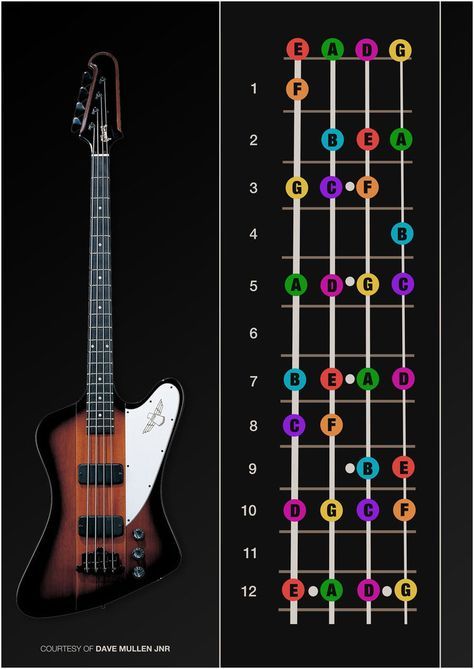
Here's half of what the OP wants, I think:

378ca2548963fd720b5d9519ff3687bc.jpg


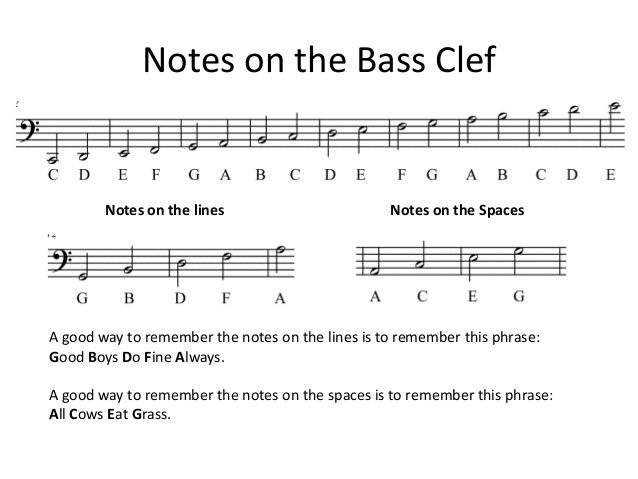
And here's the other half:

783179598ae838756bbc18687c6df083.jpg


Open strings on the bass start with the E that's the third note from the left on the top graphic under "Notes on the bass clef." Every 4th note is an open string - E - A - D - G.

It took me a long time to realize that the first fret on the E isn't F-flat, it's F.
This chart appears contradictory. If Good Boys Do Fine Always, then why is low C on a line and low D below a line at the far left? Typo?
 
I would say that, because our instrument offers choices, the opposite is true. The tone/sonority choices (at least up Ab) and practical constraints of the line (what follows?) mean that "written here sounds here" becomes "written here sounds here, here or here". As a player you'd better be sure you know which "or" is the right one for a given line.


No, you use accidentals. A hollow note head with a stem is a minim (half-note), and without a stem is a semi-breve (whole note). In 99+% of cases the note style indicates time value, not pitch.
Right on that makes total sense. Thanks!!
 
This chart appears contradictory. If Good Boys Do Fine Always, then why is low C on a line and low D below a line at the far left? Typo?

They are called ledger lines and extend the staff range. Count down spaces and lines from the low G... F(space), E (1st line), D (second space), C (second line). As you go up the grand stave, each appearance of a given letter alternates between a line and a space. Believe it or not, it makes reading easier. If you continue up you will see middle C on a line, then in treble clef it's back on a space...
 
  • Like
Reactions: Rabidhamster
...I am an absolute beginner to this instrument.

Given the above statement, I'd say forget most of what was posted here. Forget worrying about where the written "G" is on the bass (for now). Just pick ONE book. Only ONE. I still recommend Simplified Sight Reading for Bass. Whatever you do choose, start at the beginning and work through it. Work through it with determination.

If you try to apply all of these random suggestions, you will never learn anything.
 
This chart appears contradictory. If Good Boys Do Fine Always, then why is low C on a line and low D below a line at the far left? Typo?

It is not contradictory. GBDFA refers only to the 5 lines normally visible on the bass clef staff.
If played in different octaves, they will alternate lines for spaces.

Low D is on that space because that space represents low D.
Follow the lines and spaces and count the note names descending from the G on bottom of the the basic' staff:
G (line)
F (space)
E (line)
D (space)
C (line)​

once you see that the 7 sequential note names alternate lines and spaces
It's pretty clear how the same note name switches lines for spaces each octave.
 
Last edited:
  • Like
Reactions: Rabidhamster