• TalkBass has been independent since 1998. Add your voice.
    Create a free account to reply to discussions, view embedded media, and browse with fewer display ads.
    Join freeLog in
    Want zero display ads or expanded classifieds tools? Compare plans.

I made the logical decision, right? Compressors, again!

Empress first to even out dynamics before octave/dirt/fx and the Horizon last for added warmth & colour.

I prefer event out dynamics at the end as I use both an envelope follower and an overdrive that are very responsive to my dynamics, and the envelope follower sometimes outputs a peak of volume that sounds better and more even with compression placed after. But depending on your effect set-up, and how you play, and what kind of sound you are after, your approach is as valid as mine. I'd tried both ways and keep the one that better suits me.

I guess... you can add to much compression, be never too many compressors :)
 
So I have been thinking and reading and researching compressors for the longest time and I just couldn’t figure out what I wanted from my Compressor. Do I want to enhance tone with some light squash? Do I want it to be Transparent? I’ve had a few compressors but none have stuck around and the waiting list for the DE-CL will take god knows how long to be worked down until my name gets called, so I narrowed it down to two compressors; the Empress and the Diamond. Both do different things and they should give me a better idea of what I want in a Compressor, right? RIGHT? Doesn’t matter now, I ordered them both. This should be a fun experiment either way.

Just get the DB CL. IMO it's the best of all worlds. Great comp and limiter. It works amazing. I have an FEA Opti Fet and it's probably the best comp I've ever owned. I've tried all of Franks comps and several other brands. I'm an FEA guy. He has a Black Friday sale going on right now too.
 
  • Like
Reactions: willsellout
In reply to my question about the BCP-1's compression ratio, Diamond sent this reply:

"Hi thanks for emailing. Yes, the ratio is nominally 3:1, it does vary slightly with the input signal strength but for all intents and purposes 3:1. I hope that’s helpful!"

Thanks! This is one of the reasons why I am so interested in the ratio curve. Because of the way the circuit feedback of the opto driver works it doesn't seem like it would be a flat slope ratio like 3:1. But I can understand why they would say a "nominally 3:1". If the compression is more in line with a vari-slope compressor like the dbx 163x, it could still have a "nominal 3:1".

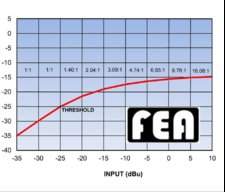
See the plot below of a compressor with vari-ratio (extreme soft-knee):
VariRatio.jpg


So if we look at the output from -25dBu (threshold setting) and the 5dBu input, we have a 10dB output change over a 30dB input span for a nominal ratio of 3:1. But with this curve the output will always be somewhat limited to approx 10dB more than the threshold setting.

Above the ratio curve are the nominal ratio slopes between each 5dBu input segment. So from -25dB to -20dB the nominal ratio slope is 1.4:1. They transition from 1:1 to 16:1 so every slope in-between is represented by a point on that curve.

I have heard that the Diamond can be overly squishy with high output basses, so I am interested in its threshold range and ratio. I get several emails from people asking question about other compressors and I feel that I need to understand this one a little better.:thumbsup:

-Frank
 
I have heard that the Diamond can be overly squishy with high output basses, so I am interested in its threshold range and ratio. I get several emails from people asking question about other compressors and I feel that I need to understand this one a little better.:thumbsup:

Well, now that you mention it... I find that to be the case with the mighty Thunderbucker 66S pickup (have one in both basses). Where previously the Diamond (@18V) worked very well with the threshold at noon, giving that 'magic fairy dust' tone and 'cleaning up' if you backed off a bit, it doesn't get on with the Thunderbuckers nearly as much. Obviously I tried varying the threshold point, but have yet to find the perfect setting. I really need to spend some time with it, as I have been concentrating on other things.

Kat
 
  • Like
Reactions: boomertech
Just get the DB CL. IMO it's the best of all worlds. Great comp and limiter. It works amazing. I have an FEA Opti Fet and it's probably the best comp I've ever owned. I've tried all of Franks comps and several other brands. I'm an FEA guy. He has a Black Friday sale going on right now too.
Yeah I saw that. You are not helping my situation right now...


Well crap..just ordered one. Time to do a shootout I guess!
 
  • Like
Reactions: jwr
Well, if you are doing an all-out compressor comparison, might as well pick up a Cali while you're at it. :D In all honesty, I'd always give the Boss BC-1X a whirl too - magnificent compressor. I personally really like my Empress. I use a high-pass filter in the side-chain with it.
 
Use both... ehhance your tone with the Diamond (it uses a fairly low ratio) at the beginning of your effect chain and level your signal at the end with the Empress.


Agree with Jebberz & BR, use both.

Now you've got two FEAs incoming as well. Keep them all, find uses for each of them in different situations.

There may be such thing as too much compression, but there's no such thing as too many compressors — don't use a screwdriver as a hammer, get the right tool for each job.

:D
 
Nice! I'm interested in hearing your thoughts when it comes in.

Me too!;) I am only going to be taking technical data, so I won't be posting opinions. But the Diamond design has always impressed me with their audiophile approach, like paralleling capacitors for better transient response and adding a current source to the transistor buffers. Enhancements that a human would never hear, but they added them anyway. They also allow you to remove the tilt EQ with an internal switch from the signal path... that's an audiophile mindset.:thumbsup:

-Frank
 
  • Like
Reactions: kat888
Me too!;) I am only going to be taking technical data, so I won't be posting opinions. But the Diamond design has always impressed me with their audiophile approach, like paralleling capacitors for better transient response and adding a current source to the transistor buffers. Enhancements that a human would never hear, but they added them anyway. They also allow you to remove the tilt EQ with an internal switch from the signal path... that's an audiophile mindset.:thumbsup:

-Frank

That is why I am interested in hearing your thoughts ;) I've actually just ordered one myself and should have it next week. I am interested to see how much the internal EQ defeat changes the sound(if at all). Usually I'm using a low ratio(3 or 4:1) so the Diamond with its soft knee characteristics should work out great.
 
The Diamond arrived today. My initial thoughts are that I like it a lot. It definitely adds a character that you can't get rid of. It fattens everything up and makes both my MBD-1 and the AO/M sound better. Definitely good stuff. Can't wait for the other pedals to arrive.

If you take the EQ out of the signal with the dip switch inside does it alter the the coloration?
 
If you take the EQ out of the signal with the dip switch inside does it alter the the coloration?
Oh you know what, I completely forgot about that. I'll try that a little later today to see what happens.

*edit* So I messed with the dip switch and it doesn't alter the inherent coloration of the pedal. It still warms and fattens the signal. The more I play with the EQ the more i really really like it. I can understand why this pedal gets the love it does.
 
Last edited:
Well as a double surprise the Empress arrived today. No shipping notice from FEA, so Im not sure when that might get here. The Empress is a very impressive little unit. Where the Diamond is intuitive and minimalist the Empress is less intuitive with more bells and whistles. The Diamond has this fat vintage vibe with what appears to be a slight hump in the mids, which works really well with my Thunderbird and my pedals. The Empress is not completely transparent but it doesn't impart a whole lot to the signal. It has a slight touch of warmth and adds articulation but otherwise appears to be fairly flat. The added clarity and articulation also works really well with my Tbird, which is sometimes a bit muted and muddy.

I love how the Empress has all these neat little switches and options and with the LED's it's very apparent what is happening to the signal. The Diamond has virtually no signaling about what is happening unless I overload the thing and the LED turns red. Most of the time it's green. So you have to rely on your ears. The Empress has red for gain reduction, green for input level and yellow for gain and input overlap, which is cool, and you can utilize the little switch to choose which you see. Ill definitely need to spend more time with both of these pedals but there are things I like about both and not much to complain about. I could definitely understand keeping both of them for different reasons.
 
Well as a double surprise the Empress arrived today. No shipping notice from FEA, so Im not sure when that might get here. The Empress is a very impressive little unit. Where the Diamond is intuitive and minimalist the Empress is less intuitive with more bells and whistles. The Diamond has this fat vintage vibe with what appears to be a slight hump in the mids, which works really well with my Thunderbird and my pedals. The Empress is not completely transparent but it doesn't impart a whole lot to the signal. It has a slight touch of warmth and adds articulation but otherwise appears to be fairly flat. The added clarity and articulation also works really well with my Tbird, which is sometimes a bit muted and muddy.

I love how the Empress has all these neat little switches and options and with the LED's it's very apparent what is happening to the signal. The Diamond has virtually no signaling about what is happening unless I overload the thing and the LED turns red. Most of the time it's green. So you have to rely on your ears. The Empress has red for gain reduction, green for input level and yellow for gain and input overlap, which is cool, and you can utilize the little switch to choose which you see. Ill definitely need to spend more time with both of these pedals but there are things I like about both and not much to complain about. I could definitely understand keeping both of them for different reasons.

Ryan is at the PO now... he will be sending tracking info soon.

Isn't the red LED on the BCP-1 to tell you how much compression is being applied, not an overload indicator?

-Frank