

Enjoy the benefits of a premium membership!
Upgrade Account
-
TalkBass has been independent since 1998. Add your voice.
Create a free account to reply to discussions, view embedded media, and browse with fewer display ads.
Join free Log in
Want zero display ads or expanded classifieds tools? Compare plans.
You are using an out of date browser. It may not display this or other websites correctly.
You should upgrade or use an alternative browser.
You should upgrade or use an alternative browser.
I NEED more punch/sustain!
- Thread starter chaunceyjiggson
- Start date
More options
Who Replied?
Get a drill and make it a string through. Ferals are cheap. Sustain, tada.
Hyper Snake Oil

Hyper Snake Oil
The thing that creates sustain is solid anchor points that allow the strings to vibrate but lose energy slowly. The more solid the anchor points the more sustain. Tuners, nut, bridge and yes the body of a bass. String throughs.
This mod made a world of difference. So no snake oil.
The thing that creates sustain is solid anchor points that allow the strings to vibrate but lose energy slowly. The more solid the anchor points the more sustain. Tuners, nut, bridge and yes the body of a bass. String throughs.
This mod made a world of difference. So no snake oil.
the thing is, even though there is improvement compared to a really bad bridge, the bridge has to be REALLY BAD to be audibly worse than something like a bad ass II. and drilling holes through your bass? LoL.... that just changes the ANGLE of the string break across the bridge saddles. the strings could be attached to a completely different guitar (as long as they were really long) and just so long as you keep the tension constant and the string break across the bridge saddles is at least a few degrees (to supply enough downward force to prevent any movement), the bass will sustain as long as the rest of it is capable of sustaining.
Now here's the thing.... the neck pockets could suck on those basses, like maybe the necks aren't attached on really solidly. that is a big problem in home-setup basses I've found.
Next, the wood could simply suck as far as sustain goes. sometimes this happens. could be short sustaining basses. not much you can/should do about that now.
thirdly - new strings. get 'em. make sure they're rounds.
fourth - get a compressor pedal. learn to use it.
fifth - get heavy gauge strings. To the guy that remarked "drop C on 34" length?", of course you can do that. C is only a semi tone higher than the B string on 34" 5 strings. As someone said, get the right guage strings here... like 120 to 130 for your C, on upwards in values of 20 to 25 between each string (depending on your guage preferences.
The thing that creates sustain is solid anchor points that allow the strings to vibrate but lose energy slowly. The more solid the anchor points the more sustain. Tuners, nut, bridge and yes the body of a bass. String throughs.
This mod made a world of difference. So no snake oil.
String through 'benefits' have been flogged much in the past. Not everyone agrees with you.

the thing is, even though there is improvement compared to a really bad bridge, the bridge has to be REALLY BAD to be audibly worse than something like a bad ass II. and drilling holes through your bass? LoL.... that just changes the ANGLE of the string break across the bridge saddles. the strings could be attached to a completely different guitar (as long as they were really long) and just so long as you keep the tension constant and the string break across the bridge saddles is at least a few degrees (to supply enough downward force to prevent any movement), the bass will sustain as long as the rest of it is capable of sustaining.
Now here's the thing.... the neck pockets could suck on those basses, like maybe the necks are attached on really solidly. that is a big problem in home-setup basses I've found.
Next, the wood could simply suck as far as sustain goes. sometimes this happens. could be short sustaining basses. not much you can/should do about that now.
thirdly - new strings. get 'em. make sure they're rounds.
fourth - get a compressor pedal. learn to use it.
fifth - get heavy gauge strings. To the guy that remarked "drop C on 34" length?", of course you can do that. C is only a semi tone higher than the B string on 34" 5 strings. As someone said, get the right guage strings here... like 120 to 130 for your C, on upwards in values of 20 to 25 between each string (depending on your guage preferences.
Best post yet. This is all good advice.
String through 'benefits' have been flogged much in the past. Not everyone agrees with you.
Everything on this website is highly disagreed apon, and just because you don't agree dosent mean it's snake oil. A bent steal plate bridge will never have the sustain of a string through or a milled bridge. IMHO.
Everything on this website is highly disagreed apon, and just because you don't agree dosent mean it's snake oil. A bent steal plate bridge will never have the sustain of a string through or a milled bridge. IMHO.
Why? If your describe it using facts based on proven laws of physics... you'll win


Only advantage I see with a string through is with the string coming through the body it has more of an angle breaking over the saddle, which gives it more downforce, which gives it a firmer bond between the plate and the saddle. If there's not much angle the saddle can vibrate separately a little which would reduce the sustain. Wouldn't a slight shim on the neck provide the same downforce on the saddle? I could be wrong, but that's how I see it.

Only advantage I see with a string through is with the string coming through the body it has more of an angle breaking over the saddle, which gives it more downforce, which gives it a firmer bond between the plate and the saddle. If there's not much angle the saddle can vibrate separately a little which would reduce the sustain. Wouldn't a slight shim on the neck provide the same downforce on the saddle? I could be wrong, but that's how I see it.
Yes it will do the same thing.
It's the break angle and pressure on the saddles that the improvements come from.

I don't understand why anyone would need more sustain. I've spent decades developing my technique to get rid of sustain. Oh well that's the way it goes. More volume gets more punch. Otherwise get a P?
Davo
Davo

Playing style makes a huge difference as well. Try it out.
If you play really aggressively, the first second or two of a REALLY hard plucked or picked string will be loud.. and then trail off quickly... then from there on the volume will taper much more gradually. Except with extreme limiting/compression, you can't keep the volume and tone of those firsts couple seconds if you really whack those strings.
Try and play with a soft or medium touch.. you'll see that your notes ring longer at the volume you started at when you plucked the note.
I just made a quick chart here..
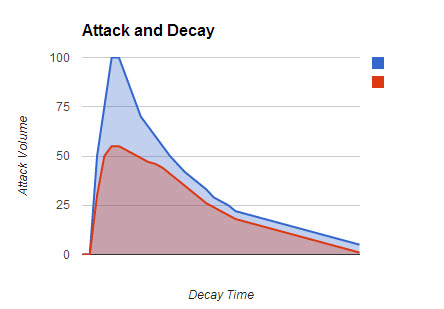
Blue is playing hard Red is playing more softly.
it's not exact but shows what I'm trying to explain. Starting quieter, your note will play longer at close to the same volume, starting loud it you will have much greater decay between your initial note and your later sustained note. I actually think the drop off is much greater at first and flattens out much more as the note decays... so playing more quietly would greatly increased the length of time your note stayed and roughly the same volume. A compressor will do it too although can color your sound as it either squashes or raises the volume of your bass.
If you play really aggressively, the first second or two of a REALLY hard plucked or picked string will be loud.. and then trail off quickly... then from there on the volume will taper much more gradually. Except with extreme limiting/compression, you can't keep the volume and tone of those firsts couple seconds if you really whack those strings.
Try and play with a soft or medium touch.. you'll see that your notes ring longer at the volume you started at when you plucked the note.
I just made a quick chart here..
Blue is playing hard Red is playing more softly.
it's not exact but shows what I'm trying to explain. Starting quieter, your note will play longer at close to the same volume, starting loud it you will have much greater decay between your initial note and your later sustained note. I actually think the drop off is much greater at first and flattens out much more as the note decays... so playing more quietly would greatly increased the length of time your note stayed and roughly the same volume. A compressor will do it too although can color your sound as it either squashes or raises the volume of your bass.

A bent steal plate bridge will never have the sustain of a string through or a milled bridge. IMHO.
My P bass has a plain ol' bent steel bridge with threaded saddles. It's got sustain for days. Just for giggles I put a BAII on it that I had lying around and it didn't do anything to add more sustain. It's also got more sustain that it's 08' MIA counterpart with the string through option & high mass bridge.
I find that a well built bass with a tight fitting body & neck joint does more for sustain than most other ideas. New strings, a good nut, and a good setup go a long way too.
Get a drill and make it a string through. Ferals are cheap. Sustain, tada.
If string through makes such a dramatically noticeable difference and is a dirt cheap option, why don't all/most, rather than few, basses have it?
There must be a valid reason. Manufacturers/Luthiers want to sell basses.

Smooth_bass88
vaxx!
- Oct 31, 2006
- 12,122
- 16,794
- Disclosures
- have been on nationally released albums, charting on the Billboard 200
FWIW, on my Laklands, I alternate through body/through bridge every other string change. The difference in tone/sustain is minimal at best.
Yes it will do the same thing.
It's the break angle and pressure on the saddles that the improvements come from.
Seems to me this would be cheaper and easier to try as well as being reversible.
Try turning your amp up and playing with a lighter touch. It's not easy, but as the graph above shows, you'll get more consistent volume and can get a nice punch (spike) any time you want it just by digging in slightly deeper.
I'm going to say that hotter pickups will work too, as long as you don't turn down your amp to compensate!
I'm going to say that hotter pickups will work too, as long as you don't turn down your amp to compensate!

Here's my thing. I have a great compressor in my tc electronic rh750 so that's not the issue. The sustain is good and the attack is great I'm just looking for a more modern kind of tone. When I play longer notes it seems to fade pretty quick. It could be a string problem though. I use power slinkies mostly with a 110 bottom. But I've notices a major difference in high mass bridges and the standard bent bridges that come on fenders. A solid piece of brass sound 100x better than a piece of bent steel.
Here's my thing. I have a great compressor in my tc electronic rh750 so that's not the issue. The sustain is good and the attack is great I'm just looking for a more modern kind of tone. When I play longer notes it seems to fade pretty quick. It could be a string problem though. I use power slinkies mostly with a 110 bottom. But I've notices a major difference in high mass bridges and the standard bent bridges that come on fenders. A solid piece of brass sound 100x better than a piece of bent steel.
Try a bass with modern sounding pickups, like QP's, and see if that makes a difference.


