
• TalkBass has been independent since 1998. Add your voice.
    Create a free account to reply to discussions, view embedded media, and browse with fewer display ads.
    Join freeLog in
    Want zero display ads or expanded classifieds tools? Compare plans.

I should do my own setups from now on

If the relief is high, then the strings are pulling more that the truss rod. So the truss rod needs to tighten, not loosen.

To check the relief, hold the first fret (so you eliminate the nut being the factor), and hold the fret where the necks joins the body. You can also put a capo on the first fret if you have one, directly on the fret, to free up a hand.

The string acts as a straight edge, and you are looking to see a little daylight between the string and the fret that is halfway between the two frets you are holding. It varies by how much, but the thickness of a credit card is ball park.

Tighten a little, play it, then revisit

If you are getting no movement, of the truss rod is moving too freely or not at all, take it to a tech
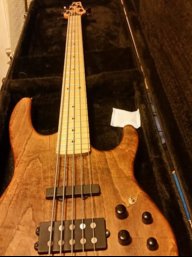
 
Dave has said numerous times that where he sets them up is just a guide..everyone has their own preferences..but yeah, feeler gauges, one of those metal cards with measurements on them for the action, and a good wrench for the truss rod..I like the T-handle ones and a straight edge one for the scale of your bass, and one of them that is just straight with no notches.. If you watch enough of dave's videos I think you should be able to set up your bass with no problems..I got addicted to watching those videos I seen so many of them its crazy..but you can learn a lot from them and he does explain how to do it, and the size feeler gauges for the nut height, and neck relief..he doesn't give all the info on one video but after you watch enough of them, you will get all the data you need..
 
If the relief is high, then the strings are pulling more that the truss rod. So the truss rod needs to tighten, not loosen.

To check the relief, hold the first fret (so you eliminate the nut being the factor), and hold the fret where the necks joins the body. You can also put a capo on the first fret if you have one, directly on the fret, to free up a hand.

The string acts as a straight edge, and you are looking to see a little daylight between the string and the fret that is halfway between the two frets you are holding. It varies by how much, but the thickness of a credit card is ball park.

Tighten a little, play it, then revisit

If you are getting no movement, of the truss rod is moving too freely or not at all, take it to a tech

The neck is too strait, that's the problem. I currently have the truss rod nut a little bit loose and I'll wait a few days and then check if if somethings happens.
I have applied a capo on the first fret, and when I hold down the string on the 24'h fret a 0,46mm pick don't move freely under the string, that's why I want more relief on the neck.
The bass if perfecly playable but I'll talk to a coworker who plays a lot of instruments about this when I meet him next time.
 
Dave has said numerous times that where he sets them up is just a guide..everyone has their own preferences..but yeah, feeler gauges, one of those metal cards with measurements on them for the action, and a good wrench for the truss rod..I like the T-handle ones and a straight edge one for the scale of your bass, and one of them that is just straight with no notches.. If you watch enough of dave's videos I think you should be able to set up your bass with no problems..I got addicted to watching those videos I seen so many of them its crazy..but you can learn a lot from them and he does explain how to do it, and the size feeler gauges for the nut height, and neck relief..he doesn't give all the info on one video but after you watch enough of them, you will get all the data you need..

You and me both. I've watched probably ten of them in the last few days. Including one where he adjusts my exact make and model. You're right, though, he doesn't explain everything that he's doing. Like what is that measurement he's making supposed to be? He doesn't always say. But sometimes he does. So if you watch enough you can learn it all.
 
It's good for a bass player to know at least some of the set up stuff & to be bale to do it themselves
You know what you want better than another person.
I've had set ups does by guys that duo it their way & ignore what you want-and others who did it right.

But too many times (and this would be guitars, not basses for me) they don't do a proper job-so it inspired me to learn myself.
Some stuff I'll still take for work--but most stuff I will do myself.
Dan Erlewine's Guitar Player Repair Guide 3rd Edition was invaluable for me.
 
Self-setup is a very practical skill to learn. It enables you to try different strings, adjust to different weather conditions, and save a bunch of money. Now I do all my setups exclusively myself (except fret dressings). :thumbsup:
Regarding unlevel fretboard - I think unless it's severely bent from the middle (like my old classical acoustic guitar :() it should only affect the lowest possible action a little bit. Or (Edit: I mean otherwise) you might be able to return it. My SG bass has a minor bump at the 2nd fret of the G string, but I still manage to get it nice and low action without fret buzz (I like to lower the action a bit more than necessary to dial in a little "clank", but that's totally controllable). :)
 
Last edited:
  • Like
Reactions: zontar
Knowing how to make some saddle, neck and pickup adjustments to an instrument is part and parcel with being a player, IMO. Having enough confidence to make the small adjustments saves you a lot of time, trouble, expense and you learn something, too. Win-Win!
 
Besides the (ever-present) possibility of an incompetent tech, the other fair point is that even the best tech can't really do a set up to perfection for you - good ones ask and can come close if they take the time, but they'll never get as close as you can once you've got a few basic tools and some experience (unless there's a serious functional problem, requiring a luthier not just a tech, I'm a big believer in doing your own setups).
I couldn't agree more!

When I lived in NE Ohio, I used to go to Woodsy's Music in Kent to have them take care of all of my maintenance needs because they actually did all questions and take the time to do it right for the individual. When I moved to Charlotte. NC, I learned to do it all myself because I didn't trust anyone else, and for that, I'm glad because I can set up each instrument to a specific standard for different playing.

It's absolutely worth it to do it yourself!
 
You and me both. I've watched probably ten of them in the last few days. Including one where he adjusts my exact make and model. You're right, though, he doesn't explain everything that he's doing. Like what is that measurement he's making supposed to be? He doesn't always say. But sometimes he does. So if you watch enough you can learn it all.

I've watched probably at least 50 or more...and yes, if you watch enough of them he does tell the measurements he is using, from the neck relief, nut distance at the first fret, pickup height, string height, neck shims, if you watch enough and take notes or remember...you will get all the info you need...and then some.
 
I have been doing my own setups for years. Adjusting the truss rod, setting string height, setting the intonation, replacing pickups. Look it up on YouTube. For me it was pretty easy to figure out. I saved a lot of money by doing the work of my basses.
________________________________

A couple of years ago I impulse bought a used Warwick off Ebay. It's the Rockbass Corvette $$ 5-string. When it arrived I was appalled at the height of the string action. I figured I'd just take it in to the local music store and have them fix it.

The told me there was only so much they could do because the neck was bent. There is a slight ripple high up on the tribble side. Anyway, it sounds great. I just wish it played more like my Ibanez SR505. Playing the Warwick is a chore and lately I've been thinking I should just get rid of it and swear off buying instruments that I can't play first.

Then something happened last night that makes me reconsider. I've been watching YouTube videos of this guy who just fixes guitars. Dave's World Of Fun Stuff. So last night I look over at the Fender FA-135CE Concert acoustic guitar. The one that has appalling action. The one that my music store also told me they couldn't make any better than it is.

I get my metric wrenches, loosen the strings, make a few truss rod adjustments and voila. The string height has gone from dreadful to...unremarkable.

I don't change my own oil. I know what's involved, sure, but I find it's worth the $50 or whatever to have someone do it who knows what they're doing. That was my philosophy on guitar setup, too–until now. I'm going bust out the tools and see what I can really do with the Warwick. These guys at the local store do not know what they are talking about.[
 
I've watched probably at least 50 or more...and yes, if you watch enough of them he does tell the measurements he is using, from the neck relief, nut distance at the first fret, pickup height, string height, neck shims, if you watch enough and take notes or remember...you will get all the info you need...and then some.
Well, today I became a Dave patron for $1 a month. Maybe at some point if I get tired of watching his videos I'll stop. Anyway, the very first thing I see after becoming one is a video just for patrons. it's short and it goes through each step and measurement. Very instructional.
 
EDIT: Could an admin please move this to the correct forum? Sorry!

A couple of years ago I impulse bought a used Warwick off Ebay. It's the Rockbass Corvette $$ 5-string. When it arrived I was appalled at the height of the string action. I figured I'd just take it in to the local music store and have them fix it.

The told me there was only so much they could do because the neck was bent. There is a slight ripple high up on the tribble side. Anyway, it sounds great. I just wish it played more like my Ibanez SR505. Playing the Warwick is a chore and lately I've been thinking I should just get rid of it and swear off buying instruments that I can't play first.

Then something happened last night that makes me reconsider. I've been watching YouTube videos of this guy who just fixes guitars. Dave's World Of Fun Stuff. So last night I look over at the Fender FA-135CE Concert acoustic guitar. The one that has appalling action. The one that my music store also told me they couldn't make any better than it is.

I get my metric wrenches, loosen the strings, make a few truss rod adjustments and voila. The string height has gone from dreadful to...unremarkable.

I don't change my own oil. I know what's involved, sure, but I find it's worth the $50 or whatever to have someone do it who knows what they're doing. That was my philosophy on guitar setup, too–until now. I'm going bust out the tools and see what I can really do with the Warwick. These guys at the local store do not know what they are talking about.
I'd say either find a new repairman, or learn to make to do your own setups.
 
Congrats to the OP!!

I got myself into setup because I'm a sick engineer and I can't use something if I don't understand how it works... I was shocked to hear so many bass players consider setting up their instrument as some sort of black art that only a few talented persons can do. Plus I didn't know anybody in my area, and didn't want to pay someone to do something if I can do it.

I encourage every person here to watch instructional videos, learn, try, and grow.
Don't get me wrong, some guitars are challenging, stripped nuts, gripped truss rod... you have to learn what requires a "normal" adjustment VS more involved ones / repairs (ex. fret leveling, recrowning, replacing truss rod...)

Anybody should be able to adjust a brand new guitar.
I see at least 2 positive outcomes: save money + make it your own!!

Here are the first videos I watched to learn. To me they summarize the essential, and following these steps (nut filing I still consider optional unless something is really off) in the right order will get you there:
Invalid Link Removed
Setting Up Your Bass Guitar: Bridge Action Height Adjustment (Step 2 of 4)
Invalid Link Removed
Setting Up Your Bass Guitar: Intonation Adjustment (Step 4 of 4)

PS: I have zero affiliation with the videos above.
 
EDIT: Could an admin please move this to the correct forum? Sorry!

A couple of years ago I impulse bought a used Warwick off Ebay. It's the Rockbass Corvette $$ 5-string. When it arrived I was appalled at the height of the string action. I figured I'd just take it in to the local music store and have them fix it.

The told me there was only so much they could do because the neck was bent. There is a slight ripple high up on the tribble side. Anyway, it sounds great. I just wish it played more like my Ibanez SR505. Playing the Warwick is a chore and lately I've been thinking I should just get rid of it and swear off buying instruments that I can't play first.

Then something happened last night that makes me reconsider. I've been watching YouTube videos of this guy who just fixes guitars. Dave's World Of Fun Stuff. So last night I look over at the Fender FA-135CE Concert acoustic guitar. The one that has appalling action. The one that my music store also told me they couldn't make any better than it is.

I get my metric wrenches, loosen the strings, make a few truss rod adjustments and voila. The string height has gone from dreadful to...unremarkable.

I don't change my own oil. I know what's involved, sure, but I find it's worth the $50 or whatever to have someone do it who knows what they're doing. That was my philosophy on guitar setup, too–until now. I'm going bust out the tools and see what I can really do with the Warwick. These guys at the local store do not know what they are talking about.
A learning experience. I assume you won't spend another cent there?
 
First of all . . . it's a Warwick. They have a pretty detailed 'do it yourself' area on their English website. Find it and save it. It's the best starting place for your Warwick. The location is already posted here up near the top.

Second . . . try some tweaks that don't make sense - but will work sometimes. I tried and tried to get my strings on my German WW $$ Corvette 5-string at the lowest possible place with no buzz. Tried over and over. Nothing got rid of the low B buzz. Then I call the Warwick luthier here in Nashville. He says oh - easy fix - raise the nut. (Warwicks have adjustable nuts) I did and it worked. Now all five strings are as low as possible and still play, and no buzz. I tweek mine maybe once every 3-4 months and that does it. Try the Warwick site first.
 
The neck is too strait, that's the problem. I currently have the truss rod nut a little bit loose and I'll wait a few days and then check if if somethings happens.
I have applied a capo on the first fret, and when I hold down the string on the 24'h fret a 0,46mm pick don't move freely under the string, that's why I want more relief on the neck.
The bass if perfecly playable but I'll talk to a coworker who plays a lot of instruments about this when I meet him next time.

For me, 0.45mm would be too much relief. I normally aim for 0.25-0.3mm with a reasonably low action.

An important thing to do is to do some measuring when you've got an action you like. You can then easily repeat them. Get a string height gauge or a engineering ruler with measurements in 1/64 or 1/10mm and some feeler gauges. A set of string radius gauges is useful. A good 15cm ruler will cost about £10, but is super useful. All the other stuff is available on Amazon for next to nothing.

Don't be afraid to experiment - it's highly unlikely that you'll break something, but having a set of measurements for string height at 1st fret, neck relief at 5-8th fret, string height at 12th or 17th fret will allow you to always come back to your starting point any time you make a change (like strings).

On my bass, once I've got it dialed in, I only make small truss rod adjustments to correct string action if it's changed as a result of humidity or temperatures. It's very quick and easy to reset neck relief to 0.3mm (or whatever you like) and you don't need to adjust the bridge at all to get back to your happy place.

It does vary from bass to bass - my GB Spitfire 5 will play with almost straight neck and action of about 1.5mm on the B string the 17th fret without buzzing, but my Ibanez SRMS805 needs 0.3mm minimum and won't play cleanly below 2.2mm. I presume the GB has a very flat fretboard and a great fret job, so the 'ideal' setup is different for each bass, i.e. the same numbers may not be optimum.
 
There’s an acronym to help you remember in what order to do the adjustments: TRAIN

Tune
Relief
Action
Intonation
Noodle :D

If I were to be so bold so add:
Tune
Relief
Tune
Action
Tune
Intonation
Tune
Noodle

John Carruthers insists on that, as well as holding the bass in the playing position when checking each setting.

Also, use a plug-in tuner, not app + phone mic for example... I made myself an adapter to plug into my phone audio jack. Perfect for setting intonation.

Also... If you can, use your ears. I've had times where the tuner says one thing but my ears say otherwise. The ears were right.
 
  • Like
Reactions: Bass Viking
I've been doing my own setups for as long as i can remember. the things to remember when adjusting the truss rod is to do it in small increments and let the neck get used to the new tension for a bit before stringing it up to standard tune. it takes a bit longer and you may have to do it more than once but you'll end up with a killer action. BTW, i'm a fan of "daves world of fun stuff" along with "the guitologist" and "uncle doug". the latter two are amp guys though. "Mr. Carlsons Lab" is a bit long winded but he explains amps well. good luck with that Warwick.