• TalkBass has been independent since 1998. Add your voice.
    Create a free account to reply to discussions, view embedded media, and browse with fewer display ads.
    Join freeLog in
    Want zero display ads or expanded classifieds tools? Compare plans.

I should do my own setups from now on

I’m fortunate enough to have a great tech. Very honest, unbelievably affordable and he always takes the time (before and after) to explain the process and then go over the bass with me before I leave. And if I discover that something isn’t quite right (I never have yet), he gives me 30 days to bring it back and he will correct it at no charge. He once relocated a string tree that was off center by drilling a new hole in the headstock and filling the old one, of course. He then created a notch for easy trussrod access... all this stuff was done to my 60s Fender J (reissue). This involved carving a bit of the body out and notching the pickguard. He painted the carved area with black paint to make it looked “finished”. Totally professional job. All that for under $60! Otherwise, I do my own setups. And as others have mentioned, someone else will never get your bass setup exactly the way you like. It pays to do your own setup work, for sure.
 
I’m considering doing this. If I learn how to set my bass up to how I like, I can do it as often as I like, as I don’t have to pay anyone else to do it for me. I don’t have to give my bass away. I don’t have to drive two hours in traffic for it.

If I’m going to do my setups at home, what tools will I need? Is there like some sort of ready-made kit I can buy that’s got all the little bits and bobs?

All I’ve got is a set of different size Allen keys and a few screwdrivers. What else would I need? Thanks
 
  • Like
Reactions: instrumentalist
There's players that could care less, can play any action, and can't be bothered with much past tuning the thing, and that's OK.

After having a 'professional setup' done in other locales before I moved to Nashville (where there are world-class techs), and having the newly-adjusted axe just feel wrong in my hands, I thought it was time for me to learn basic field-grade set-up. Now for an axe with a bum nut, badly rutted frets, a ski-jump forming, or any serious problems, I go to a tech. But for my typical bass (serviceable nut and frets, relatively straight fingerboard, functional truss rod(s) and bridge), I taught myself to do it, and I've never looked back.

There's lots of online advice and tutorials, but I'd recommend sticking with Carruthers or Dan Erlewine, recognized techs and builders of the first order. Some of the other stuff, I'm not so crazy about . . . . .

There's a subtle interplay of relief, string height, and intonation that sometimes takes a while to wrap your head around ( . . . . . took me a while, lemme tell ya), but once you 'get it', then it's a relatively simple procedure. Again, bear in mind, I'm not leveling or replacing frets, replacing nuts, etc., I'm only fine-tuning my axes to fit me. Once you get used to it, your hands will feel when things start to creep out of adjustment, amazing when you think the adjustments are in the thousandths of an inch range.

Here's Fender's Guide to Adjusting Your Bass, and the basic tenets and numbers quoted are fine for most similar instruments, and the method is a good one to internalize and then apply to different axes: It made a good starting point for my 24-fret neckthru basses.

Invalid Link Removed
 
I’m considering doing this. If I learn how to set my bass up to how I like, I can do it as often as I like, as I don’t have to pay anyone else to do it for me. I don’t have to give my bass away. I don’t have to drive two hours in traffic for it.

If I’m going to do my setups at home, what tools will I need? Is there like some sort of ready-made kit I can buy that’s got all the little bits and bobs?

All I’ve got is a set of different size Allen keys and a few screwdrivers. What else would I need? Thanks
For simple setup you just need the tools to adjust the truss rod, string height, and intonation. A good tuner, ruler (mine does 64ths of an inch), capo and feeler gauges will take you most of the rest of the way. Beyond that you go to leveling which means a leveling beam of some type (could even be a flat file, but a decent beam isn't that expensive) and crowning file. Understring gauges are nice to have also, but you can do the same thing with a ruler.
 
Last edited:
More and more often music stores are foregoing having an actual tech on staff. Some of their salespeople dabble in basic adjustments at best. Three branches of the biggest chain nearest me have no one that is qualified to even change strings.
 
Besides the (ever-present) possibility of an incompetent tech, the other fair point is that even the best tech can't really do a set up to perfection for you - good ones ask and can come close if they take the time, but they'll never get as close as you can once you've got a few basic tools and some experience (unless there's a serious functional problem, requiring a luthier not just a tech, I'm a big believer in doing your own setups).

Check out this brilliant series of short videos on the Fodera website that show you how to set up your bass. [Invalid or Expired Link Removed] . Obviously, not just for Foderas.

You remind me that it's time for me to do my season-change check of set up.
 
  • Like
Reactions: bholder
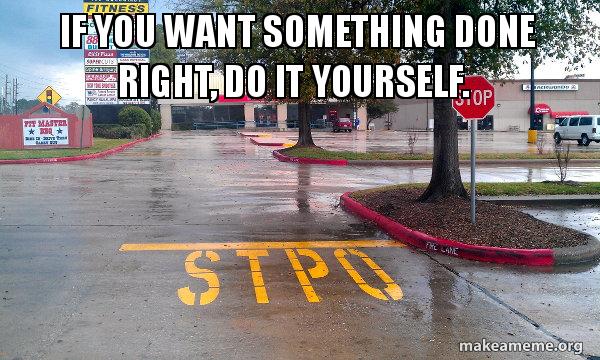
Yeah, there's the old expression, "if you want something done right, do it yourself".

Another reason for doing our own set-ups is that our basses are always changing due to humidity, temperature and the wood aging. So, a good set-up bass today, may not be so tomorrow.

Almost every time I pull out one of my basses, I'm nearly always checking and re-adjusting string height, truss rod clearance, intonation, pickup adjustment.

Why do major rock bands always have a guitar tech on tour with them? To keep their guitars and basses properly set-up.

Yeah, it's a good idea to know how to do our own set-ups.

if-you-want-5bee13.jpg
 
Find a local person who knows what they are doing, ask in musicians circles.
It pays to have new acquisitions looked at by a competent, experienced pro at least once.
Why do major rock bands always have a guitar tech on tour with them? To keep their guitars and basses properly set-up.
Just to comment - these tour techs are definitely the real pros, generally a different class than you might find at your local big box music store. ;) But where ever you find one, a good tech is definitely worth their weight in gold. Still need to learn to do for yourself, or you don't really understand your instrument (or know what to tell the tech you want). The more you know, the better, even with a good tech.

 
Great discussion, folks. I'm glad everyone has found this interesting enough to comment. I want to interject one point, though. There's a lot of "if you don't like the way a tech sets up your instrument its because everyone's different and only you know what you like," etc. I just want to remind us all: some instruments are F'd up big time. It isn't a matter of personal preference. Something is fundamentally wrong. This is the case with my Warwick bass. When I got it in the mail I was shocked. You could practically shoot an arrow with this thing, such was the string height. And when I got it back from my local tech, it wasn't really any better. It isn't that he doesn't know exactly how I like my instruments to feel. It's that he a) doesn't know how to do his job or b) the instrument is broken.

Last night's foray into bass setup at least familiarized me with the process (and the idiosyncrasies of the Warwick bridge and nut), but today is the day I get that action down to where it needs to be and figure out if it can happen without too much buzz.
 
I worked up the nerve to crank down on the truss rod of my new bass last night after reading this. It took half a clock wise turn to get it just a touch lower than the recommended starting point. By doing just that there was a massive improvement in tone and feel. I then adjusted the saddles to 4/64" to 3.5/64" and is a night and day difference.
I used a strobostomp tuner to clean up the A string that was slightly going sharp at the 12th fret.

The tone and feel is so much better it's crazy. I do have a slight buzz on the 4th fret G that I am going to try to clean up with backing off the truss rod a pinch rather than giving up the action height as the E,A,D are perfect.
 
Doing adjustments like a truss rod tweak SHOULD be something that most players could learn to do themselves. None of this is rocket science. Bridges have saddle screws that screw in and out to adjust string height and such. It's all pretty easy generally, and if you DO encounter something unusually tough... THEN go get a tech.

That being said, if your Warwick does have a rise somewhere down the fretboard, then , yes... you can only get the action (string height) down so low without buzzing or fretting out. the dreaded "tongue rise" as seen in so many bolt-on's is a real hard problem to work around. I see no motivation for a tech to intentionally sell you a poor setup. A good tech will set it up "right to the edge" of buzzing and then give it back to you with an explaination of why the action can't go down any lower.

Years ago, that issue was solve by planning the neck and refretting. Is that not done anymore?
 
Half a turn can be massive. An 8th to quarter turn and revisit later is a safer route when getting a feel for it.
I took it in two quarter turn steps with re-tuning between.

It may be the fret. So you might want to look into filing that part of the fret down very slightly. It's a step further afield, I know...

I sighted down the neck looking for deviations and didn't see anything. Its a new Spector Euro but the initial set up was really bad, I don't know if that was Sweetwater or Spector. I'm so close to having it the way I want it. I think I will have someone experienced handle any permanent adjustments like the frets or nut.
 
One of the best investments I have ever made is in set of gauged nut files. Almost every new bass I've encountered benefited from filing the nut lower. I don't have measurements that I go by. I sight down the neck and file until the string movement from open to 1st fret is just slightly more than the movement from the 1st to 2nd fret. I see no reason why it should be any higher on a bass. On a guitar, banging out open chords? Sure. On a bass? Why?
 
Half a turn can be massive. An 8th to quarter turn and revisit later is a safer route when getting a feel for it.
How long does it take the neck to respong to truss rod adjustment ?
Should I wait a day or two for the wood to settle.

I have a new Yamaha that I'm trying to adjust a little but it seems not to happen anything when I loosen the trussrod nut.
Is the 5-piece neck too stiff ?
The action is a bit high on the upper frets, that's why I'm messing with it.