• TalkBass has been independent since 1998. Add your voice.
    Create a free account to reply to discussions, view embedded media, and browse with fewer display ads.
    Join freeLog in
    Want zero display ads or expanded classifieds tools? Compare plans.

I thought playing fretless was easy!

I used to play fretted pretty much in the middle between frets, I would guess a lot of people do. That makes lined fretless feel/look like you're playing a fret high because now you're playing on the lines not in the gaps. Even muscle memory of the position on the same scale is off. I moved my positioning on fretted to almost on the fret and it makes going back and forth easier. Jaco's played a fretted in his video series exactly ON the frets.
There are good reasons to play in the same place (close to the fret) on both fretted and fretless. If you play in the middle between frets you actually have to press the string a bit further down, which is both harder and also actually stretches the string a bit more, which may make intonation harder. Coming from guitar, I used to start out playing between the frets, but on bass, playing close to or almost on the fret works better.
 
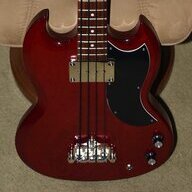
I've been wanting a fretless for a while now and been considering that fretless above and the squier.

Good basses, but I lean towards a five string, 24 fret fretless. I´m already looking at a cheap warwick streamer but I´m afraid the string spacing is too tide.

I would love an Adamovic Eclipse fretless. I played a Jupiter fretless at Nikola´s shop and was blown away.
 
There are good reasons to play in the same place (close to the fret) on both fretted and fretless. If you play in the middle between frets you actually have to press the string a bit further down, which is both harder and also actually stretches the string a bit more, which may make intonation harder. Coming from guitar, I used to start out playing between the frets, but on bass, playing close to or almost on the fret works better.
I've always said playing fretless improves my fretted playing for exactly this reason - fingering accuracy helps both.
 
On a fretted bass, you can press down anywhere behind a fret and the fret becomes the nut, so to speak. So no matter where you fret the note - whether close to the fret or almost on the one behind it - it will still behave as though it is perfectly ON the spot where lines are on a lined fretless. The fret becomes the fulcrum. With a fretless you have to let your fingertip pressure become the fulcrum for the string, and to be in tune you'll need to be (on a lined board) exactly where the lines are.

I've been playing my fretless exclusively since upgrading, and I'm happy to say that I didn't have to alter my left hand technique much, as I have always played right behind the fret. That being said, I'm finding chords to be a HUGE challenge. Even simple triads are seriously making me work.
 
  • Like
Reactions: Emanuel Apascaritei
Ever since I put together my first fretless bass, my fretted basses get no love.
 

Attachments

  • 1779072_938317786201718_5118069645384077689_n.jpg
    1779072_938317786201718_5118069645384077689_n.jpg
    75.6 KB · Views: 70
  • Like
Reactions: Emanuel Apascaritei
It's a lot easier for me without lines. The side dots need to be on the note. I can figure out the placement of the half step in between two dots. I also happen to be the lead singer most of the time and when I play fretless I don't have the time to look at the dot and then find the line above it. As far as being in tune goes, if I sing in pitch(& I do), why would I play out of pitch? If you just play your normal patterns and listen you should be fine. I bought a factory fretless 1972 Fender P in a pawn shop for $185 years ago. As soon as I played it, I decided I was going to play it exclusively. I showed up at a gig with just that bass the next night. The band thought I had lost my mind. It took a few weeks to get comfortable singing and playing without frets but that was my main bass for about 3 years.
 
It's a lot easier for me without lines. The side dots need to be on the note. I can figure out the placement of the half step in between two dots. I also happen to be the lead singer most of the time and when I play fretless I don't have the time to look at the dot and then find the line above it. As far as being in tune goes, if I sing in pitch(& I do), why would I play out of pitch? If you just play your normal patterns and listen you should be fine. I bought a factory fretless 1972 Fender P in a pawn shop for $185 years ago. As soon as I played it, I decided I was going to play it exclusively. I showed up at a gig with just that bass the next night. The band thought I had lost my mind. It took a few weeks to get comfortable singing and playing without frets but that was my main bass for about 3 years.

You really had the guts!
 
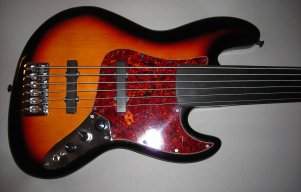
My first serious fretless experience came very late in my bass playing career when I prepped for a Bad Company tribute project and had to learn a big chunk of their catalog. Being a faithful purist, I wanted to sound just like Boz Burrell. I did it on an MIM Jazz fretless just like the one in the OP. Fretless is a great sonic tool to have in your belt, and very addictive.
 
My first serious fretless experience came very late in my bass playing career when I prepped for a Bad Company tribute project and had to learn a big chunk of their catalog. Being a faithful purist, I wanted to sound just like Boz Burrell. I did it on an MIM Jazz fretless just like the one in the OP. Fretless is a great sonic tool to have in your belt, and very addictive.


Yeah, it is addictive indeed :bassist:
 
  • Like
Reactions: grrg63
I'm not sure it was guts I had....LOL! Playing reggae bass and still covering lead vocals is a handful even with frets. Just to see the look of horror on the rest of the bands faces was worth the $185. After they got over it, other bassists always thought I was doing something nearly impossible and inquired about it. I currently use both fretted and fretless basses in the studio and live.
 
I've gravitated to fretless ever since I started taking lessons 45 years ago. The shop where I took lessons had a bright orange Les Paul (knock off) body fretless with a blank fingerboard; and I used to play that thing waiting for the lessons. The guy I was taking the lessons from, Bart Fiori - a Motown era Detroit session guy, used to tell me I didn't want a fretless bass. "Yeah, right," I used to think.

Let's not get into the lines vs no lines thing too much. I will try to summarize some of the points, and hopefully just get it out of the way.

1) No lines looks cooler. It does. Plus, when I finally did start on fretless, Jaco was on the scene, he used lines, and I was doing everything I could NOT to be Jaco. LOL.

2) Lines can be confusing for a player transitioning from frets, depending on your fret target technique. Jaco discusses this in his video. If you are targeting the space between the frets, the lines will drive you nuts. If you are targeting the string stop right at the frets (which may be a better technique), then the lines will make more sense. Just depends on the player. I've seen both. Bottom line is the string needs to stop where the fret would be, and that's the line if it's there, not between. And, yes, you still have to use your ears.

3) In playing position (standing), you can't see the fingerboard for the first seven frets or so; so, in that lower (money) position, the fingerboard markings are somewhat irrelevant; and you just have to understand your fingerboard edge markings. I find that upright left hand fingering with shifts as taught in the Simandl books to be pretty useful down there, except when finger extensions may be needed, but YMMV.

You CAN see the fingerboard when you get up towards the octave, and IME the fingerboard markings up there are extremely useful for two reasons; first, large shifts are common into that register, and second, intonation is more sensitive because the notes are closer together. Lines work well for that, but some of the higher end builders put reference dots up there, and those are also good. Fingerboard markings are NOT training wheels, especially in this area. They are practical reference points.

As much as I adore fretless tones, they can be not worth the effort in certain mixes; especially those with heavy guitar wash. I mean you can do it, but what's the point? Fretless is particularly awesome with horn sections and in more intimate small group settings. IME. GL and MWAH!
 
I used to play fretted pretty much in the middle between frets, I would guess a lot of people do. That makes lined fretless feel/look like you're playing a fret high because now you're playing on the lines not in the gaps. Even muscle memory of the position on the same scale is off. I moved my positioning on fretted to almost on the fret and it makes going back and forth easier. Jaco's played a fretted in his video series exactly ON the frets.

Playing fretted between the frets is considered "sloppy" playing. Generally teachers say you play right behind the fret. some players move that to right on the fret to help give some damping and control the tone. But getting your finger in just the right spot on the fret to control tone is rather tricky and takes some practice.

Playing on a lined fretless that has been perfectly intonated (using edge of credit card to set note right on line) you'll find that the position of your finger will vary a bit from note to note if you check them with a tuner. Usually it's either right on the line or slightly behind the line because strings aren't perfect. And it depends on how your finger flattens out as it presses the string.

You might think that intonation setup on a fretless isn't that important but I find it MORE important than on fretted.
 
Playing fretted between the frets is considered "sloppy" playing. Generally teachers say you play right behind the fret. some players move that to right on the fret to help give some damping and control the tone. But getting your finger in just the right spot on the fret to control tone is rather tricky and takes some practice.
Totally agree; BUT, there are some exceptionally fine players, such as Chuck Rainey, who do target right between the frets. So, I've personally given up on trying to force any kind of fretted technique as "right."
 
It´s a fretless after all right? Kidding a side, it´s really important to be well intonated and setted up. But it´s not my bass and I don´t want to fiddle with it.

If it was mine I would have changed the strings and shim it. The action is really high for me. On my fretted basses I have the action at arround 1.5 mm for the low b at last fret, on this one I think it is arround 2 mm min on the E string.

I´ve noticed this myself too. You have to be just a hair behind the line in order to be in tune. Man this is hard.

If the action is too high then the fret line is probably sharp when you "fret" Intonation needs to be properly set for the action.
 
  • Like
Reactions: Emanuel Apascaritei

Latest posts