
Enjoy the benefits of a premium membership!
Upgrade Account
-
TalkBass has been independent since 1998. Add your voice.
Create a free account to reply to discussions, view embedded media, and browse with fewer display ads.
Join free Log in
Want zero display ads or expanded classifieds tools? Compare plans.
You are using an out of date browser. It may not display this or other websites correctly.
You should upgrade or use an alternative browser.
You should upgrade or use an alternative browser.
I tune my bass slightly flat when recording. Is that wrong?
- Thread starter Santol
- Start date
-
- Tags
- flat intonation recording tune
More options
Who Replied?
I noticed that the fretted notes on my J Bass are slightly sharp. I understand this happens because by pressing on the string I increase the tension - especially with my high-action set up. It's still strange that this doesn't occur at the 12th string. Notes up here aren't sharp at all after I fixed the set-up and intonation. But well before that, the first few positions, all the fretted notes are slightly sharp when the bass is tuned perfectly.
Anyway, to get around this issue, I decided to tune the bass slightly flat so that the fretted notes are perfect. I do this only when recording; especially on songs which don't require open strings. Has anyone else been doing the same?
I had a Rick 4001 that had a nice feeling setup. Was in tune open and at the 12th fret. Lower frets were slighly sharp with lesser amounts of sharpness until about the 7th fret where it was so little that it didn't matter. Had to have a new nut made. The nut had been cut wrong and the break point was too close to the frets. New nut had that point set back further. Was perfectly in tune everywhere then.

Are you guys saying your instruments are pitch perfect on the open strings and on all the other fretted notes?
A well made, well setup instrument... YES. My Dingwall with a fresh set of strings and a good setup will be dead on with the strobe tuner on every string on every fret. A cheap bass that is well setup, you should expect less than 2 cent variance at any fret. I used to set my intonation about 2 cents flat at 12 on a cheaper bass and then pull the string to pitch if I needed to. But I no longer own a cheapo.
My fretless bass isn't always in tune everywhere no matter the setup...

I use Melodyne a lot for both "fixing" things, and also as a creative tool (like, making mutant harmony vocals etc. etc.). It does work a treat on many things, but it can easily introduce noticeable artifacts, so ya gotta be judicious with it. I wouldn't track something counting on fixing things later with it. Unless it's some deliberately "out" thing, like something you grabbed field recording or whatever, that you know you'll be playing with later.You need to get with it! Celemony has been around since 2000.
Probably all your favorite major-label recordings, in the last 10 years, have tracks (not just vocals) processed with Celemony Melodyne.
I hope I'm not bursting any bubbles...

I would suggest at least trying the flatter neck and compare the tone with what you currently have, you might be pleased with the change and, of course, you can always go back.For the record, the nut is nicely shimmed. Down to almost fret level. The high action is due to the bow in the neck, not the nut height.
The sound is incredibly special (sexy and warm) and if changing the neck to a straight one to get ultimate low action is going to alter the sound significantly, I'll never consider it.
When I setup my Tbird with very flat neck relief and very low action I got the improved playability that I was looking for. What I also got, unexpectedly, was improvement in intonation, tone and sustain. I did have a luthier install a bone nut cut for my strings and for the low action and light touch that I use.
I use Melodyne a lot for both "fixing" things, and also as a creative tool (like, making mutant harmony vocals etc. etc.). It does work a treat on many things, but it can easily introduce noticeable artifacts, so ya gotta be judicious with it. I wouldn't track something counting on fixing things later with it. Unless it's some deliberately "out" thing, like something you grabbed field recording or whatever, that you know you'll be playing with later.
One should always get the "best" performance possible. Then, judiciously use tools like Melodyne for those one or two notes that need a little massaging. The goal being a Happy Ending!


Invalid Link Removed
I'm waiting for True Temperament Fanned Frets.
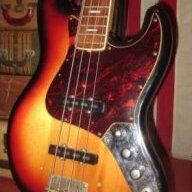
The opinions expressed here are all over the spectrum. I'll go with the consensus and try to get it set up to perfection. If it doesn't work, I'll throw rounds on this and get the classic P bass+flats. Possible a PJ bass+flats, just to be sure I can get some of this jazz sound I like so much.
Just curious what you meant by this.Attitude adjustment to go with it, perhaps.

Can't recommend TI Jazz Flats enough for this!It's a 70s J bass and maybe the neck has been deformed over the years or something... The action is high and can't be lowered since I have heavy flats on it and the tension must be really high on this old neck. It sting gives me nice Jamerson thumps on it and I love the sound.
But regardless of the condition of my bass, isn't it the case with every instrument that the fretted notes are slightly higher? Isn't it worth it to tune a little flat to compensate for it anyway?
Maybe find some low tension flats that work with the neck? Better yet, take it to someone qualified and see if they can get the neck straightened out.

yeah, my bass is within the 99 percentile of being pitch perfect, when properly set up.I'm a big DIY guy and don't believe in getting others to do things for me if I can invest a reasonably short time and learn how to do it myself. That said, I don't understand what a luthier could do here if it's well intonated at the 12th fret already. The bridge looks fine too. The strings are old vintage flats I took out of unsealed envelopes... The problem might be with them.
I don't have another bass here at the moment, to check. Are you guys saying your instruments are pitch perfect on the open strings and on all the other fretted notes?
Has your bass been set up by anyone else?
I understand the DIY mindset, and applaud it, but sometimes, having someone else do something for us is the best way to learn.
I thought i liked high action. All my basses had high action. One of them developed a problem not dissimilar to yours so i took it to a knowledgable tech. By default, he set up my bass with super low action, which i never thought to do. Upon recieving the bass, i discovered that low action made the bass SOOO much easier and enjoyable to play. Now that's how i do my set ups & i'd never have known it except by having someone do it for me.
A luthier could lookat your bass and figure out why your fretted notes are sharp, which it seems is a thing outside your scope of knowledge. Simple as that. Be it a warped neck, a truss rod that needs adjusting, or a nut not properly filed. And, once done, you'd have learned something else to look for when setting up your basses in the future.
It sure as hell is more enjoyable and easier to play. But it seems to be common knowledge that it affects the sound as well. I haven't tested it myself on this particular bass, but I can't lose the tone I'm getting here. If I have to lose a bit of comfort playing high action, I don't mind.Upon recieving the bass, i discovered that low action made the bass SOOO much easier and enjoyable to play. Now that's how i do my set ups & i'd never have known it except by having someone do it for me.
And i can dig that. But the general consensus, what I'd think, is that something somewhere is off a bit. A second set of eyes might could see something you don't.It sure as hell is more enjoyable and easier to play. But it seems to be common knowledge that it affects the sound as well. I haven't tested it myself on this particular bass, but I can't lose the tone I'm getting here. If I have to lose a bit of comfort playing high action, I don't mind.
That's all.

I noticed that the fretted notes on my J Bass are slightly sharp. I understand this happens because by pressing on the string I increase the tension - especially with my high-action set up. It's still strange that this doesn't occur at the 12th string. Notes up here aren't sharp at all after I fixed the set-up and intonation. But well before that, the first few positions, all the fretted notes are slightly sharp when the bass is tuned perfectly.
Anyway, to get around this issue, I decided to tune the bass slightly flat so that the fretted notes are perfect. I do this only when recording; especially on songs which don't require open strings. Has anyone else been doing the same?
Coming in later to the party.
Nope, at all, I set up my bass so the fretted note, with my usual mode and force, will be perfectly in tune. A good bass should allow this by regulating the octave, given the bass has a normal action setted by turning the truss rod. Unless the bass is severely damaged, I can't see a reason to not solve the issue or limit the symptom
It's a 70s J bass and maybe the neck has been deformed over the years or something... The action is high and can't be lowered since I have heavy flats on it and the tension must be really high on this old neck. It sting gives me nice Jamerson thumps on it and I love the sound.
But regardless of the condition of my bass, isn't it the case with every instrument that the fretted notes are slightly higher? Isn't it worth it to tune a little flat to compensate for it anyway?
Heavy flats don't need high action. Try sorting out the action with the truss rod.

If you didn't notice it, it wasn't a problemJust a little sharp and only noticed when monitoring through a chromatic tuner. Otherwise I'd never know I had a problem.
. Seriously, though, don't let yourself be a slave to a chromatic tuner.Human beings pressing strings against metal frets = not every single note being perfectly in tune.
That said, I had a guitar which had intonation issues, and I would just tune it so that whatever part I was recording was as close to being in tune as possible. Sometimes I'd change the direction I applied pressure to compensate for flat/sharp notes.
But whatever you do, don't fret
 .
.
Just yesterday I watched this very interesting video in which this guy explains the "James Taylor" tuning method,
where he tunes every string of the guitar few cents flat. Maybe it's appliable to the bass guitar?
Have a look.
where he tunes every string of the guitar few cents flat. Maybe it's appliable to the bass guitar?
Have a look.


