• TalkBass has been independent since 1998. Add your voice.
    Create a free account to reply to discussions, view embedded media, and browse with fewer display ads.
    Join freeLog in
    Want zero display ads or expanded classifieds tools? Compare plans.

I used to not like P basses

I know what I'm saying isn't 100%, it's just something that I have noticed. I think part of truly commanding a bass guitar is learning to hold down a rock-solid line while adding a certain personal expression to it, instead of taking the easy option of meandering up/down to the detriment of the instrument (which is tempting, because it is fun and possibly easier than holding a true line). There's many non-P people who have mastered this, and obviously a lot of Precision enthusiasts who have yet to, but the design of the instrument seems to help this skill to develop naturally.

Part of it is in the neck. Kim Deal (from The Pixies: here) for example, is a small lady who plays a Precision with a thick neck. You can hear that, and she makes it work for her. She'll play simple but elegant lines that arguably have far more personality than faster, more complex arrangements. This is part of the magic of the Precision at least to my ear: it holds the bass player firmly in the "bass position" of the band, but within that there is so much room for emphasis. Each note can be individually crafted to express a subtle difference in emotion - even just going from one to the other, over and over - in a way that you can't always get on others.

From what I can see, what you may lose in variety, you gain back tenfold in nuance. I'm still an amateur, but this is my experience from thinking at-length about it.
That may be true for P basses with fat necks, but what about the "A" or "B" necks? That's Jazz bass territory.
 
I thought people on this forum complained about non-stock standard Fender equipment. :p
I used to until I heard some of the pickups Fender's been making in a live environment. I don't know what they've been using since 2012 when they changed the AmStd pickup, but the pickup they used in the 2008-2012 AmStds was crap and the one in the MIA's with the S1 switch wasn't much better. I have a 2009, and I couldn't get that pickup off there fast enough. Got a Geezer on it now and it absolutely sings. I'd have gladly left it on there if I thought I could deal with it, but I would have had to sell the bass and I really liked it otherwise.
 
You need help. What is the point of collecting non-collectable basses? With all the money spent on those 10 P basses, you could have 2 or 3 MIA P basses.

I understand the idea that instead of having many objects that are sort of different aspects of what you want, it would be better (or at least less cluttered) to have one that is really good. Personally I accumulate too many things, but even I wouldn't have 10 P-basses, don't even have a place to put them.

However, collecting non-collectable objects isn't necessarily bad. Some collections are just for personal reasons, and it's a lot less hassle than trying to collect valuable objects. I expect the OP never has to worry about whether one of his basses has the wrong pot codes or tuners or whatever.
 
I blame all of the crap slap on two players: Louis Johnson and Flea, not that Flea is a bad player:cool:
As far as Sheehan is concerned, I've only seen him once and it was a supporting role and all I have to say is that brother is rock solid.
 
I understand the idea that instead of having many objects that are sort of different aspects of what you want, it would be better (or at least less cluttered) to have one that is really good. Personally I accumulate too many things, but even I wouldn't have 10 P-basses, don't even have a place to put them.

However, collecting non-collectable objects isn't necessarily bad. Some collections are just for personal reasons, and it's a lot less hassle than trying to collect valuable objects. I expect the OP never has to worry about whether one of his basses has the wrong pot codes or tuners or whatever.

I can't imagine what I'd do with ten Ps. I have a P, a Jazz fiver, and I'm building a P/J in the hopes that it can be "the one". But I do understand the collecting bug.
 
However, collecting non-collectable objects isn't necessarily bad. Some collections are just for personal reasons, and it's a lot less hassle than trying to collect valuable objects. I expect the OP never has to worry about whether one of his basses has the wrong pot codes or tuners or whatever.

What you write here reminds me of an article by irreverent 60's rock critic Richard Meltzer (anyone remember his book "The Aesthetics of Rock"?).
Meltzer wrote a satiric and extremely insightful article, a guide to collecting contemporary bottle caps, bottles then being the standard delivery system in soda vending machines.
The counter-culture implication was that the "collector" would procure the "caps" by prying them off the bottles still in the cooler without paying. That the caps could be scored for free
was fortunate because part of the joke was the inherent worthlessness of the 'caps. It mattered not to Meltzer, who prattled on about collecting, trading with your friends, how to trade doubles and the like.
The whole article in fact lampooned the fetishistic and compulsive mindset of collectors, but also was a sort of zen reminder that one can often have just as much fun with no money as with a lot of money
-- except that it's cheaper. And of course where consuming fetishes are concerned, beauty it definitely in the eye of the beholder.
 
  • Like
Reactions: JIO and reddesert
You need help. What is the point of collecting non-collectable basses? With all the money spent on those 10 P basses, you could have 2 or 3 MIA P basses.

Different strokes for different folks.

Variety is the spice of life:

IMGP3938a.jpg


IMGP2723a.jpg
 
  • Like
Reactions: Warhawk
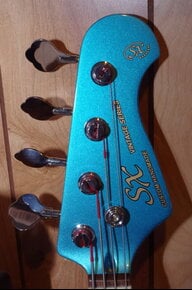
I've never really been a P bass guy - I've owned one P-Lyte, in the 90s, and one P-styled frankenbass, earlier this year. Mostly, I don't like the lines of the traditional P body, split pickup, and pickguard, aesthetically. The sound was neither here nor there, I just thought they were ugly, boring looking affairs. But I've started really digging certain ones... The Sting signature model was probably the first one I really liked, then the acoustic-electric with the F hole, and now I find I really like the Steve Harris and the new seafoam green PJDeluxe.

So, while my main bass is a riff on the J bass, I might end up with an actual P before too long myself.
 
I've never really been a P bass guy - I've owned one P-Lyte, in the 90s, and one P-styled frankenbass, earlier this year. Mostly, I don't like the lines of the traditional P body, split pickup, and pickguard, aesthetically. The sound was neither here nor there, I just thought they were ugly, boring looking affairs. But I've started really digging certain ones... The Sting signature model was probably the first one I really liked, then the acoustic-electric with the F hole, and now I find I really like the Steve Harris and the new seafoam green PJDeluxe.

So, while my main bass is a riff on the J bass, I might end up with an actual P before too long myself.

I'd suggest trying out a G&L SB-1 sometime, just for kicks and giggles. You might find that pickup makes you a P-lover. It did it for me. It has just enough top-end and clarity so that it cuts through really nicely, but the tone knob is perfectly matched so you can warm it up to a more traditional P-sound if you want. The bass is also extremely HOT but it doesn't have that mid-heavy sound usually associated with that. The output level is darn near an active bass.

For reference, I played Jazzes for 12-14 years, and now my main player is a G&L SB-1. An SB-1 even works for slap lines without sounding chunky like a normal P bass. Some people like a the sound of a P-bass slapped, but I don't. The SB-1 sounds great played this way.

Anyway, some people may not consider an SB-1 a real P-bass. I say it's a modernized one, and it is still produced by a Leo Fender company.
 
I know what I'm saying isn't 100%, it's just something that I have noticed. I think part of truly commanding a bass guitar is learning to hold down a rock-solid line while adding a certain personal expression to it, instead of taking the easy option of meandering up/down to the detriment of the instrument (which is tempting, because it is fun and possibly easier than holding a true line). There's many non-P people who have mastered this, and obviously a lot of Precision enthusiasts who have yet to, but the design of the instrument seems to help this skill to develop naturally.

Part of it is in the neck. Kim Deal (from The Pixies: here) for example, is a small lady who plays a Precision with a thick neck. You can hear that, and she makes it work for her. She'll play simple but elegant lines that arguably have far more personality than faster, more complex arrangements. This is part of the magic of the Precision at least to my ear: it holds the bass player firmly in the "bass position" of the band, but within that there is so much room for emphasis. Each note can be individually crafted to express a subtle difference in emotion - even just going from one to the other, over and over - in a way that you can't always get on others.

From what I can see, what you may lose in variety, you gain back tenfold in nuance. I'm still an amateur, but this is my experience from thinking at-length about it.

I've noticed that most of the female bass players I see tend to use a Precision. Should I read something Freudian in that?