• TalkBass has been independent since 1998. Add your voice.
    Create a free account to reply to discussions, view embedded media, and browse with fewer display ads.
    Join freeLog in
    Want zero display ads or expanded classifieds tools? Compare plans.

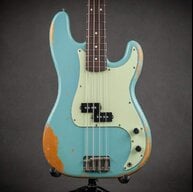
I want this P bass.

6K €??? I will never pay that much for any instrument (my top limit has always be 1K €, plenty of goodies at that price and bellow), it is crazy money for a plank of wood and bits.

I always feel, when I see those prices, that the world is crazy when on one end some splash those sumns on toys when on the other people cant pay for basics...something is not right.
 
Here's one from '62/'63 supposedly. It's only $1,200 U.S. and 50km from my home.

auqqgssw4s7zciy9hoso.jpg


I'd rather get a '60s red, '60s speckled replica from Spitfire.
Obviously I meant new real tort. I never raid anything about vintage pickguards.
I don't understand why Fender can't do what Spitfire does. The market for real tort is there and Fender could easily sell this as an upgrade.
 
  • Like
Reactions: Katoosie
Yep. All for less than the price of a new avri
Musikraft charges 450 dollars for Brazilian rosewood alone and it's only available to ship in the US. I believe this type of wood is basically extinct. So that neck would cost about one grand. Very reasonable, all things considered, if the quality is there.
I'm thinking about ordering a neck from them, with regular rosewood but dark, but at 500 dollars plus shipping and import taxes to Europe, so basically $700, it better be good.
 
  • Like
Reactions: Katoosie
The road worn sanding treatment is all wrong. I've never made a bass Road Worn other than through natural causes and they look nothing like that.
The patch on the arm bevel looks bad, the rest of the wear seems ok.
I don't care if the body is reliced, other than the peace of mind, but a reliced neck feels so good. It must be nitro though.
 
  • Like
Reactions: Katoosie
Musikraft charges 450 dollars for Brazilian rosewood alone and it's only available to ship in the US. I believe this type of wood is basically extinct. So that neck would cost about one grand. Very reasonable, all things considered, if the quality is there.
I'm thinking about ordering a neck from them, with regular rosewood but dark, but at 500 dollars plus shipping and import taxes to Europe, so basically $700, it better be good.
Side note, quite a few people from Poland are making their way to TB.

What gives? (:
Just an observation.

Pozdrowienia ze Szwecji!
 
  • Like
Reactions: andare
I don't care if the body is relic'd, other than the peace of mind, but a relic'd neck feels so good. It must be nitro though.

I have dry hands I really don't notice if a neck is been sanded or not, however I do take a scrubby to just about every neck I've ever had and it seems to make it feel a bit slicker. Duller too. And sometimes I just don't do anything to the neck except keep it good and clean with warm water on a rag and sometimes I'll spray a little lemony furniture polish on the back of the neck (silicon).
 
  • Like
Reactions: Katoosie and andare
I have dry hands I really don't notice if a neck is been sanded or not, however I do take a scrubby to just about every neck I've ever had and it seems to make it feel a bit slicker. Duller too. And sometimes I just don't do anything to the neck except keep it good and clean with warm water on a rag and sometimes I'll spray a little lemony furniture polish on the back of the neck (silicon).
By reliced neck I don't mean sanded. I actually hate those, especially since the sanded area often has hard edges. It looks so fake. I mean rolled edges, low frets and nicks and dings under gummy nitro.
My relic neck is old and I think a lot of the wear is authentic. Something about it can't be faked.
I always roll the edges of the board and knock down the glossy back to a dull shine.
I've never played a neck that was worn down to the bare wood.
 
  • Like
Reactions: Katoosie
Obviously I meant new real tort. I never raid anything about vintage pickguards.
I don't understand why Fender can't do what Spitfire does. The market for real tort is there and Fender could easily sell this as an upgrade.


I suppose it wasn't obvious that I wasn't talking about tortoises.
I meant celluloid or whatever plastic can be used today, with three-dimensional swirls, like in the vintage Fender days, like Spitfire and Avantguard are producing nowadays, as opposed to printed patterns.

Spitfire and Avantguard aren't celluloid-based. Celluloid plastic has been out since 1973, as Turnaround was saying.

Between the amount of market demand and the cost of scaling up the processes Spitfire and Avantguard use I suspect therein lies the practical reasons why Fender or any other large plastic sheet material suppliers do not do this.

Based on my communication with Mark at Spitfire during the WIP it's obvious that his workflow involves a small-scale or small batch process.
 
Last edited:
  • Like
Reactions: Katoosie and andare
Musikraft charges 450 dollars for Brazilian rosewood alone and it's only available to ship in the US. I believe this type of wood is basically extinct. So that neck would cost about one grand. Very reasonable, all things considered, if the quality is there.
I'm thinking about ordering a neck from them, with regular rosewood but dark, but at 500 dollars plus shipping and import taxes to Europe, so basically $700, it better be good.

Musikraft's quality is top-notch.

I never would order a neck for myself with Brazilian rosewood. Having a neck Brazilian rosewood fretboard made today doesn't make any sense to me. I only mentioned Brazilian before for a point of comparison as far as prices.

I have one with a select piece of dark Indian rosewood; it's very dark. That costs $60 vs $50 for a slab of Indian rosewood not selected for darkness.
 
Last edited:
  • Like
Reactions: Katoosie and andare
The road worn sanding treatment is all wrong. I've never made a bass Road Worn other than through natural causes and they look nothing like that.

Most of the apparent distressing on Fender's "Road Worn" series guitars/basses isn't distressing at all, nor is it from sanding.

What you see is accomplished through a systemized finishing process for production line models that involve applications of masking that block the lacquer when the body is sprayed, leaving patches of wood exposed. The remainder of the appearance is achieved when the finish on the body is buffed on a wheel; they smooth and blend the transitions between the lacquer and the bare spots.

The lacquer finishing and distressing on Fender Custom Shop Pino signatures series P basses, which seem so commonly coveted, is also accomplished similarly. It's obvious from how the so-called belt buckle rash on the backs of Pino P basses looks.

This is necessitated by Fender's requirement of repeatable consistency of "relicing" on certain signature series and "Road Worn" series production.

The techniques Fender Custom Shop uses for finish distressing for non-signature series instruments and what Gibson Murphy Lab uses are different and much more time-consuming and skill-intensive than the mass production methods used for Fender signature series "Road Worn" models.

The most expensive "Master Built" Fender Custom Shop instruments that are ordered with aging or distressing get the most exacting and time-intensive treatments which are entirely different from a production line instrument, most of all the MIM "Road Worn" series instruments.

It's like anything else. There's a relationship between the intensity of time and work put into making something and the price.
 
Last edited:
  • Like
Reactions: MrRobert
Most of the apparent distressing on Fender's "Road Worn" series guitars/basses isn't distressing at all, nor is it from sanding.

What you see is accomplished through a systemized finishing process for the production lines that involve applications of masking that block the lacquer when the body is sprayed, leaving patches of wood exposed. The remainder of the appearance is achieved when the finish on the body is buffed on a wheel; they smooth and blend the transitions between the lacquer and the bare spots.

The lacquer finishing and distressing on Fender Custom Shop Pino signatures series P basses, which seem so commonly coveted, is also accomplished similarly. It's obvious from how the so-called belt buckle rash on the backs of Pino P basses looks.

This is necessitated by Fender's need for repeatable consistency of "relicing" on certain signature series and "Road Worn" series production.

The techniques Fender Custom Shop uses for finish distressing for non-signature series instruments and what Gibson Murphy Lab uses are different and much more time-consuming and skill-intensive than the mass production methods used for the signature series "Road Worn" models.

The most expensive "Master Built" Fender Custom Shop instruments that are ordered with aging or distressing get the most exacting and time-intensive treatments which are entirely different from a production line instrument, most of all the MIM "Road Worn" series instruments.

It's like anything else. There's a relationship between the intensity of time and work put into making something and the price.


To be clear, about the masking, I'm not referring to masking tape. Pieces of irregular contour-cut adhesive-backed film are cut on a machine. Those are stuck to the prepped wood body before spraying the finish. The was this works is akin to making a silk screen.
 
6K and they screwed on a 10 buck pickguard that looks like it's made up of a mix of blood and puke. It is screaming for a black guard. Go build one yourself from parts like many have suggested here. You could even buy a digital Weller soldering station, screw up the paintwork three times before you nailed the art of rattlecan nitro application and still come out three grand ahead.