• TalkBass has been independent since 1998. Add your voice.
    Create a free account to reply to discussions, view embedded media, and browse with fewer display ads.
    Join freeLog in
    Want zero display ads or expanded classifieds tools? Compare plans.

I want to build a buffing machine

I have one of those Sioux drills, an older one, and I love it! It's my favorite electric drill on my main woodworking bench. But it's not the right thing for buffing; too slow, wrong shape.

Those yellow DeWalts are just right for buffing. The speed, shape and weight are perfect. I hold it two-handed; one around the body, just behind the chuck, the other on the handle/trigger.
 
Last edited:
  • Like
Reactions: Water buffalo
Man, you guys have me really reconsidering the entire plan here. I was really hoping that the buffer would make life a bit easier... but it sounds like I may be better suited to spend the money elsewhere.

I've done bodies in the past with the drill and hand polishing, when I was "restoring" a grungy old finish. And the results were okay. But I really was hoping that a full size buffer would produce the results seen by major builders, as well as cutting down on the prep time. And the project didn't seem too difficult or costly, however that was before I really saw what needs to be used to achieve the proper end result.

So... this may just go on the back burner for now. I really need to work on some other, more productive things currently, as far as building goes.
 
Digging this one up from the dead. @Bruce Johnson in this thread you mention doing most of your buffing with a 6" wheel in an electric drill. In a couple newer threads such as this one, you talk about stationary buffing machines. Are you still using mostly hand drills with 6" wheels, or stationary, or both?

One the verge of setting up a more dedicated finishing area in the shop and I'm considering building a stationary machine, just not sure if it's justifiable versus a good handheld setup.
 
  • Like
Reactions: Beej
Digging this one up from the dead. @Bruce Johnson in this thread you mention doing most of your buffing with a 6" wheel in an electric drill. In a couple newer threads such as this one, you talk about stationary buffing machines. Are you still using mostly hand drills with 6" wheels, or stationary, or both?

One the verge of setting up a more dedicated finishing area in the shop and I'm considering building a stationary machine, just not sure if it's justifiable versus a good handheld setup.

Hey dwizum;

My buffing tools and technique remain about the same as my post from a few years ago. I still prefer to clamp the body or neck down to the bench and use handheld electric drills with 6" unsewn cotton buffing wheels. I prefer that over holding the neck against a larger wheel on a stationary buffing machine. I do have a cool horizontal spindle machine which I can quickly put the buffing wheels on. And I use it occasionally. But most of the time I prefer the handheld drills.

IMG_7037B.jpg


IMG_7068B.jpg
 
This is the machine I use for stationary buffing, when I want to.

This is a Crozier Speed Lathe. A very rare machine that you don't see for sale often. I was lucky to spot this one at a machinery auction about 15 years ago. It's used in the machine shop for quick second operations on lathe jobs.

Basically, it's a stout electric motor, but the spindle is hollow and is made to take a standard 5C collet, like the spindle of a small metal lathe. The lever at the back closes and opens the collet. The lever at the front is On-Off-Brake. Slap the lever and it's up to speed; slap it again and it screeches to a stop. The switch on the back box is 1750 rpm or 3450 rpm. A simple strong machine made to run all day in a factory.

IMG_1342B.jpg


So, I use the Crozier as a multi-purpose buffer/sander. I put a 1" 5C collet in it, and machined up a set of shafts for it from 1" mild steel bar stock. The shafts can be removed and swapped in seconds, and can be locked in any position, up close or extended out.

Here's three of the shafts that I've made up for it. The one in the front is fitted with a big sanding mop head. The one in the middle is a stack of grey Scotchbrite disks. That's the one I use most often, for putting a satin finish on aluminum parts. The shaft in the machine has a small keyless drill chuck on the end. It will clamp onto any small arbor. That's one of my 6" cotton paint buffing wheels.

IMG_1344B.jpg


This a cool machine for a Luthier's shop.....If you happen to spot one somewhere, and nobody knows what it is.

Crozier is the only company I know of that made these Speed Lathes. And that's the only product they made.
 
  • Like
Reactions: mapleglo
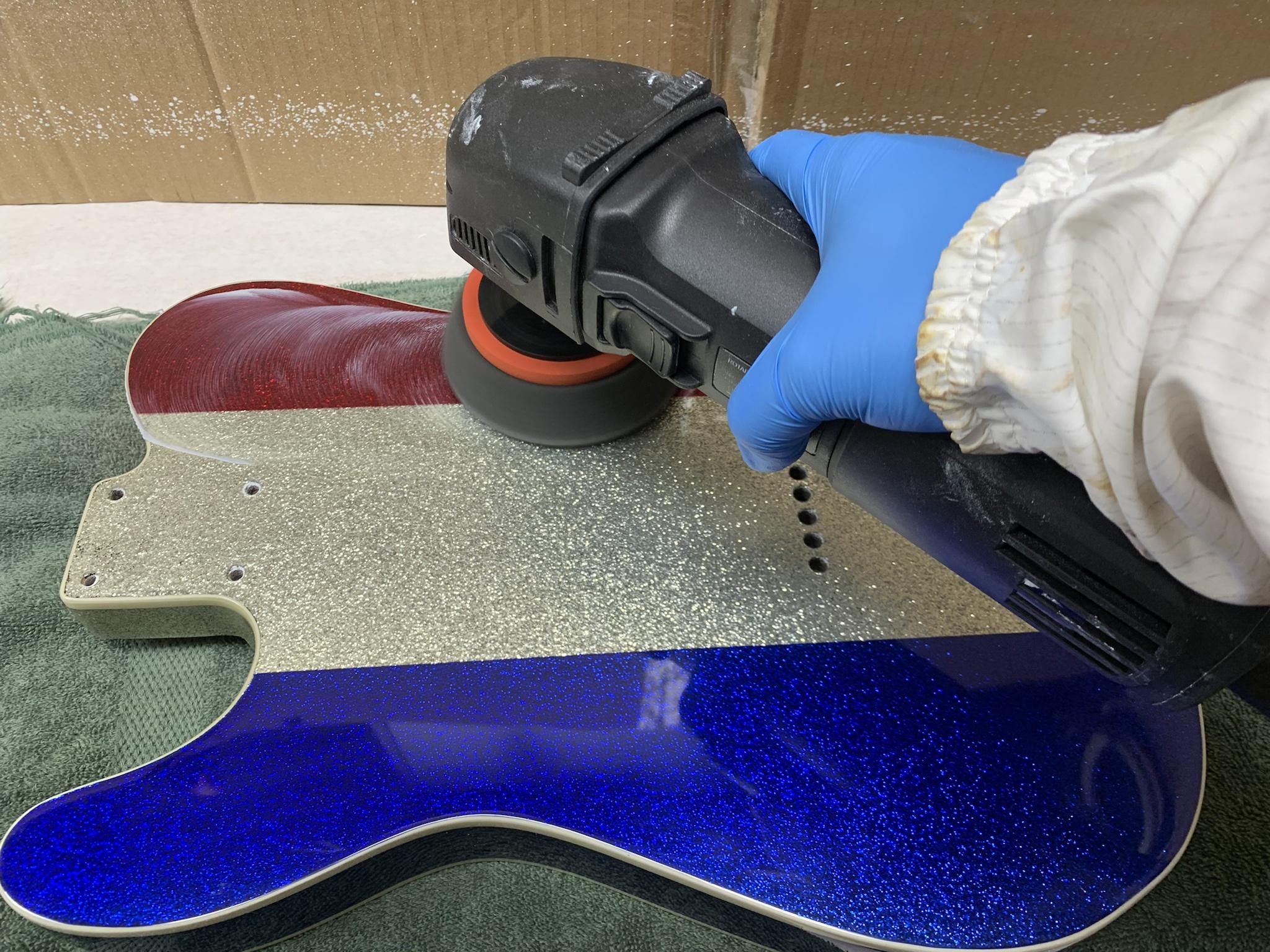
I'm curious if anyone uses one of the many specialty right angle polisher / buffers for instrument work? I know a lot of folks use them for polishing out their car finishes.

https://www.amazon.com/dp/B004W1WGIC?tag=bestseller087e-20&linkCode=osi&th=1&psc=1&keywords=Power Polishers & Buffers

I don't do a lot of finish polishing, but do use the cotton buffs in a hand held drill once in a while. It seems like the 9" buff and other features like slow start-up and wide range of speed, along with the ergonomics would make these good candidates for instrument work.

I've read so many accounts of those large diameter buffs grabbing and destroying instruments that I'd be leery of ever wanting one. There are certain operations they seem suited for like acoustic guitars with large flat areas, but all the more intricate curvy stuff might be catch fodder.
 
Last edited:
As an Amazon Associate, TalkBass may receive commissions from qualifying purchases made via links on this site.
I'm curious if anyone uses one of the many specialty right angle polisher / buffers for instrument work? I know a lot of folks use them for polishing out their car finishes.

https://www.amazon.com/dp/B004W1WGIC?tag=bestseller087e-20&linkCode=osi&th=1&psc=1&keywords=Power Polishers & Buffers

I don't do a lot of finish polishing, but do use the cotton buffs in a hand held drill once in a while. It seems like the 9" buff and other features like slow start-up and wide range of speed, along with the ergonomics would make these good candidates for instrument work.

I've read so many accounts of those large diameter buffs grabbing and destroying instruments that I'd be leery of ever wanting one. There are certain operations they seem suited for like acoustic guitars with large flat areas, but all the more intricate curvy stuff might be catch fodder.

I use a buffer like that which I bought from Harbor Freight.

buffer.jpg


It works fine.
 
As an Amazon Associate, TalkBass may receive commissions from qualifying purchases made via links on this site.
I'm curious if anyone uses one of the many specialty right angle polisher / buffers for instrument work? I know a lot of folks use them for polishing out their car finishes.

https://www.amazon.com/dp/B004W1WGIC?tag=bestseller087e-20&linkCode=osi&th=1&psc=1&keywords=Power Polishers & Buffers

I don't do a lot of finish polishing, but do use the cotton buffs in a hand held drill once in a while. It seems like the 9" buff and other features like slow start-up and wide range of speed, along with the ergonomics would make these good candidates for instrument work.

I've read so many accounts of those large diameter buffs grabbing and destroying instruments that I'd be leery of ever wanting one. There are certain operations they seem suited for like acoustic guitars with large flat areas, but all the more intricate curvy stuff might be catch fodder.

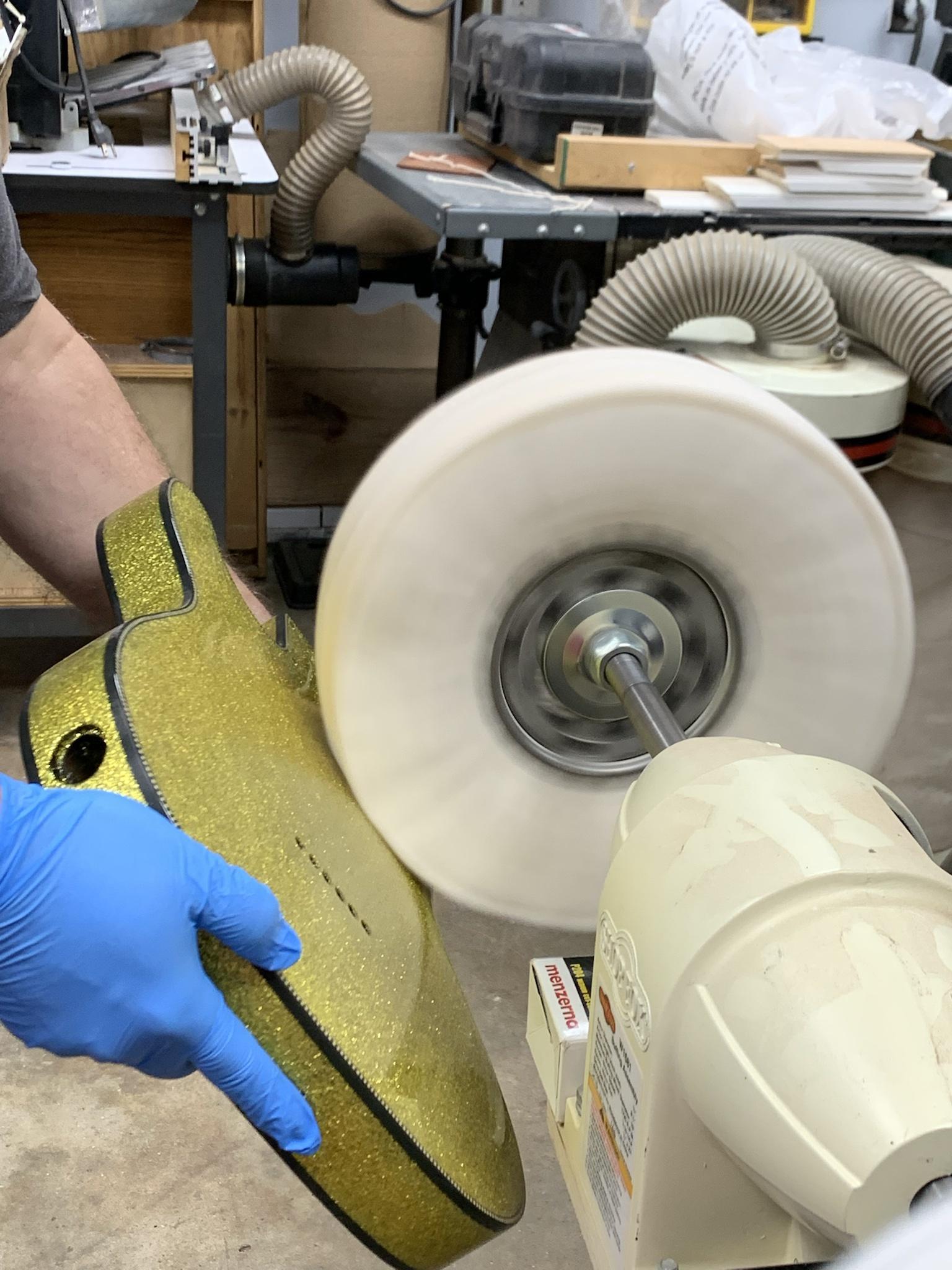
I use both. I typically start with a Shop Fox buffing arbor with medium and fine Menzerna sticks. I run 3 canton (medium) and 3 domet (fine) buffs on either side. I then follow that up with a detail buffer and fine 3m compounds for the final polish. I get very good results with that setup.

One of the tricks to using a buffer is to set it up so that the belt can slip a little bit. That way if your workpiece catches, or you get a little too aggressive, the belt slips and the buffs slow down or stalls.

WV9ZAJ4.jpg


Ei4VjBD.jpg


AURGoFR.jpg


Edited to add:
Also, if you're buffing nitro lacquer, you do not want high RPM on the buffing wheels. Mine runs somewhere between 700-850... certainly less than 1000. If you go higher, you'll just have problems. I don't know what RPM to use for other finishes as I have no experience with others.
 
As an Amazon Associate, TalkBass may receive commissions from qualifying purchases made via links on this site.
I'm curious if anyone uses one of the many specialty right angle polisher / buffers for instrument work? I know a lot of folks use them for polishing out their car finishes.
I do.
Because.. painting cars & bikes is how I learned to cut & rub. If your sanding is done properly... you don't need a big scary (potentially hot) buffing wheel.
Also... I much prefer a *pneumatic* angle polisher. More control... plus the phbpbtttt sound is cool.:roflmao:
 
Last edited:
I do.
Because.. painting cars & bikes is how I learned to cut & rub. If your sanding is done properly... you don't need a big scary (potentially hot) buffing wheel.
Also... I much prefer a *pneumatic* angle polisher. More control... plus the phbpbtttt sound is cool.:roflmao:
I am used to using pneumatic tools from working in an industrial setting but a large compressor isn't in my shop scenario or budget. Otherwise, I love air tools!
 
So pleased with the results I'm getting using 6" loose cotton buffing wheels on a hand drill. I have a heavy duty drill that tops out at probably 600-800 rpm or so and it's perfect. I'm using the 3m super duty compound as a first step. Undecided on the second step, I'm trying both mother's micro polishing glaze and meguiars swirl remover 2.0.

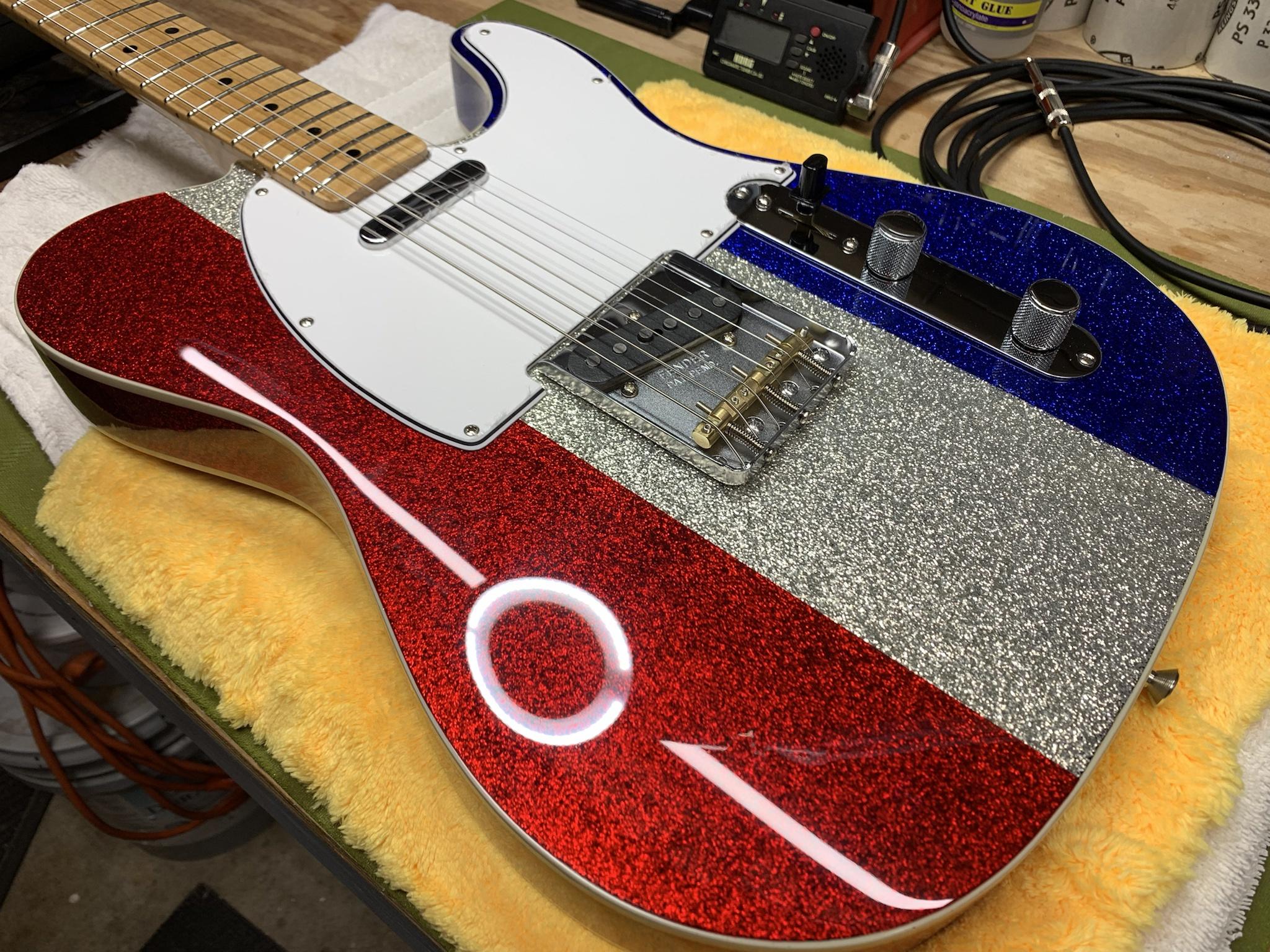
This is sprayed varathane ultimate water based poly. I literally just put the drill down so it's still on the bench and not posed very well but I couldn't help snap a photo. It was actually hard to photograph because my camera kept trying to focus on the reflection instead of the guitar itself. I had to switch to manual focus mode. That right there confirms how perfect the gloss is as far as I'm concerned.

IMG20220728065351.jpg
 

Attachments

  • IMG20220724163542.jpg
    IMG20220724163542.jpg
    602.8 KB · Views: 26
I use both. I typically start with a Shop Fox buffing arbor with medium and fine Menzerna sticks. I run 3 canton (medium) and 3 domet (fine) buffs on either side. I then follow that up with a detail buffer and fine 3m compounds for the final polish. I get very good results with that setup.

One of the tricks to using a buffer is to set it up so that the belt can slip a little bit. That way if your workpiece catches, or you get a little too aggressive, the belt slips and the buffs slow down or stalls.

WV9ZAJ4.jpg


Ei4VjBD.jpg


AURGoFR.jpg


Edited to add:
Also, if you're buffing nitro lacquer, you do not want high RPM on the buffing wheels. Mine runs somewhere between 700-850... certainly less than 1000. If you go higher, you'll just have problems. I don't know what RPM to use for other finishes as I have no experience with others.
I use a similar buffer arrangement, I put my motor on a hinged plate, so anything other than the ligh drag on the wheel, causes the motor to climb up, causing the belt to slip. gravity, and some springs on the motor mounted on the hinged plate create the tension on the belt.
 
  • Like
Reactions: Gary_M
I do.
Because.. painting cars & bikes is how I learned to cut & rub. If your sanding is done properly... you don't need a big scary (potentially hot) buffing wheel.
Also... I much prefer a *pneumatic* angle polisher. More control... plus the phbpbtttt sound is cool.:roflmao:
AAND i use the buffing wheel, because that is what i learned to use at G&L in the 80's :D
 
  • Like
Reactions: Rôckhewer