
Enjoy the benefits of a premium membership!
Upgrade Account
-
TalkBass has been independent since 1998. Add your voice.
Create a free account to reply to discussions, view embedded media, and browse with fewer display ads.
Join free Log in
Want zero display ads or expanded classifieds tools? Compare plans.
You are using an out of date browser. It may not display this or other websites correctly.
You should upgrade or use an alternative browser.
You should upgrade or use an alternative browser.
Double Bass I was shopping for an igloo
- Thread starter Hogslapper
- Start date
More options
Who Replied?

- Jan 12, 2004
- 1,493
- 1,270
- Disclosures
- Owner, Stand Up Guy Basses (Repair/Sell/Buy upright basses)
Nicely done, the bottom block looks pretty intact!
What sort of glue is that big glob in the bottom centre of your post #19 pic? I'd be willing to bet it's not hide glue. Hopefully it can all be removed in under two hours, without causing more damage. Most people don't realize the work they're causing when they put a ton o glue in to "hold things together"...
What sort of glue is that big glob in the bottom centre of your post #19 pic? I'd be willing to bet it's not hide glue. Hopefully it can all be removed in under two hours, without causing more damage. Most people don't realize the work they're causing when they put a ton o glue in to "hold things together"...
Factory glue glob. I don’t know what HN White used for glue,but it oozed from every seam, almost like silicon caulk? I’ve cut out most places. Its been there for 80 years, I don’t think it will do any more damage.
You can destroy that endpin with no worries- NOBODY I know wants to keep that part original!
With the BFH, you risk stressing the block and its connections with the ribs and the back. I don't have photos, so I'll try to describe my preferred method:
- remove the endpin lock key
- take a 2x4 or larger size scrap of wood
- drill a hole in 2 x 4 large enough for the whole endpin to fit through it, but still secure around the perimeter next to the endpin hole.
- slip 2 x 4 over the endpin
- Put a large C clamp going against the 2x4, over the ribs & block, then making contact on the inside of the endpin, so that in a very controlled manner you should be able to gradually tighten the clamp such that it "pops" the endpin back away from the body while keeping everything else intact and secure...
If no luck on the first attempt: repeat multiple times until clamp, 2x4, and BFH smash the whole thing to splinters, then call me for a replacement. I have a drawer full of old janky endpins that are technically "vintage, period correct"
Every old American Standard that I have been inside of has a couple of giant compression circles on the inside of the spruce blocks where they use one specific clamp to glue them in and someone liked a LOT of pressure.
I like your idea way better than mine, but will point out that you'll probably need to put something over the hole for one side of the C clamp to bear on while the other side bears on the inner end of the end pin assy.
Actually, I would only use the BFH with the rib all round the end pin assy fully supported. Probably a stack of 2 x 4s with hole drilled, set on the floor, put bass vertically on that with remains of exterior part of end pin assy sticking into the holes (now the tail block is supported on the 2 x 4s), then push/tap DOWN (outwards) with BFH. I would never just whack away at the inner end of the assembly, although my post did imply that.
Just a different kind of BFH. Bolted Finesse Handle. I think the torque of the tap/bolt loosened it somewhat, just a theory

Greg Clinkingbeard
Commercial User

This thread is gold. I don't have anything to contribute, but love to watch an old Standard get brought back to life. Subbed.
Thank you. As a confirmed internet Luddite, this is my first attempt at social media, as well as my first project instrument.
The patient has survived my initial internal probes and patches and is being prepared for closing.
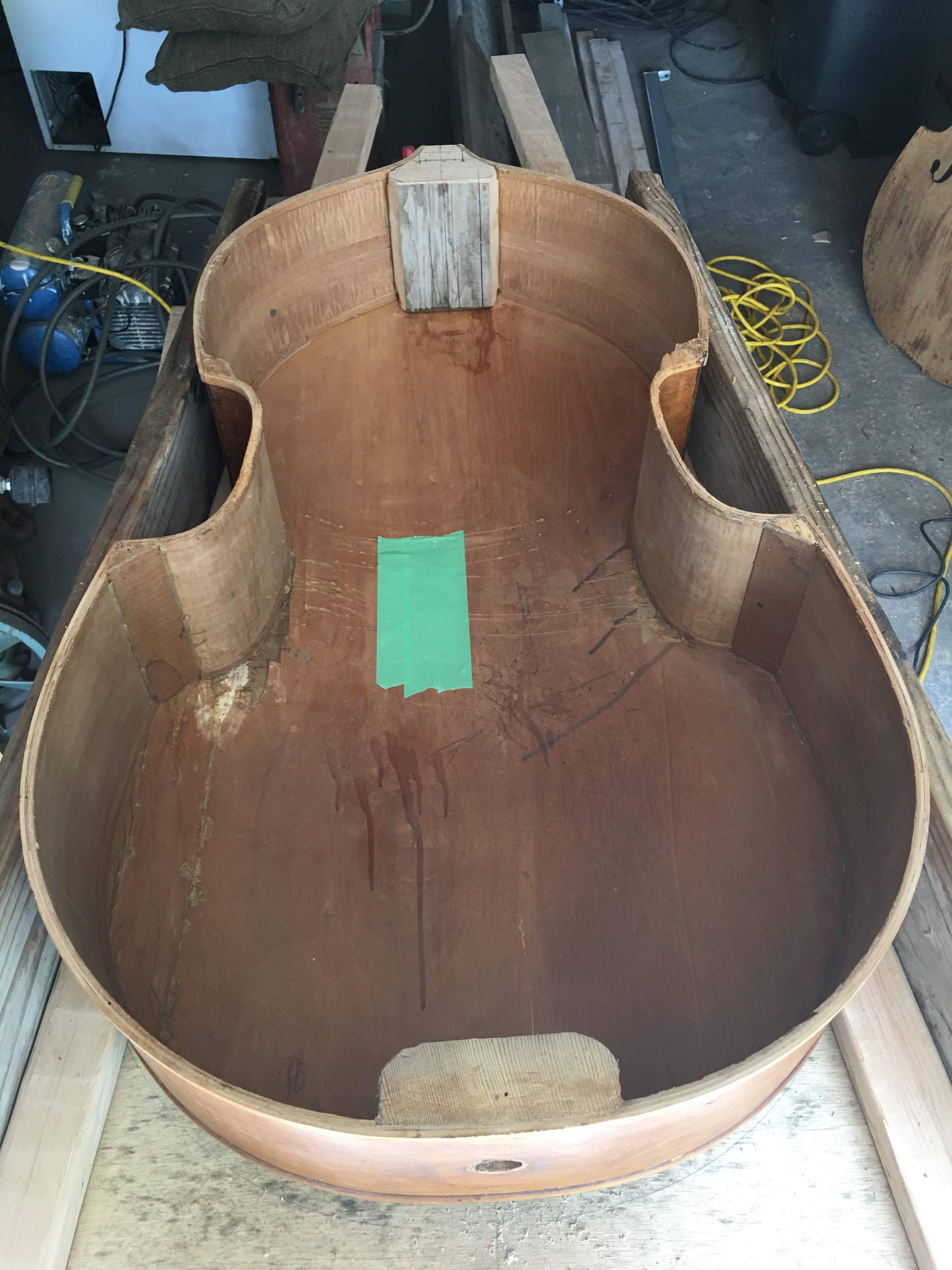
You can see the C bouts, it appears the factory used an axe to finish trimming the curves. Then the voids were flooded with the rubbery glue . I assume its the factory glue? Its in every seam on the body, corner blocks,neck and tail.
I’ve been using broken glass to scrape the glue from the edges.
The patient has survived my initial internal probes and patches and is being prepared for closing.
You can see the C bouts, it appears the factory used an axe to finish trimming the curves. Then the voids were flooded with the rubbery glue . I assume its the factory glue? Its in every seam on the body, corner blocks,neck and tail.
I’ve been using broken glass to scrape the glue from the edges.
Thank you. As a confirmed internet Luddite, this is my first attempt at social media...
Welcome, and what a great way to start.

A word of caution: I don't lump Talkbass together as "social media" along with FB, Twitter, Instagrm, and the rest. I have come to consider those the devil and have reduced my internet footprint to just here, Youtube, and a personal website. As always, EEMMV, but life has sure been a lot better on my end since I removed myself from those steaming cesspools where everyone considers themselves an expert and a pundit regardless of whether they know the first shagging thing about what they are weighing in on or not. Here, with the folks in this thread giving advice, at least you can be sure that the advice is solid and backed by decades of experience. These guys are the real deal.
I would be amazed if the factory work was that crude. My permanent collection includes a '35 King, which I've been inside of to fix a loose bass bar and collapsed top. The attention to detail is shocking for a plywood bass. I would suggest that a factory which chose to assume the added expense of including a flamed maple interior laminate that would hardly ever be seen would not trim the blocks with a hatchet. It just doesn't track in my mind.
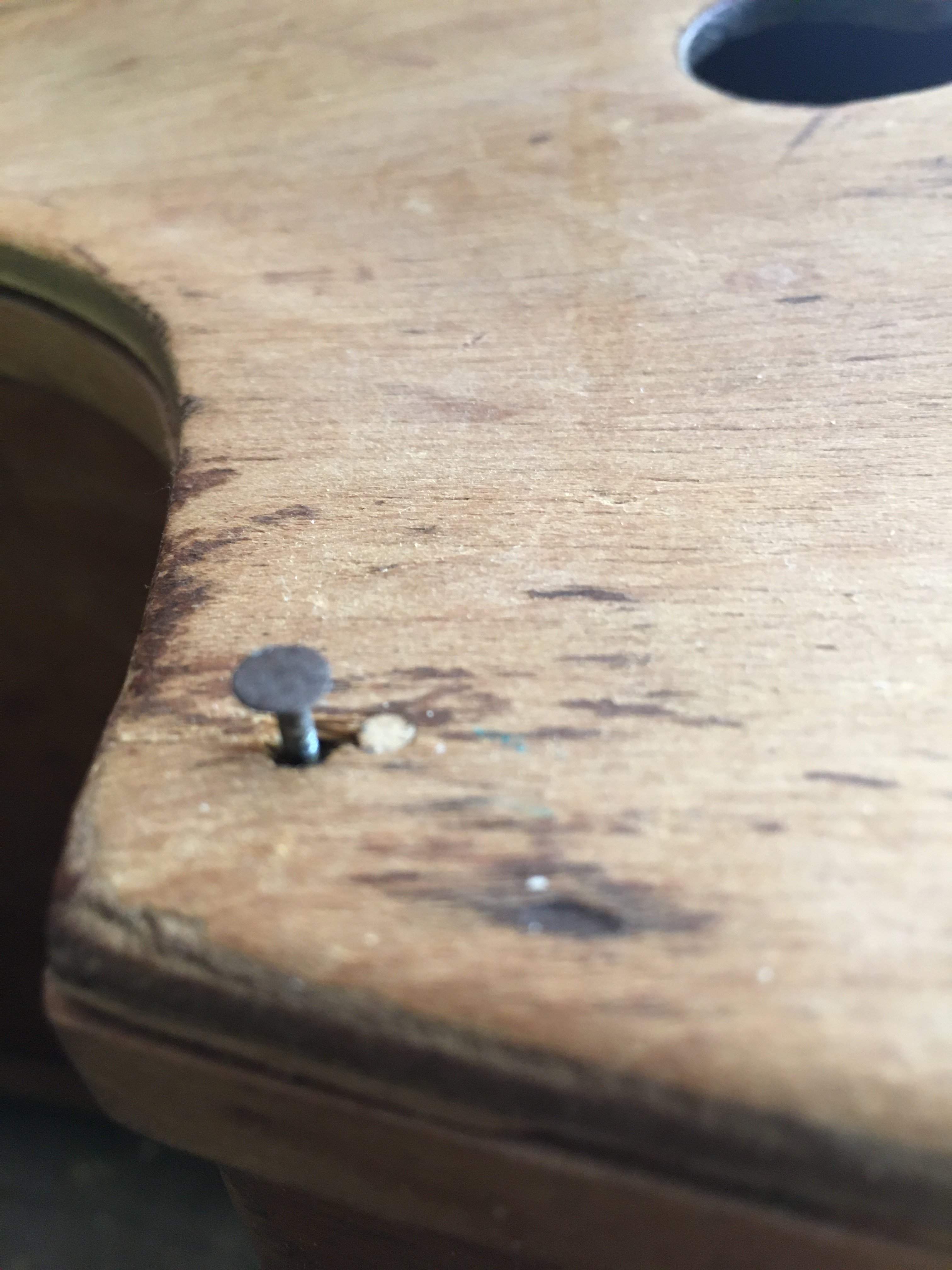
Some previous benefactor blessed me with a dozen nails through the top to use as locator guides at glue up. One nail at each block, and another at each midpoint.

Thank you. As a confirmed internet Luddite, this is my first attempt at social media, as well as my first project instrument.
The patient has survived my initial internal probes and patches and is being prepared for closing.View attachment 3811618
You can see the C bouts, it appears the factory used an axe to finish trimming the curves. Then the voids were flooded with the rubbery glue . I assume its the factory glue? Its in every seam on the body, corner blocks,neck and tail.
I’ve been using broken glass to scrape the glue from the edges.
Kudos for the primitive outside mold to keep the rib garland from springing.

Small nails were actually used from the factory- one on each corner block, one on the backside of the neck block below the button, and one on the frontside of the tail block near the saddle. Originally they were just small brads that were sunk below the surface and then covered with a bit of filler.
For the C bouts, they used a solid section of inner lining that was NOT pre-bent. They just put it in a vise and broke the wood about every 1/2 inch so they would fit the curve and then glued in place. I've seen that same technique on some early 20th century European basses, so I always figured they had an old guy who was trained there building them.
'Funny thing about the American Standard vs King basses- they were both built in the same factory. The American Standards always have exceptional voice and projection, but the workmanship and materials was very basic- get the job done, but never anything fancy. The Kings, on the other hand, always exhibit beautiful workmanship, much more refined design, and always exceptional materials.
Nice effort with the restoration!
For the C bouts, they used a solid section of inner lining that was NOT pre-bent. They just put it in a vise and broke the wood about every 1/2 inch so they would fit the curve and then glued in place. I've seen that same technique on some early 20th century European basses, so I always figured they had an old guy who was trained there building them.
'Funny thing about the American Standard vs King basses- they were both built in the same factory. The American Standards always have exceptional voice and projection, but the workmanship and materials was very basic- get the job done, but never anything fancy. The Kings, on the other hand, always exhibit beautiful workmanship, much more refined design, and always exceptional materials.
Nice effort with the restoration!
So here’s a closer look at the broken/bent C bout linings and the buggerish ,plastic glue I’ve been encountering. You think it’s from a previous, post factory entry?
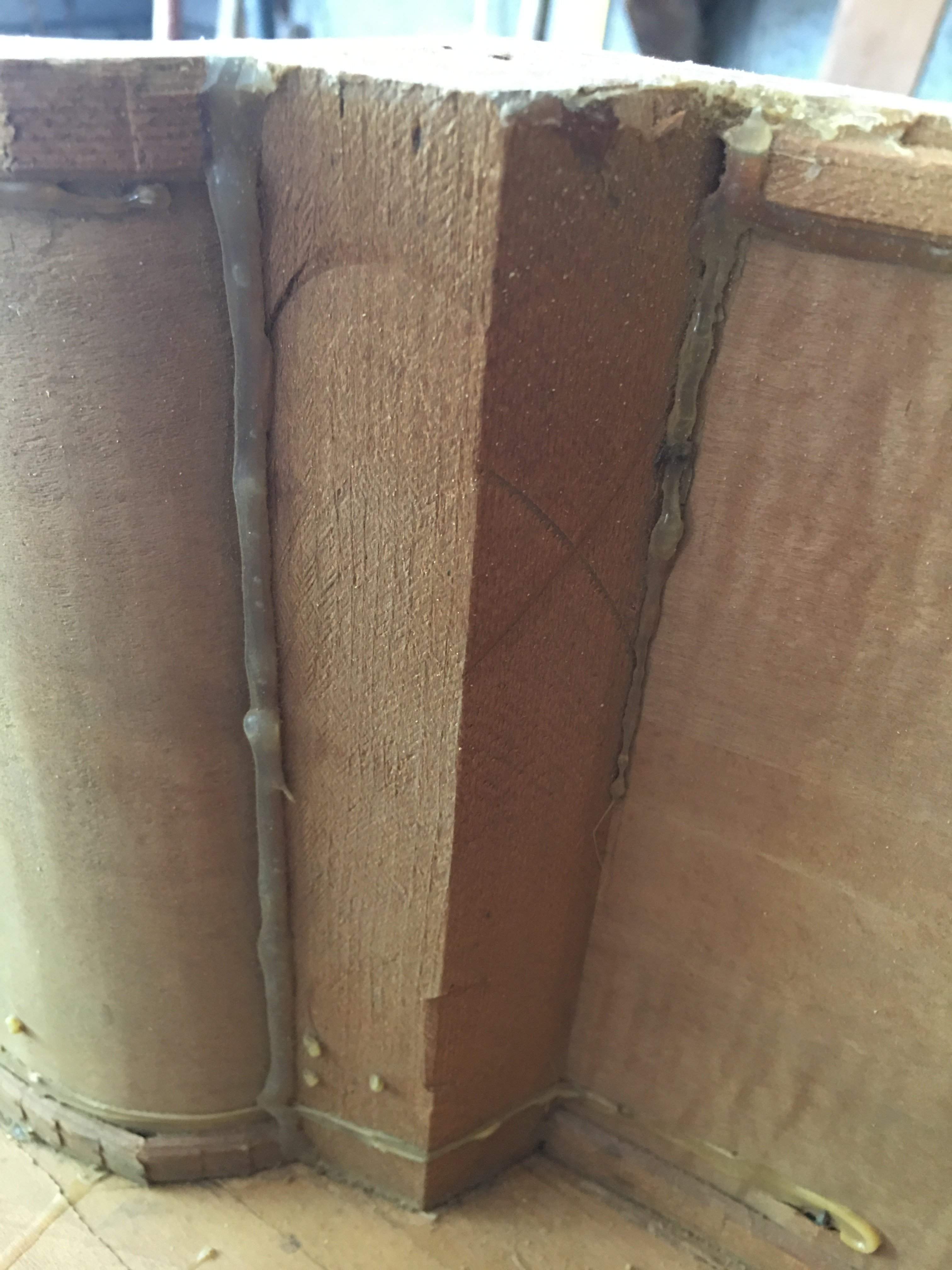
Neither that block nor the caulk are original.
This is one of the reasons I hang around this forum: to learn. What are the tip-offs that neither block nor caulk are original? My guess is the poor fit of the block against the ribs, with the caulk being used as gap filler.

What are the tip-offs that neither block nor caulk are original?
First, the fact that the block is square in profile and not shaped in any way. Second, the appearance of the globs of dried glue in no way resemble HHG which tends to be crystalline and amber in color, and also wildly unlikely to clump up.
No, Bubba been in that and left behind whatever he had laying around. God knows what happened to the original blocks.

Looks like hot-melt adhesive to me. Always a first choice in last resorts. Heat up a knife end and see if it'll remelt.


