• TalkBass has been independent since 1998. Add your voice.
    Create a free account to reply to discussions, view embedded media, and browse with fewer display ads.
    Join freeLog in
    Want zero display ads or expanded classifieds tools? Compare plans.

I wish I'd gotten a multifx sooner

I have a Zoom MS-60B and it's definitely good, but the learning curve is steep. Once you get it set up, you can have multiple pedal chains to switch through, plus it has a built-in tuner. I don't always use it because it's not as simple as using discrete pedals with their own knobs, but I certainly wouldn't knock anyone who does use it. You have multiple versions of most types of effect: delays, choruses, phasers, synth pedals, compressors, reverbs, etc.

Only thing it's not great at is dirt. Everyone has their own favorite flavor of dirt, and chances are your multiFX pedal won't have that flavor. In my case it's my old Darkglass B3k; there's nothing on the Zoom that sounds like it, so I think it's a 2-pedal minimum for me. Maybe 3 if I need my favorite synth pedal.

But to get to the heart of the matter: I enjoy having a large collection of pedals for the same reason some people like to have lots of different basses. It's just another hobby, I guess. It's fun to switch them up and check out the cool paint jobs and all that.

Or wine collections :)
 
  • Like
Reactions: Spectrum
I've been using pedals for 10 years and recently picked up my first multifx unit, the Eventide H90. Honestly, I wish I’d made the switch sooner.

For a long time, I bought into the popular rhetoric around things like, "I can tell the difference between a digital and analog drive or delay pedal in a 20-instrument mix," "An analog octaver feels different than a digital one," "Digital effects have terrible latency and sound artifacts," "Menu-diving is a pain" and so on.

There was also a time when multifx were pretty rare on boards (in recent years, I've noticed more and more pros incorporating pedals like the HX Stomp and Eventide H9 into their setups).

So, I never really gave multifx much thought.

Then, in January, I decided to build a new pedalboard and realized I was stuck in the same old pattern. Buy a few pedals, play them for a bit, get bored, sell them and repeat.

Why not try a multifx? That way, when I get bored, I can explore new sounds and revisit old ones without the constant buying and selling.

What I’ve discovered is that, in my experience, none of that rehashed rhetoric holds up—at least not with the H90. The octaver in the H90 doesn’t “feel different under the fingers” than the 3 Leaf Audio Octabvre I had. It doesn’t have any “digital artifacts.” The distortions sound fantastic, even without the need for OP amps and transistors, and I doubt anyone could tell them apart from analog ones. Want to talk about latency? Try engaging the boost on the analog Effectrode LA-1A compressor. And sure, the menus could be more intuitive, but it’s not much different than using a smartphone.

I guess I'm done with my rant.

What has been your experience with multifx pedals?
You started with what is arguably the very best multi effect unit made. I am not surprised you are happy with it.
 
  • Like
Reactions: PhatBottomBass1
I have practically only used digital multifx all my life with just a couple of single analog pedals long ago (and sold quickly). Although I find them essential on guitar, I don't really use the one I have for bass.

I am an engineer and I do not fear complexity. But also, I am not convinced that operating a multifx is more complicated than operating a board with 10 different individual pedals connected together 🙂 The latter only has the advantage that can be built gradually.
 
  • Like
Reactions: DCErik
The H90 is incredibly powerful and sounds amazing. I have and H90 and HX Stomp on my board. I split my input signal to both and also connect both send/returns to each other so I can run them in series, parallel, or whatever crazy routing I can concoct with inserts. Then the stereo outs from each run into a Saturnworks Active Stereo Mixer/Summer. The result is magic. I've been messing around with both analog and digital effects for years and this current combo is the best sounding and most versatile setup I've ever had.
 
  • Like
Reactions: DCErik
I never bonded with the amps in the Helix, but I would gladly rock an HX Effects! I may try an H90 and/or a Zoom B6 one day. Kemper was also very very good - GREAT amps, but its effects maybe rank slightly below Helix for my tastes. I even had a Boss GT-1000 for a while, and it just felt “generic” to me - for lack of a better term. For now I am back to Tonex and big box Strymon multis to spark my joy.
 
Last edited:
I don't disagree with you, but I might take it from a different perspective...I wish multi effects were as good as they are today sooner. I remember when multi effects were just 3 pedals 'glued' together. Then they came out with the digital stuff, and there was some that were nice, but lacking in some areas. We have a lot of good options today.
I have been using a Stomp on my board for the past few weeks. I haven't made the final decision, but it's looking like it will stick around. I still have an analog drive and preamp. I don't use a lot of other effects often. But, I do use them often enough to have them on the board. So the Stomp just makes sense.
 
  • Like
Reactions: DCErik and Giff
IMG_20241105_162650_846.jpg.webp

Wurd!
 
Sure when it comes to polyohonic octaver/pithchifting, clean repeats and special effects delay, as well as reverb digital rule.

I can however very much feel the difference when it comes to modulation and not least drive.

Is it because analog is better at this, not necessarily, but it does sound different.

Digital does tend to sound somewhat more polished, and analog more organic, this isn't necessarily better or worse though, just a mater of preference.

Can anyone tell the difference in a mix, in most cases probably not, unless the bass happens to be very forward in the mix, but then again that doesn't stop you from upgrading pickups or even basses, amps, e.t.c, does it?

And most people could probably not even tell the difference of you playing with an effect engaged or not, that however doesn't stop you from using it either, does it?

Can you feel the difference under your fingers, would be a better question, since that actually does affect your playing, I don't know about you, but I can.

Again not necessarily better or worse, just personal preferences.

Finally multi effects in general just doesn't get you the same amount of choices, if you are very specific about your tone, as single pedals does, regardless if they are analog or digital.

Multi effects simply just tends to be somewhat more generic in terms of effects in their nature.

They are however very convenient, and some allows for advanced signal routing that otherwise would quickly get very complicated to replicate with single pedals.
 
Last edited:
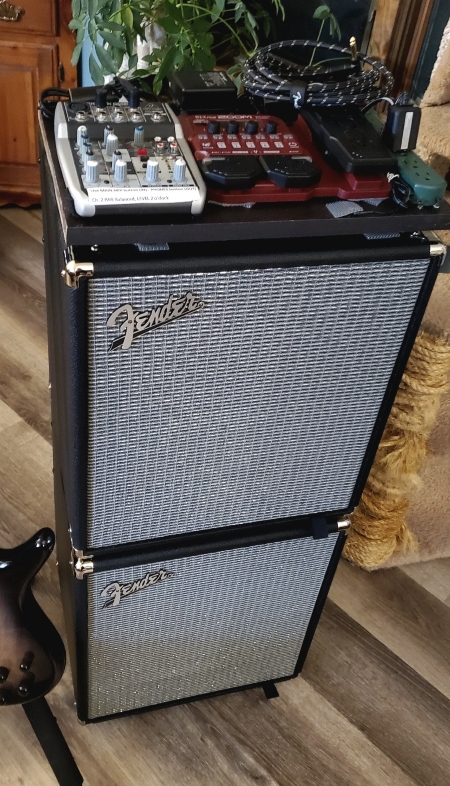
I don't use effects in an on/off manner dependent on songs. I use my Zoom B1X as my "tone" shaper and created 4 distinct tones I use in saved Presets.

For the most part effects are used judiciously in combination with others to give me "my" tone(s). Not as single use "special" effects. I like that it also has 50 adjustable drum tracks, looper and tuner.

This B1X is my tone creator and my bass sounds pretty much the same whether it's through my amp or headphones, monitors or FOH. Bass > B1X > Xenyx 4 channel mixer.

I either have my "pedalboard" set up in a home made rack for writing/recording (USB to laptop and headphones) or velcroed to the top of my amp for gigs.

Effects-Mixer-endtable.jpg


Rumble-Rig4.jpg
 
Last edited:
  • Like
Reactions: DCErik
) But for chorus, octaver, reverb, tremolo, delay or any other FX I may need, I use a dinosaur ZOOM B3. It’s completely adequate, and even excels at certain sounds. The “Heaven” pedal emulates my Eden WT-800 pretty well. I’ve found it very handy if I should need any particular but rarely used effect.

Versus the ZOOM B6, which was feature rich, and offered a lot, but I found I did not want to go thru the learning curve of programming it. There are those like myself that simply don't want to learn to program the thing. And it ends up for sale 30 days after it’s received.

But if you’ve found your mutliFX sweet spot, thats great. ( I may now need to find out what the hubbub is about)

Ouch! Haha. I love my Zoom B3....dinosaur, or not. I get a lot of usable sounds out of it.
 
I can't count the number of times I have built up an awesome pedal collection, then realized I could sell all of them to fund the purchase of an awesome multi effects unit, then realized I don't need all of the power and flexibility it provides and I can sell it to fund a bass, then start building up a new awesome pedal collection, and on and on...

I stopped driving myself crazy with the realization that these two options aren't really interchangeable. There are unique characteristics to each set up that can not be replicated by the other, by their very nature. The analogy I can use is that I used to think that pedals vs multifx was like a Precision vs a Jazz. Now, in my view, I think pedals vs multifx is actually more like a bass vs a piano. Can you substitute a bass for a piano? Sure, but not really. Can you substitute a piano for a bass? Sure, but also not really. There are areas of overlap, but also areas of distinction.

What makes the distinction is less about tonality, which is fantastic with both systems and the area that overlaps, and more about the operation and balance between simplicity and complexity. That is where you have to make your decision.
 
...The operation and balance between simplicity and complexity.
I think of the way I use my Zoom B1X as complex simplicity.

There is a lot "under the hood" yet it's easy to program and doesn't require one to use all that it offers. I haven't touched the settings since I first programmed it for the 4 basic tones I like. They are saved in their own Preset Patch (50 through 55, with "50" being a "dry" setting (no effects).

Very easy to quickly go from one tone to another. It would take me forever to get my tone with single use effects because not only would I need to turn each on or off and remember which combination I used, but also need to dial each one in because each effect blended into my sound is not at the same setting.
 
Last edited:
  • Like
Reactions: Giff
I have a Zoom MS-60B and it's definitely good, but the learning curve is steep. Once you get it set up, you can have multiple pedal chains to switch through, plus it has a built-in tuner. I don't always use it because it's not as simple as using discrete pedals with their own knobs, but I certainly wouldn't knock anyone who does use it. You have multiple versions of most types of effect: delays, choruses, phasers, synth pedals, compressors, reverbs, etc.

Only thing it's not great at is dirt. Everyone has their own favorite flavor of dirt, and chances are your multiFX pedal won't have that flavor. In my case it's my old Darkglass B3k; there's nothing on the Zoom that sounds like it, so I think it's a 2-pedal minimum for me. Maybe 3 if I need my favorite synth pedal.

But to get to the heart of the matter: I enjoy having a large collection of pedals for the same reason some people like to have lots of different basses. It's just another hobby, I guess. It's fun to switch them up and check out the cool paint jobs and all that.
Same thing for me, the Zoom pedals really changed my opinion on multi-fx in a positive way. I'd also venture to say there are things digital effects do better than analog ones (IMO).

Dirt is still my holdout too...will happily change my mind when the right pedal comes along though.
 
  • Like
Reactions: Spectrum
I've been exclusively multi effects most of my life. Only recently started getting into individual analog pedals in the last year. Started with a para driver and I don't know why I didn't go this route earlier.

At the moment, my board consists of the para, an MS-60B+ and a Joyo Scylla compressor. Truth be told, I could easily get my sound with just the zoom and the para. Best of all, I wouldn't need to bring a power supply since the zoom can be battery powered and the para can use 9v or phantom.
 
For me it’s too much a good thing at once. I couldn’t handle a shipment of 50 stomp boxes at once either. lol.

I think not all multi effects created equal, the h90 on the high end of the options, iirc.
 
For me it’s too much a good thing at once. I couldn’t handle a shipment of 50 stomp boxes at once either. lol.
I started with a MultiFx, and I was not familiar with individual effects at all, so I surely had that feeling of overwhelming choices. Particularly with those many presets: Not only 100 pedals but 100 different pedal boards each with a few different stomp boxes, all with individual settings...
I had to grab a few individual stomp boxes to get familiar with types of effects. For drives, I still prefer those. But now I like MultiFx for their compactness and variation.
 
I've been using pedals for 10 years and recently picked up my first multifx unit, the Eventide H90. Honestly, I wish I’d made the switch sooner.

For a long time, I bought into the popular rhetoric around things like, "I can tell the difference between a digital and analog drive or delay pedal in a 20-instrument mix," "An analog octaver feels different than a digital one," "Digital effects have terrible latency and sound artifacts," "Menu-diving is a pain" and so on.

There was also a time when multifx were pretty rare on boards (in recent years, I've noticed more and more pros incorporating pedals like the HX Stomp and Eventide H9 into their setups).

So, I never really gave multifx much thought.

Then, in January, I decided to build a new pedalboard and realized I was stuck in the same old pattern. Buy a few pedals, play them for a bit, get bored, sell them and repeat.

Why not try a multifx? That way, when I get bored, I can explore new sounds and revisit old ones without the constant buying and selling.

What I’ve discovered is that, in my experience, none of that rehashed rhetoric holds up—at least not with the H90. The octaver in the H90 doesn’t “feel different under the fingers” than the 3 Leaf Audio Octabvre I had. It doesn’t have any “digital artifacts.” The distortions sound fantastic, even without the need for OP amps and transistors, and I doubt anyone could tell them apart from analog ones. Want to talk about latency? Try engaging the boost on the analog Effectrode LA-1A compressor. And sure, the menus could be more intuitive, but it’s not much different than using a smartphone.

I guess I'm done with my rant.

What has been your experience with multifx pedals?
I ran into a bit of the option paralysis problem with multis. It’s not so much a digital vs analog thing, I actually do use some digital pedals. I even still have an hx stomp laying around I need to get on it and sell. But I did notice over the years that the limitations of standalone pedals were actually a plus for me because they force me to write more creative lines instead of chasing creative sounds if that makes sense. Listening back to all the music I’ve recorded I definitely prefer the work I’ve done when I was focused more on my bass playing and less on effects. I definitely like effects. But all I need is a pre amp, octave, compressor, and a delay that has modulation that can double as a chorus. I use effects better when they are just “seasoning” as in the basslines can hold up without them and it’s just for that last 5%. I don’t even use dirt of any kind anymore.
 

Latest posts